The Red Tsunami Quotes
by T Casey Fleming
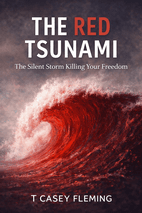
The quotes in this collection are not polite reflections. They are direct, unsettling, and meant to jolt you awake. Each one lands like a warning you can't unhear, stripped of spin or comfort.
What makes this book so quotable is its refusal to soften the truth. T Casey Fleming writes with the urgency of someone who believes we are out of time for euphemisms. The lines stick because they name the threat plainly and challenge us to act.
Top Quotes from The Red Tsunami
“America isn’t falling apart by accident; she's being attacked from within.”
Vince Everett Ellison, a Project 21 Ambassador and author, in his endorsement of the book.
This line succinctly captures the central thesis that the nation's decline is not random but a targeted assault, resonating with readers who feel something is deeply wrong.
“You're being played, and you deserve to know how and why.”
Author's direct message to the reader about manipulation.
This concise statement captures the book's core premise and empowers the reader with a sense of justified awareness.
“The first rule of unrestricted warfare is that there are no rules, with nothing forbidden.”
Quote from Colonel Qiao Liang, co-author of 'Unrestricted Warfare.'
It encapsulates the CCP's amoral strategic doctrine, shocking readers with the admission that they operate without any ethical or legal constraints.
“The impact of a weaponized Nipah virus inside of the United States...would completely eclipse that of COVID-19. COVID was the rehearsal. Nipah would be the headline act.”
Dr. Sean Lin warning about future bioweapons being developed by the CCP.
The theatrical metaphor escalates the threat dramatically, leaving readers with a haunting image of an even deadlier and more deliberate attack to come.
“Propaganda wants you to believe a certain thing. Cognitive warfare doesn't care what you believe; it cares about disrupting how you think.”
A colleague and Senior U.S. Naval Counterintelligence Officer makes the distinction between propaganda and cognitive warfare.
It succinctly captures the unique danger of cognitive warfare, which targets the ability to think rather than just beliefs, making it far more insidious.
“Our kids are getting cotton candy from ByteDance; children in China are getting spinach.”
Peter Schweizer, President of the Government Accountability Institute, contrasts TikTok's Western and Chinese content.
This vivid metaphor exposes the double standard and highlights the deliberate targeting of Western youth with mind-numbing content.
“The enemy is not at the gates. They are inside the village. And are armed to kill.”
Conclusion of the section on Volt and Salt Typhoon.
The stark, visceral metaphor conveys that infiltration has already occurred, creating a sense of urgent vulnerability.
Themes Behind the Quotes
The first major theme is the idea of a hidden war being waged against America from within. The book argues that the Chinese Communist Party has moved beyond traditional espionage into open assault on public health, information, and sovereignty. Fentanyl poisoning, biological weapons, and cognitive warfare are all presented as tools of a coordinated strategy to weaken the West.
A second recurring theme is the need for clear eyed resistance. The quotes call for courage over sympathy, for action over complacency. They insist that the danger is not theoretical or distant but already inside homes and schools. The underlying message is that defending freedom requires facing uncomfortable facts and refusing to be paralyzed by confusion.
Quotes by Chapter
Acclaim for “The Red Tsunami”
“This is not fear-mongering. This is what those of us fighting fentanyl, border insecurity, and Chinese operations have been trying to warn America about for years.”
April Babcock, founder of Lost Voices of Fentanyl, who lost her son to the fentanyl crisis, endorsing the book.
It provides a powerful, emotional credibility check, distinguishing the book from alarmism by grounding it in real-world experience of those on the front lines.
“This book is not merely diagnostic; it is prescriptive. Fleming offers a Whole-of-Society survival guide - a blueprint for individuals, families, communities, and nations to harden themselves against the CCP's influence.”
David Murrin, global forecaster and author, in his endorsement.
It highlights the book's practical value, giving readers hope and agency rather than just describing the problem, which resonates with those seeking actionable solutions.
My Personal Message to You
“In the pages ahead, you'll access counterintelligence insights few ever see - clear facts, hard truths.”
Opening line of the chapter, directly addressing the reader.
It sets a tone of secrecy and urgency, promising exclusive knowledge that most people are denied.
“I created this survival guide because no one else would, drawing on fresh briefings from trusted colleagues and top experts interviewed specifically for this work.”
Author explains his motivation and sources for the book.
It establishes credibility and the unique nature of the information, implying a duty to inform.
Briefing One You Are The Main Character
“The pill wasn't pharmaceutical grade as advertised. It was a counterfeit pill, made on advanced Chinese pill presses just over the border in Mexico. Smuggled in. Dosed with fentanyl - just a sprinkling, a speck in the chemical powder. But enough to slowly stop her breathing, and her heart.”
Narrator describing the counterfeit fentanyl pill that kills Sophie Ellstrom.
This passage starkly illustrates the lethal consequences of the fentanyl crisis, turning a promising student's story into a cautionary tale about the hidden dangers in everyday life.
“Only the thought of his children asleep down the hall keeps him from grabbing his keys and ending his pain. For now.”
Brody Miller, after losing his job and facing financial ruin, contemplates suicide.
It captures the profound despair of economic collapse and the fragile hope held by love for family, a relatable struggle for many.
“Natalia will never see America, home, or her family again.”
Narrator summarizing Natalia's fate after being trafficked.
The devastating finality of this short sentence underscores the irreversible loss of freedom, family, and homeland, making the horror of human trafficking palpable.
“But heed my words: it's far more exhausting to fight monsters when they are already inside the gates - in your city, in your home attacking your children and their minds.”
The author warns about the enemy already infiltrating society.
This metaphor about monsters inside the gates is a powerful call to action, emphasizing the urgency of confronting threats before they become entrenched.
Briefing Two The Battle for You and Your Freedom
“The Chinese Communist Party (CCP) is a radical, dark, and diabolical mafia-type criminal gang - the most strategic, lethal, committed, and capable in history.”
Author's characterization of the CCP.
This visceral condemnation frames the entire chapter's argument, using extreme language to convey the severity of the threat.
“It's either that, or we lose the world and all freedom so many before us fought to preserve.”
Author's conclusion about the stakes of the war.
This line creates a stark, urgent call to action, emphasizing that the cost of inaction is the loss of civilization itself.
“Mao understood that to rule absolutely, he had to hack off the roots of Chinese civilization itself.”
Describing Mao Zedong's Cultural Revolution and the 'Four Olds' campaign.
This line distills a brutal historical insight into a single, visceral metaphor, making the regime's deliberate destruction of culture unforgettable.
Briefing Three The Battle For Your Body Biological War
“The CCP's greatest weapon is that Americans still believe biology is about medicine. For Beijing, biology is about power.”
Dr. Sean Lin, former U.S. Army microbiologist, explaining the CCP's strategic view of biology.
This line starkly contrasts American assumptions with Chinese intentions, revealing a fundamental deception that resonates deeply with readers concerned about national security.
“The CCP sees biology as a battlefield and pandemics as opportunities for dominance.”
Dr. Sean Lin summing up the communist mindset toward biological warfare.
It succinctly captures the CCP's opportunistic and aggressive posture, making readers see the pandemic as a deliberate power play rather than a natural disaster.
“COVID was a live-fire study of how a novel pathogen degrades Western readiness, logistics, and civil order.”
Dr. Sean Lin describing the pandemic as a test of unrestricted warfare tactics.
This quote reframes COVID-19 as a calculated experiment, evoking a chilling sense of vulnerability and highlighting the systemic weaknesses the CCP exploited.
Briefing Three | Part II The Battle For Your Body Drug War
“Iam not asking for sympathy. I am asking for courage. Courage to confront the CCP’s responsibility without euphemism. Courage to hold accountable those who enable this chemical assault. Courage to protect our children with the urgency we would summon in the face of any foreign attack - because that is precisely what this is.”
Dr. Rafael Marrero, who lost his son to fentanyl, speaking as both a national security expert and a grieving father.
The repetition of 'courage' transforms personal grief into a call to action, demanding moral clarity and urgency in a crisis that is often met with denial.
“Feel this: 350+ families attending funerals - every. single. day.”
A stark interjection in the chapter’s list of fentanyl death statistics.
By translating abstract numbers into a daily ritual of grief, this line makes the horror visceral and impossible to ignore.
“The DEA doesn’t call them “overdoses” anymore, because they're not. They call them “Accidental Poisoning Deaths.””
The chapter explains how federal agencies have changed their terminology.
It highlights a crucial semantic shift that reclassifies these deaths from personal failure to criminal poisoning, reinforcing the argument that this is a deliberate attack.
“Every puff before then is exponential in damage since the brain is in high-growth mode.”
Dr. Daniel Amen explains the permanent harm marijuana inflicts on the developing teenage brain.
This line crystallizes the irreversible cost of casual drug use with a stark, scientific urgency that resonates with any parent or young person.
Briefing FourThe Battle For Your Mind Cognitive War
“The goal isn’t to convince, but to confuse and paralyze.”
Dr. Robert Epstein, Senior Research Psychologist, warns about the systematic psychological dismantling of the West.
This chillingly simple summary reveals the enemy's strategy: not persuasion, but disabling rational thought and action.
“It will simply feel like an incremental continuation of normal life. Only that “normal” life we are living will no longer be ours. It will no longer be free. It will thoroughly belong to the Chinese Communist Party.”
The author describes the outcome of losing the cognitive war.
The haunting idea that defeat will feel like normal life makes this passage deeply memorable and underscores the stealthy nature of cognitive warfare.
Briefing FiveThe Battle For Your Data Cyber War
“Every time you hear of a data breach anywhere in the world, a chunk of your freedom is gone forever.”
Opening epigraph of the chapter.
This line instantly personalizes the abstract threat of cyberattacks, making each breach feel like a loss of personal liberty.
“By failing to act, America taught the Chinese Communist Party (and Russia, Iran, and North Korea) the most dangerous lesson of all: our red lines are illusions, our sovereignty negotiable, and our leaders unwilling to defend the very Republic they swore to protect.”
Author's critique of U.S. inaction after the cyberattacks.
This powerful indictment of political failure crystallizes the consequences of hesitation, resonating with readers who fear weak leadership.
“By 2018, Beijing didn’t need to hack anymore - Apple gave them the keys.”
This line appears after describing how Apple complied with Chinese data laws, giving Chinese authorities control over iCloud data.
It starkly illustrates how corporate compliance can enable government surveillance more effectively than hacking, making the point both shocking and memorable.