The Red Tsunami Key Takeaways

by T Casey Fleming
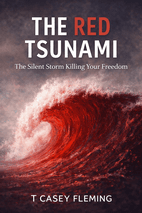
The Red Tsunami by T Casey Fleming Book Cover

5 Main Takeaways from The Red Tsunami

The CCP's Unrestricted War Is a Current, Multi-Domain Threat to Your Freedom.

The book argues that China is not waiting for a future conflict but is actively waging a synchronized campaign across economic, technological, biological, and cognitive fronts to weaken the West from within. Examples include cyber-espionage, intellectual property theft, and cognitive disorientation tactics aimed at demoralizing populations.

You Are the Main Target in a Covert Battle for Your Mind and Body.

From engineered bioweapons targeting specific ethnicities to addictive vapes and digital propaganda, the CCP's strategy directly assaults individual health and autonomy. The social credit system and forced organ harvesting illustrate a regime that seeks total control over human life, making personal vigilance essential.

Western Institutions Are Compromised, From Campuses to Corporations.

The Thousand Talents Program drains American IP, while corporate collaboration with China cedes data control. Universities promote Marxist ideology, and Hollywood self-censors, all contributing to a systemic vulnerability that the CCP exploits for subversion.

Victory Requires Personal Vigilance and a Cultural-Spiritual Renaissance.

Defense starts with individual actions like securing data, buying alternative products, and restoring faith and family values. A 60-day personal action plan provides steps to build resilience and advocate for community-level change against the ideological erosion.

Understanding the New Vocabulary of Hybrid Warfare Is Essential for Defense.

Terms like 'Gray Zone,' 'Cognitive Warfare,' and 'Inversion Matrix' describe tactics used to erode sovereignty without open conflict. Recognizing these concepts helps identify attacks and mount effective resistance, turning awareness into armament for free societies.

Executive Analysis

The five key takeaways collectively form the book's central thesis: that the Chinese Communist Party is waging an immediate, unrestricted war across every domain of Western society—biological, cognitive, economic, cultural, and spiritual—with the goal of subjugation without conventional conflict. This integrated assault exploits institutional vulnerabilities and individual complacency, making each person a target in a battle for survival and freedom.

'The Red Tsunami' matters because it translates complex geopolitical analysis into an urgent survival manual for the general public, bridging the gap between intelligence circles and everyday citizens. In the genre of political thrillers and security exposés, it stands out for its actionable prescriptions, calling for a whole-of-society response rooted in personal vigilance, cultural renewal, and spiritual resilience against totalitarianism.

Chapter-by-Chapter Key Takeaways

Acclaim for “The Red Tsunami” (Chapter 1)

  • Immediacy of the Threat: The expert consensus is that the warfare described is not a future possibility but a current, active campaign inflicting real harm on American society, economy, and population.

  • Integrated Warfare: The CCP’s strategy is a synchronized attack across military, economic, technological, biological, cognitive, and spiritual domains, designed to weaken the West from within without triggering conventional war.

  • A Guide for Empowerment: “The Red Tsunami” is validated as a crucial tool for public understanding, praised for translating intelligence-level analysis into an actionable guide for personal and community resilience.

  • A Universal Call: The book is deemed essential reading for every segment of society—from policymakers and CEOs to parents, teachers, and students—emphasizing that collective awareness and action are the only paths to victory.

Try this: Recognize that the hybrid warfare described is ongoing and immediately begin using this book as a manual for personal and community resilience.

My Personal Message to You (Chapter 2)

  • The book is presented as an essential manual for modern survival, uncovering truths the author believes are being deliberately obscured.

  • The content is built upon exclusive, contemporary intelligence from trusted experts, structured for quick mastery.

  • The core premise is a warning: you are the central target in a series of covert wars, and this guide is your tool for empowerment.

  • The author’s motivation is framed as a personal mission to serve and equip the reader with clarity and actionable knowledge.

Try this: Treat this book as a critical survival tool and commit to mastering its content to uncover obscured truths about covert wars.

Briefing One You Are The Main Character (Chapter 3)

  • Coercive economic diplomacy and massive, state-linked digital propaganda networks are actively deployed to influence Western policy and public opinion.

  • A wide array of social issues—from racial justice movements and gender ideology to historical monument removal—are framed not as organic domestic developments, but as elements of a coordinated, foreign-backed strategy to divide society and erode its foundational institutions.

  • The overarching conflict is defined as an ongoing Unrestricted War, a decades-long "gray zone" campaign aiming to subdue the West through societal fragmentation and subversion without triggering a conventional military response.

  • The author's expertise and a life-changing FBI briefing led to a dedicated counterintelligence mission, identifying the CCP as the central orchestrator of this multi-front assault on the free world.

  • The author shifts from global stakes back to something very personal: why he feels compelled to fight this particular fight, and why he believes you must see yourself as part of it too.

  • The author’s sense of mission is rooted in a childhood shaped by hard work, a veteran father, and real experiences of “running to the fire” to help others.

  • His education and early nickname “The Protector” reinforced an identity centered on service, leadership, and defending others.

  • He argues that we are already in an unconventional war with the CCP, fought across digital, economic, educational, and cultural domains rather than traditional battlefields.

  • This conflict, in his view, targets not just territory or markets but the very rules and values that govern the modern world.

  • He insists that victory requires a whole‑of‑society response: coordinated action from business, government, educators, parents, universities, and ordinary citizens.

  • Western technology and openness have been used to strengthen an authoritarian rival, and he warns that complacency and nostalgia are dangerous.

  • The book positions itself as a survival guide meant to awaken readers to their role in this struggle and to convince them that they are not bystanders, but main characters in a defining conflict for global freedom.

Try this: Identify yourself as a key participant in this conflict and assess how your daily choices impact national security and societal cohesion.

Briefing Two The Battle for You and Your Freedom (Chapter 4)

  • The CCP’s historical brutality has evolved into a sophisticated system of digital and psychological control that seeks to erase individuality, faith, and memory.

  • Modern tools like the social credit system, AI surveillance, and forced labor camps extend Mao’s logic into a new era, with Xinjiang and Hong Kong serving as proof-of-concept for global subjugation.

  • Forced organ harvesting, transnational repression, and slave-like labor conditions reveal a regime willing to monetize and destroy human life at scale.

  • Strategically, the CCP has pursued a decades-long plan of “Unrestricted Warfare,” using economic integration, IP theft, rare earth dominance, and even pandemics to weaken the West.

  • China functions as a “puppetmaster” for hostile regimes such as Russia, Iran, and North Korea, enabling wars and terrorism while maintaining plausible deniability.

  • Western leaders have often believed CCP rhetoric about “win-win” cooperation, ignoring the clear evidence of hostile actions.

  • U.S. security officials now describe the CCP as the defining threat of this generation, while emphasizing that the Chinese people themselves are victims of the regime.

  • The CCP’s campaign is portrayed as a direct assault on your body, mind, faith, family, and economic future, framed as a total and personal war that demands a response.

Try this: Educate yourself on the CCP's systems of control, like the social credit system, to understand the existential threat to personal liberty.

Briefing Three The Battle For Your Body Biological War (Chapter 5)

  • Next-generation bioweapons are being engineered for ethnic and racial targeting, with Western populations cited as the primary objective.

  • These weapons are designed as "assassin's mace" tools, prized for their asymmetry, stealth, and deniability to cripple societies.

  • China is actively developing these apocalyptic technologies in defiance of international norms, seeking weapons that could bypass all existing medical defenses.

  • The threat is framed as an existential, personalized war waged at the biological level against every individual in the targeted populace.

Try this: Advocate for and support biodefense initiatives and public health policies that address the threat of engineered pathogens.

Briefing Three | Part II The Battle For Your Body Drug War (Chapter 6)

  • Marijuana use before brain maturity (age 25-32) causes permanent, scan-verified damage to the prefrontal cortex, impairing executive function and increasing the risk of psychosis by a factor of eleven.

  • Modern drug strategy includes marketing synthetic and herbal substances as “natural” or “legal” to bypass regulation and public suspicion, creating a new wave of dependency.

  • Vapes are a multifaceted weapon: they are engineered for extreme addiction and physical harm, while their electronic components can serve as conduits for malware and data theft, merging health and national security crises.

  • The overarching theme is one of systematic, deliberate warfare aimed at poisoning and weakening Western society physically, mentally, and digitally, necessitating a vigilant and multifaceted defense.

Try this: Monitor and discuss the risks of modern drug trends with young people, emphasizing the permanent neurological damage and national security implications of vaping.

Briefing FourThe Battle For Your Mind Cognitive War (Chapter 7)

  • Cognitive warfare aims to demoralize populations by attacking belief in the individual, amplifying societal flaws, and promoting a contrasting, idealized image of the adversary to induce hopelessness and reduce collective will.

  • A core tactic is "cognitive disorientation," using AI and coordinated messaging to create an overwhelming flood of contradictory information, deliberately paralyzing critical thought and eroding trust in all information sources.

  • Pro-CCP propaganda narratives are subtly interwoven with demoralizing messages, promoting a false mythology of Chinese superiority and inevitability while deflecting criticism.

  • Legacy media is presented as compromised, either through reliance on CCP-influenced sources or through a culture that shames legitimate skepticism, thereby failing to counter these cognitive operations and contributing to public confusion.

Try this: Develop critical media literacy skills to identify and resist coordinated propaganda narratives that aim to paralyze thought and erode trust.

Briefing FiveThe Battle For Your Data Cyber War (Chapter 8)

  • Corporate Collaboration Enables Control: Companies like Apple, under pressure, have ceded physical and cryptographic control of user data to the Chinese state, creating potent surveillance tools.

  • Justice Systems Are Battlefields: The successful hacking of sealed U.S. court documents represents a direct attack on judicial sovereignty, compromising sensitive investigations and endangering human sources.

  • The Threat is Asymmetrical and Overwhelming: China’s cyber capabilities dwarf U.S. defensive resources, and the battlefield has expanded to the darknet, now dominated by state actors.

  • Every Citizen is on the Front Line: With connected devices and even common home routers acting as data conduits, individual Americans are part of the national attack surface whether they know it or not.

  • Institutional Fragmentation Hinders Defense: The U.S. response is crippled by divided military responsibility, political hesitation, and a societal model that inherently limits centralized cyber defense.

Try this: Secure your personal digital devices and networks, and pressure companies to prioritize user data sovereignty over market access in China.

Briefing Six The Battle For Your Child’s Mind Education War (Chapter 9)

  • The Thousand Talents Program is a state-sponsored operation systematically draining American intellectual property to advance China's military goals.

  • U.S. campuses have been compromised by both espionage activities and substantial foreign funding, leading to security breaches and institutional dependency.

  • Marxist ideology has permeated liberal arts education, promoting anti-American narratives and discouraging the development of practical, constructive skills.

  • A strategy of demoralization, as historically used by communist regimes, is being employed to create division and stifle free speech on campuses.

  • The combined effect of these efforts poses a direct threat to American technological superiority, national security, and the preservation of democratic values.

Try this: Audit local school curricula and university partnerships for foreign influence, and support programs that teach practical skills and patriotic history.

Briefing Seven The Battle For Your Livelihood Economic War (Chapter 10)

  • Corporate Pillaging: The CCP employs cyber-espionage, insider theft, and coerced technology transfer to systematically dismantle Western companies like Nortel, AMSC, and Motorola, transferring their innovation to state-backed Chinese competitors.

  • National Security Theft: Intellectual property theft is not merely economic; it is a direct military threat. The CCP actively steals U.S. defense and dual-use technologies to rapidly advance the capabilities of the People’s Liberation Army.

  • Infrastructure as a Battleground: The CCP’s long-term goal is control over the global economic and communications ecosystem—from undersea cables to satellite networks and maritime ports—to exert strategic coercion.

  • Systemic Complicity: Western businesses and investors have been complicit, sacrificing long-term security and innovation for short-term access to Chinese markets and labor, often unknowingly financing the CCP’s rise through common investment vehicles.

  • An Urgent Choice: The chapter frames the situation as a civilizational struggle, demanding that nations and companies strategically decouple from China and align with a coalition of free allies to preserve economic independence and security.

Try this: Make conscious consumer choices to reduce dependency on Chinese supply chains and advocate for economic decoupling policies.

Briefing Eight The Battle For Your Loyalty Culture War (Chapter 11)

  • The CCP is engaged in a deliberate, multi-front campaign to dismantle Western cultural pillars: religious faith, patriotic historical narrative, and belief in free-market capitalism.

  • A core psychological strategy is the "Inversion Matrix," designed to make Western citizens despise their own heritage, prosperity, and freedoms.

  • Social and political movements in the West are often financially and algorithmically amplified by CCP-linked entities not for ideological alignment, but to create division, chaos, and revolutionary conditions.

  • American institutions, including Hollywood and professional sports, are frequently complicit in the CCP's cultural warfare due to financial dependence, leading to self-censorship and the normalization of authoritarian narratives.

  • The end goal of this cultural warfare is portrayed as the erosion of national unity and sovereignty from within, making societies vulnerable to demoralization and eventual control.

  • A network of foreign funding, allegedly led by billionaire Neville Roy Singham and linked to the Chinese Communist Party, is presented as a primary financier of divisive protest movements and Marxist ideological campaigns within the United States.

  • The narrative argues that Marxist ideology has deeply infiltrated American social justice movements and even religious institutions, repurposing civil rights language to serve anti-American, pro-CCP agendas and foster societal dysfunction.

  • The CCP is described as waging a multi-pronged cultural war, leveraging technology, propaganda, and funded activism to amplify racial, political, and religious divisions—exemplified by its promotion of antisemitic and anti-Israel narratives post-October 7.

  • This form of warfare is characterized as a slow, corrosive process designed to paralyze American society from within by normalizing division and moral confusion.

  • The proposed solution is not purely political but cultural and spiritual, emphasizing the restoration of family, faith, and virtue as the foundational necessities for preserving the republic.

Try this: Strengthen community bonds and cultural institutions that promote unity, and critically examine the funding behind divisive social movements.

Briefing Nine The Battle For Your Country Political War (Chapter 12)

  • Lawfare is a Primary Weapon: The CCP actively weaponizes the U.S. legal system to silence critics, steal technology, bankrupt competitors, and reshape American laws from within.

  • Real Costs and Silenced Voices: American companies face devastating financial losses, while dissidents and diaspora communities are terrorized into silence through litigation, coercion, and covert police operations.

  • The Goal is Subjugation, Not Competition: The endgame of CCP political warfare is the complete erosion of American sovereignty and constitutional rights, reducing the nation to a vassal state.

  • Dependency Equals Control: By dominating global supply chains and creating deep economic dependencies, the CCP seeks to achieve colonization without invasion, making resistance seem impossible.

  • The Threat is Existential and Immediate: The systematic erosion of institutions is happening now; delay and normalization bring the nation closer to a point of no return for freedom and self-determination.

Try this: Support legal reforms that protect against frivolous lawsuits by foreign entities and diversify economic dependencies to safeguard sovereignty.

Five Case Studies on Communism Let These Be a Warning (Chapter 13)

  • Freedom is an Economic Asset: Hong Kong’s case demonstrates that political freedoms and rule of law are not separate from economic success; they are its foundational "secret sauce." Destroying one inevitably destroys the other.

  • The Authoritarian Boomerang: The CCP’s repression in Hong Kong followed a predictable communist pattern of self-inflicted economic wounds, mirroring Venezuela and Cuba. The pursuit of total control directly undermined the city’s prosperity.

  • The High Cost of Fear: The National Security Law created a climate of uncertainty that proved more toxic to markets than any tariff. When trust evaporates, capital and talent flee.

  • A Warning for Free Societies: The methodical dismantling of Hong Kong—beginning with subtle legal changes and escalating to overt oppression—serves as a playbook for how freedoms are lost incrementally, not all at once.

Try this: Study the downfall of Hong Kong as a cautionary tale and advocate for policies that preserve economic freedoms alongside political rights.

Briefing Ten The Battle For Your Soul Religious War (Chapter 14)

  • The core conflict is between a worldview affirming inherent, God-given human dignity and one seeking to create a state-controlled "New Man" devoid of transcendent loyalty.

  • The Chinese Communist Party operates as a totalitarian political religion, requiring the eradication of all independent spiritual life.

  • The CCP's domestic persecution of Tibetan Buddhists, Uyghur Muslims, Falun Gong practitioners, and Christians is systematic, brutal, and constitutes a campaign of "theologicide."

  • This repression includes methods ranging from cultural erasure and forced indoctrination to torture, organ harvesting, and demographic elimination.

  • The threat is global: the CCP actively exports its repression, targeting diaspora communities and seeking to influence institutions abroad to silence dissent and normalize its ideology.

Try this: Raise awareness about the CCP's persecution of religious groups and support diaspora communities facing transnational repression.

Briefing Eleven The Battle For God Spiritual War (Chapter 15)

  • Communism, particularly as embodied by the CCP, is fundamentally an anti-God system that seeks to replace spiritual authority with state control, waging a spiritual war on Western civilization.

  • The erosion of religious faith through cultural Marxism and "woke" ideology leaves societies vulnerable to materialist seduction and totalitarian takeover, as warned by historical figures like Solzhenitsyn.

  • The CCP actively funds and promotes this spiritual decay through influence operations, aiming to dismantle Judeo-Christian cohesion and moral foundations.

  • Many Christian interpreters view CCP leaders like Mao and Xi through biblical prophecy, seeing them as aligned with Antichrist figures due to their demand for absolute allegiance and suppression of faith.

  • Understanding this spiritual dimension is crucial for resisting authoritarian encroachment and preserving the freedoms rooted in transcendent purpose.

Try this: Reinforce your spiritual foundations and recognize ideological attacks on faith as part of a broader strategy to enable totalitarian control.

Briefing Twelve You Are Already A Soldier In World War III (Chapter 16)

  • Systematic Advancement: The CCP’s long-term strategy, as outlined in the adapted "45 Goals," is not theoretical but a documented playbook with a high rate of successful implementation across economic, political, cultural, and social domains.

  • Convergence of Threats: The external threat of CCP subversion is amplified by an internal threat from globalist structures seeking to implement identical systems of digital control and eroded sovereignty.

  • Surrender, Not Seizure: The central thesis is that freedoms are voluntarily surrendered through apathy, dependency on state promises, and internal division, not taken by force alone.

  • Unified Defense Required: Effective resistance requires transcending traditional left-right political divides to form a coalition of all freedom-loving citizens against the common existential threat of totalitarianism.

  • Awareness is Armament: The first and most critical step in this conflict is breaking public ignorance and understanding the enemy’s comprehensive strategy.

Try this: Transcend political divides to build coalitions focused on common threats, and educate others about the documented playbook of subversion.

Briefing Thirteen The Final Battle For The World Your Citizen Survival Guide (Chapter 17)

  • The defense against perceived hybrid warfare requires individual action across economic, cultural, religious, and personal security domains.

  • Economic resilience is framed as a personal responsibility, achieved through supply-chain awareness, buying alternatives, and advocating for protective policies.

  • Cultural defense prioritizes civic unity, transparency, and community engagement as antidotes to polarization and foreign influence.

  • A structured, 60-day personal action plan provides a step-by-step method to build habits of vigilance, reduce dependencies, and transition from personal preparedness to community advocacy.

Try this: Implement the 60-day personal action plan to build habits of vigilance, reduce dependencies, and transition from preparedness to community advocacy.

Briefing Fourteen A New Vocabulary For A New World (Chapter 18)

  • The Battlefield is Everywhere: Modern conflict, or Unrestricted Warfare, is not confined to a battlefield. It is a total societal competition targeting economics, technology, law, culture, and individual psychology.

  • Asymmetry is the Strategy: Adversaries avoid direct military confrontation with superior powers. Instead, they use Gray Zone and Hybrid Warfare tactics—like Debt-Trap Diplomacy, Cognitive Warfare, and Salami-Slicing—to erode strength and gain advantage without triggering a conventional war response.

  • Perception is the Primary Target: A central pillar of this new warfare is the systematic manipulation of reality. Through Gaslighting, Narrative Control, and the Inversion Matrix, the goal is to fracture shared truth, sow Anomie, and make societies incapable of unified resistance.

  • Infiltration Replaces Invasion: The Invisible Invasion uses tools like the United Front, Colonization of the Mind, and Elite Capture to subvert institutions from within. The fight is inside our universities, media, legal systems, and corporate boardrooms.

  • Understanding the Language is Self-Defense: This new vocabulary is not jargon; it is a diagnostic tool. Recognizing these terms and concepts is the first critical step in identifying the attacks, understanding the adversary's playbook, and mounting an effective defense of free societies.

Try this: Learn and use terms like 'Gray Zone' and 'Cognitive Warfare' to accurately diagnose and communicate about modern threats in everyday conversations.

Recommended Documentaries, Podcasts, TV Series and Films (Chapter 19)

  • This collection underscores the critical role of media in understanding contemporary China, presenting a spectrum of viewpoints from journalistic investigations to advocacy filmmaking. The recommendations collectively highlight themes of technological surveillance, human rights concerns, and the geopolitical tensions defining China's relationship with the world. Engaging with these works provides a more nuanced, if often challenging, picture beyond official narratives.

Try this: Consume the recommended documentaries and podcasts to gain a multifaceted perspective on China's global strategies and human rights record.

Articles of Note (Chapter 20)

  • The sources collectively portray China's strategy as integrated and multi-domain, seamlessly blending military modernization (via Civil-Military Fusion) with political, economic, and cognitive tools.

  • A central challenge for analysts and policymakers is the opacity of CCP systems, from defense budgeting to the operations of front organizations and think tanks, complicating accurate assessment and response.

  • The academic and policy debate is evolving from traditional state-on-state competition frameworks toward concepts like "cognitive competition," "political warfare," and "hybrid warfare," emphasizing the battle over narratives and perception.

  • The bibliography underscores a persistent tension within China studies between analyzing the CCP's formidable, coordinated power and examining its potential internal constraints and crises, as hinted in works questioning the Party's future endurance.

Try this: Stay informed by reading analyses that highlight the opacity of CCP systems and the evolution of concepts like 'political warfare' in academic debates.

Works Cited (Chapter 21)

  • The chapter's argument is built on a wide array of sources, including official U.S. government reports, mainstream and conservative news outlets, academic journals, and geopolitical strategy texts.

  • The citations collectively paint a picture of a prolonged, multi-domain conflict with China, encompassing espionage, technological theft, ideological influence, and the exploitation of societal weaknesses.

  • A recurring theme across sources is the concept of "cognitive war" or non-kinetic conflict, targeting education, public health, social cohesion, and national morale.

  • The inclusion of both Chinese official statements and Western analyses creates a contrast between the perceived strategic discipline of the CCP and the vulnerabilities identified within American society.

Try this: Verify claims by consulting the cited sources, which range from government reports to geopolitical texts, to build an evidence-based understanding of the conflict.

Publisher’s Note (Chapter 22)

  • The publisher frames the guide as an urgently needed survival manual, not a conventional book.

  • The reader's primary role, upon finishing, is to become an active propagator of the material.

  • A clear distribution strategy is outlined, targeting both personal networks and public institutions.

  • The message is designed to spur immediate action, culminating in a direct link for bulk purchases.

Try this: Share this book with your network and institutions, and consider bulk purchases to spread its message as part of a coordinated defense effort.

Continue Exploring