The Rational Optimist Quotes
by Matt Ridley
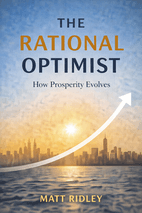
Here you'll find some of the most memorable lines from Matt Ridley's "The Rational Optimist" — a book that doesn't shy away from big, counterintuitive ideas. These quotes capture his core argument: humanity's greatest leaps come from exchange, not isolated genius. What makes this book so quotable is its ability to reframe familiar progress in startling, concrete terms, turning abstract economics into vivid, shareable insights. You'll encounter sharp observations about trade, time, trust, and the hidden engines of human flourishing. They're the kind of lines that make you stop, nod, and want to pass them along.
Top Quotes from The Rational Optimist
“It is my contention that in looking inside our heads, we would be looking in the wrong place to explain this extraordinary capacity for change in the species. It was not something that happened within a brain. It was some thing that happened between brains. It was a collective phenomenon.”
The author, Matt Ridley, explains his central thesis about the source of human cultural change.
This passage succinctly reframes the explanation of human progress from individual intelligence to collective exchange, a powerful and counterintuitive insight that sets the stage for the entire book.
“Exchange is to cultural evolution as sex is to biological evolution.”
Ridley introduces the core analogy that drives his argument about the cumulative nature of culture.
This metaphor is both memorable and elegant, instantly clarifying how trade and specialization accelerate innovation in the same way that sexual reproduction accelerates biological evolution.
“From six hours to half a second - a 43,200-fold improvement — for an hour of lighting: that is how much better off you are than your ancestor was in 1800, using the currency that counts, your time.”
Ridley calculates the dramatic decrease in work time needed to afford artificial light over centuries.
By converting economic progress into time saved, this vivid example makes the abstract concept of 'getting richer' emotionally and intuitively understandable.
“Time: that is the key. Forget dollars, cowrie shells or gold. The true measure of something's worth is the hours it takes to acquire it.”
Ridley introduces the idea that time, not money, is the ultimate measure of value.
This aphoristic statement reframes economic thinking in a human-centric way, resonating with readers who feel time scarcity more than money scarcity.
“Money is not metal. It is trust inscribed.”
The chapter opens with this epigraph from Niall Ferguson's 'The Ascent of Money'.
It distills the chapter's central argument that money's value derives from collective trust, not intrinsic worth, in a memorable and concise form.
“Imports are Christmas morning; exports are January's MasterCard bill.”
Opening epigraph by P.J. O'Rourke on The Wealth of Nations.
Humorous analogy that captures the essence of trade balance and consumer benefit.
“The blinding brightness of this realisation still amazes me: we can build a civilisation in which everybody lives the life of the Sun King, because everybody is served by (and serves) a thousand servants, each of whose service is amplified by extraordinary amounts of inanimate energy and each of whom is also living like the Sun King.”
The author reflects on the transformative potential of fossil fuels to create universal prosperity.
It captures the astonishing vision that fossil energy can provide everyone with unprecedented wealth and comfort, akin to royalty, by multiplying human effort through machines.
Themes Behind the Quotes
A central theme running through these quotes is that human progress stems from collective cooperation and specialization. Ridley argues that our unique capacity to exchange goods, services, and ideas among strangers is what drives innovation and prosperity. This process, which he compares to biological evolution, allows us to leverage each other's skills and knowledge far beyond what any individual could achieve alone. Another key idea is the redefinition of wealth in terms of time rather than money. The dramatic reductions in the time required to obtain necessities like light or food illustrate a long term trend of improving living standards. The book also consistently champions trade and interdependence as forces for good, while warning that self sufficiency and isolation are symptoms of decline. Ultimately, these quotes convey a hopeful message that embracing change, trusting in collective ingenuity, and continuing to exchange will lead to even greater human flourishing.
Quotes by Chapter
Prologue: When Ideas have Sex
“The more human beings diversified as consumers and specialised as producers, and the more they then exchanged, the better off they have been, are and will be.”
Ridley summarizes the virtuous cycle of specialization and trade that underpins economic progress.
It captures a fundamental and optimistic economic principle in a single, clear sentence, linking past, present, and future prosperity to cooperative exchange.
“This book dares the human race to embrace change, to be rationally optimistic and thereby to strive for the betterment of humankind and the world it inhabits.”
Ridley states the ambitious call to action of his book.
This sentence boldly articulates the book's mission to challenge pessimism and inspire hope through reason and evidence, making it an inspiring and quotable mission statement.
Chapter One - A better today: the unprecedented present
“The availability of almost everything a person could want or need has been going rapidly upwards for 200 years and erratically upwards for 10,000 years before that: years of lifespan, mouthfuls of clean water, lungfuls of clean air, hours of privacy, means of travelling faster than you can run, ways of communicating farther than you can shout.”
The author, Matt Ridley, describes the long-term improvement in human living standards.
This sweeping statement captures the breadth of progress across multiple dimensions, making the abstract concept of 'improvement' tangible and relatable.
“The United Nations estimates that poverty was reduced more in the last fifty years than in the previous 500.”
Ridley cites a UN estimate to emphasize the unprecedented rate of poverty reduction.
This stark contrast between recent and historical progress challenges pessimistic narratives and highlights the transformative power of modern economic growth.
Chapter Two - The collective brain: exchange and specialisation after 200,000 years ago
“Exchange is to technology as sex is to evolution. It stimulates novelty.”
Ridley contrasts Neanderthals' lack of trade with modern humans' rapid innovation.
The metaphor brilliantly captures the dynamic, generative nature of exchange, making the abstract concept of economic trade feel as fundamental as biological reproduction.
“Without trade, innovation just does not happen.”
Ridley explains why Neanderthals stagnated technologically while modern humans advanced.
This succinct assertion distills the chapter's central thesis into a memorable, almost aphoristic statement that challenges common assumptions about lone geniuses.
“To paraphrase H.G. Wells, ‘We had struck our camp forever, and were out upon the roads.”
Ridley describes the moment barter allowed humans to leave self-sufficiency behind.
The borrowed line evokes a sense of irrevocable departure and adventure, marking a turning point in human history with poetic force.
“Cooking is the most female-biased of all activities, the only exceptions being when men prepare some ritual feasts or grill a few snacks while out on the hunt.”
Ridley discusses the sexual division of labor in hunter-gatherer societies.
It humorously and insightfully links ancient cooking roles to modern gendered behaviors like barbecuing, making evolutionary history relatable.
Chapter Three - The manufacture of virtue: barter, trust and rules after 50,000 years ago
“In no other species can two individuals that have never before met exchange goods or services to the benefit of each other, as happens routinely each time you visit a shop or a restaurant or a website.”
The author contrasts human trade with animal behavior, noting that no other species routinely exchanges goods with strangers.
This observation underscores the extraordinary nature of human cooperation and the foundation of commerce, making the reader reflect on everyday transactions.
“If human economic progress has included a crucial moment when human beings learned to treat strangers as trading partners, rather than enemies, then oxytocin undoubtedly played a vital role.”
The author speculates on the role of the hormone oxytocin in enabling trust and trade among strangers.
It ties biological evolution to economic progress, offering a compelling explanation for how humans overcame xenophobia to build prosperous societies.
“Trade is prehistoric and ubiquitous.”
The author concludes a section listing archaeological evidence of ancient long-distance trade.
This punchy, declarative statement challenges the common misconception that trade is a modern invention, emphasizing its deep evolutionary roots.
Chapter Four - The feeding of the nine billion: farming after 10,000 years ago
“Whoever could make two ears of corn, or two blades of grass, to grow upon a spot of ground where only one grew before, would deserve better of mankind, and do more essential service to his country, than the whole race of politicians put together.”
Opening epigraph from Jonathan Swift's Gulliver's Travels.
It forcefully declares that agricultural innovation is more valuable than politics, setting the theme of the chapter.
“He was a walking encyclopedia of accumulated knowledge —- knowledge of how to fashion tools and clothes and from what materials to make them.”
Describing Oetzi the Iceman's equipment and knowledge.
It vividly illustrates how ancient humans relied on accumulated knowledge from many others, highlighting the power of collective intelligence.
“Farming is the extension of specialisation and exchange to include other species.”
After explaining how Oetzi's domesticated animals worked for him.
This line succinctly redefines agriculture as a form of trade with other species, a key insight of the chapter.
“The characteristic signature of prosperity is increasing specialisation.”
Contrasting modern wealthy societies with poor ones that are self-sufficient.
It offers a clear, memorable marker of economic development, linking prosperity directly to trade and specialization.
Chapter Five - The triumph of cities: trade after 5,000 years ago
“A modern combine harvester, driven by a single man, can reap enough wheat in a single day to make half a million loaves.”
Author describing the productivity of modern agriculture.
Striking statistic highlights the dramatic increase in efficiency enabling urbanization.
“Cities exist for trade. They are places where people come to divide their labour, to specialise and exchange.”
Author's definition of cities' purpose.
Concise and powerful statement linking cities to trade and specialization.
“Merchants make wealth; chiefs nationalise it.”
Author summarizing the pattern from Ubaid and Uruk.
Memorable aphorism that encapsulates the conflict between wealth creation and state capture.
Chapter Six - Escaping Malthus’s trap: population after 1200
“Increasing self-sufficiency is the very signature of a civilisation under stress, the definition of a falling standard of living.”
From the chapter's discussion of how Malthusian crises arise from decreasing specialisation rather than population growth.
This line captures a profound insight about economic history in a single, sharp definition; it resonates because it reframes decline not as mere scarcity but as a retreat from interdependence.
“In the preindustrial world, sporadic technological advance produced people, not wealth.”
Attributed to Greg Clark, summarizing the Malthusian dynamic before the Industrial Revolution.
This aphorism is memorable and unsettling, overturning the modern assumption that technology always raises living standards by showing that it once just fed more mouths.
“Europe was, in Joel Mokyr's words, ‘the first society to build an economy on non-human power rather than on the backs of slaves and coolies’.”
Describing Europe's shift to capital-intensive, labour-saving technology after the Black Death.
The phrase 'non-human power' crystallizes a pivotal historical turning point; it challenges readers to appreciate the ethical and economic significance of mechanization.
“The only way we can preserve and nurture other and more precious freedoms is by relinquishing the freedom to breed, and that very soon.”
Garrett Hardin in his essay 'The Tragedy of the Commons', advocating coerced population control.
This stark, chilling statement exposes the coercive logic behind mid-twentieth-century population policies, making it a powerful warning about trading liberty for survival.
Chapter Seven - The release of slaves: energy after 1700
“History supports this truth,’ writes the economist Don Boudreaux: ‘Capitalism exterminated slavery.”
The author cites economist Don Boudreaux while drawing a connection between the rise of fossil fuels and the end of slavery.
This line powerfully asserts that capitalism, fueled by fossil energy, made slavery economically obsolete, challenging the common narrative that abolition was purely moral.