The Practice of Groundedness Quotes
by Brad Stulberg
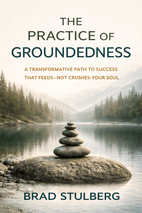
These quotes capture the core wisdom of Brad Stulberg's book. They offer practical insights on finding stability in a chaotic world. The writing is direct and rooted in real experience. Each line stands on its own as a reminder to slow down and focus on what matters.
The book's quotability comes from its blend of ancient philosophy and modern research. It gives you phrases that stick, helping you rethink your approach to growth and success. Whether you need a nudge toward patience or a push toward self acceptance, these lines deliver.
Top Quotes from The Practice of Groundedness
“Groundedness is unwavering internal strength and self-confidence that sustains you through ups and downs.”
The author defines the core concept of groundedness.
This concise definition captures the essential quality that the entire book promotes, offering a clear and powerful alternative to the restless pursuit of external achievement.
“The curious paradox is that when I accept myself just as I am, then I can change.”
Carl Rogers, pioneering humanistic psychologist, observed this.
This quote captures the counterintuitive truth that self-acceptance is a prerequisite for genuine change, not an obstacle to it.
“Progress in anything, large or small, requires recognizing, accepting, and starting where you are. Not where you want to be. Not where you think you should be. Not where others think you should be. But where you are.”
The author states this as the first principle of groundedness.
It clearly defines acceptance as starting from reality, not wishful thinking, which is essential for grounded progress.
“It is a thoughtful and steady persistence that requires slowing down in the short term to go faster and farther in the long term.”
The author defines the type of patience he advocates for in the chapter.
This line reframes patience as a strategic advantage rather than passive waiting, which is both counterintuitive and empowering.
“The truth about progress is this: when you don't rush the process, when you take small and consistent steps over time, you give yourself the best chance to end up with massive gains.”
The author introduces the principle of consistency compounding in the section on patience.
It distills a core lesson of groundedness into a clear, actionable maxim that counters the myth of overnight success.
“You don't become what you think. You become what you do.”
Opening of the chapter, emphasizing that understanding principles is not enough without action.
This line cuts through intellectualization and reminds readers that real change comes from behavior, not just mindset.
“If you concentrate on the process, the results you are hoping for tend to take care of themselves.”
This is one of the guiding principles the author offers for successfully practicing groundedness.
It reframes success as a natural byproduct of focused effort, reducing anxiety about outcomes and promoting sustainable engagement.
Themes Behind the Quotes
A central theme is the importance of inner stability over external achievement. True strength comes from accepting where you are and nurturing your foundations, not from chasing surface level success. This groundedness allows for sustainable growth and resilience through life's inevitable ups and downs.
Another theme is the power of process and presence. Real progress requires slow, consistent action and full engagement in the moment. Vulnerability and connection with others are also essential; isolation weakens us while community and vulnerability strengthen our core. The book repeatedly emphasizes that what we do shapes who we become more than what we think.
Quotes by Chapter
1. Grounded to Soar
“It is only once you are grounded that you can truly soar, at least in a sustainable manner.”
The author summarizes the central thesis of the chapter.
This memorable phrase inverts conventional wisdom, arguing that true high performance and fulfillment come from a stable foundation rather than relentless forward motion.
“The deeper and lower the ground, the higher and more immeasurable is the elevation and the height.”
The author cites the 13th-century Christian mystic Meister Eckhart.
This ancient wisdom elegantly echoes the book's theme, reinforcing that depth of groundedness enables sustainable greatness.
“We need to stop spending so much time worrying about our metaphorical overstory, our high-hanging branches, and instead focus on nourishing our deep and internal roots.”
The author describes the moment of insight during a hike with his friend Mario.
The vivid tree metaphor makes the abstract concept of groundedness tangible and relatable, urging readers to redirect attention from external appearances to internal strength.
2. Accept Where You Are to Get You Where You Want to Go
“It's normal to feel pain in your hands and feet if you're using your feet as feet and your hands as hands. And for a human being to feel stress is normal—if he's living a normal human life.”
Stoic emperor Marcus Aurelius wrote this in his meditations.
This normalizes stress as part of a human life, contradicting the toxic positivity of modern culture.
“It is only when you fully accept your current abilities and circumstances that you can perform from a place of freedom and play to win.”
The author summarizes a key principle contrasting a performance-approach versus performance-avoidance mindset.
This directly challenges the conventional belief that dissatisfaction drives peak performance, offering a counterintuitive yet research-backed insight.
3. Be Present So You Can Own Your Attention and Energy
“A wandering mind,” the researchers write, “is an unhappy mind.”
Harvard researchers summarize their findings on the link between distracted attention and unhappiness.
This line is powerfully concise, flipping the common glorification of multitasking and mental busyness on its head. It reminds readers that constant mental wandering is a direct source of discontent.
“Attention is a finite resource,” Batista says. “And attention vampires are lurking everywhere, literally sucking the life out of us.”
Ed Batista, a Stanford lecturer, explains the need to guard one's attention from digital and social distractions.
The vivid metaphor of 'attention vampires' makes the abstract concept of distraction feel immediate and threatening. It is memorable and encapsulates the modern struggle to protect our focus.
“Happiness equals love—full stop.”
George Vaillant, director of the Harvard Study of Adult Development, states the study's central conclusion after decades of research.
This blunt, five-word conclusion cuts through complexity to offer a timeless truth. It resonates because it reframes happiness not as achievement or productivity, but as the presence of love.
“We are at our best when we are fully absorbed in the present moment.”
The author summarizes the shared message of Buddhism, Taoism, Stoicism, and Greek philosophy regarding presence.
This sentence distills ancient wisdom and modern psychology into a single actionable insight. It is a hopeful and empowering reminder that our peak performance and fulfillment come from being fully here.
4. Be Patient and You’ll Get There Faster
“When you work on something significant, something significant is working on you.”
The author reflects on the hidden growth that occurs during plateaus and slow progress.
It captures the reciprocal nature of deep work, reminding readers that inner transformation happens alongside outer effort.
“Instead of always thinking, Don’t just stand there, do something, we should at least consider thinking, Don’t just do something, stand there.”
The author offers a counterintuitive alternative to the commission bias, the tendency to favor action over inaction.
This clever twist on a common saying challenges the cultural urge to always act, promoting the value of thoughtful stillness.
5. Embrace Vulnerability to Develop Genuine Strength and Confidence
“Vulnerability is not a weakness, a passing indisposition, or something we can arrange to do without,” writes Whyte. “Vulnerability is not a choice. Vulnerability is the underlying, ever-present, and abiding undercurrent of our natural state. To run from vulnerability is to run from the essence of our nature.”
The poet and philosopher David Whyte is quoted in the chapter to reframe vulnerability as an essential, inescapable part of being human.
This passage powerfully redefines vulnerability from a flaw to a fundamental truth, making readers feel that embracing it is not optional but necessary for authenticity. The lyrical repetition and bold assertion invite readers to stop fleeing their own nature.
“In all my research’s two-hundred-thousand-plus pieces of data, I can't find a single example of courage that didn't require vulnerability. ... Can you think of one moment of courage that didn't require risk, uncertainty, and emotional exposure?”
Researcher Brené Brown is cited from her book Braving the Wilderness to link vulnerability directly with courage.
This rhetorical challenge cuts through the common misconception that vulnerability is weak, instead exposing it as the hidden root of every brave act. It sticks with readers because it forces them to search their own memory and arrive at the same conclusion.
“Where there is resistance, suppression, or delusion there is fragility, unfilled cracks in your ground.”
The author uses this metaphor to explain how avoiding vulnerability creates instability within yourself.
The image of 'unfilled cracks in your ground' is visceral and memorable, making abstract psychological concepts feel concrete. It resonates because it equates self-deception with structural weakness, motivating readers to face rather than hide their vulnerabilities.
“The appearance of fervent confidence and absolute certainty may seem like signs of strength, but they are usually signs of weakness.”
The author reflects on impostor syndrome and the paradox of intellectual humility in coaching high performers.
This reversal of conventional wisdom is both provocative and liberating, letting readers off the hook from pretending to have all the answers. It offers a new definition of strength—one rooted in honesty rather than facade—which many find deeply comforting and aspirational.
7. Move Your Body to Ground Your Mind
“To feel completely alone and isolated leads to mental disintegration just as physical starvation leads to death.”
Psychologist, sociologist, and philosopher Erich Fromm writes in Escape from Freedom about the necessity of relatedness.
The stark analogy equates loneliness with starvation, driving home that community is not a luxury but a biological and psychological necessity.
“Not so, Ananda! Not so! This is the entire spiritual life, that is good friendship, good companionship, good comradeship.”
The Buddha responds to his attendant Ananda's suggestion that good friendship is half the spiritual life.
This ancient wisdom elevates community to the very core of spiritual practice, challenging the modern emphasis on individual achievement and self-reliance.
“A diminishing circle of friends is the first terrible diagnostic of a life in deep trouble: of overwork, of too much emphasis on a professional identity, of forgetting who will be there when our armored personalities run into the inevitable natural disasters and vulnerabilities found in even the most average existence.”
Poet-philosopher David Whyte warns about neglecting community in his book Crossing the Unknown Sea.
It serves as a haunting early warning system, reminding readers that shrinking social connections signal deeper imbalances before crisis hits.
“If you're lonely at the top, you're doing it wrong. High performers focus on pulling others up. They are generous as they rise and create a tribe.”
Shalane Flanagan, elite distance runner, tells the author this insight about community.
It powerfully reframes success as collective rather than solitary, inspiring readers to lift others as they climb.
8. From Principles to Action
“The goal is not to be the best or perfect. The goal is to give an honest effort, to incrementally become more grounded.”
Closing of the introductory paragraph, defining the true aim of the groundedness journey.
It provides a liberating reframe from perfectionism to steady, compassionate progress, making the path feel achievable.
“Habit energy is stronger than we are,” says Zen master Thich Nhat Hanh. “It is pushing us all the time.”
Discussion of habit energy in the context of ancient Eastern psychology and behavior change.
It acknowledges the power of ingrained routines and validates the difficulty of change, while also setting up the need to work with habit energy rather than against it.
“We often make things more complex than they need to be as a way to avoid the reality that what really matters for behavior change is consistently showing up and doing the work.”
Section titled 'Choose Simplicity over Complexity'.
This line exposes a common self-sabotaging pattern and delivers a straightforward, motivating truth that cuts through excuses and overthinking.
9. Focus on the Process, Let the Outcomes Take Care of Themselves
“The way practice works,” an anonymous Japanese Zen teacher once remarked, “is that we build up our practice, then it falls apart. And then we build it up again, and then it falls apart again. This is the way it goes.”
The author shares this observation to normalize the cycle of progress and relapse in any practice.
It validates the inevitable setbacks in personal growth, relieving the pressure to be perfect and encouraging persistence.