The Pivot Year Quotes
by Brianna Wiest
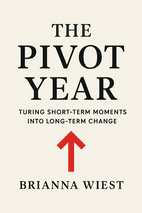
Inside this collection, you will find lines that feel like quiet revelations. They are the kind of words that stop you mid page and make you look up. These quotes speak to uncertainty, growth, and the subtle art of paying attention. Brianna Wiest has a way of turning ordinary moments into invitations for change.
What makes The Pivot Year so quotable is its honesty. It does not promise easy answers. Instead, it offers language for what we already sense but cannot name. Each line feels like it was written just for the moment you needed it. That is why these quotes stick with you, long after you close the book.
Top Quotes from The Pivot Year
“The courage with which you enter today will become the fate that you meet tomorrow.”
The author addresses the reader at the start of Day 1, framing the day as a choice that shapes destiny.
This line captures the empowering idea that our daily choices and mindset directly influence our future, motivating readers to act with intention.
“When you do not know what is next, you enter the realm of infinite potential.”
The author discusses the benefits of embracing not knowing.
It succinctly captures the liberating idea that uncertainty isn't a weakness but a doorway to limitless possibilities, which resonates with anyone feeling stuck or anxious about the future.
“Happiness is not what your house looks like, but how you love the people within its walls.”
The author reflects on the true meaning of happiness.
This line resonates because it shifts focus from material possessions to the quality of relationships, a universal truth that many forget in the pursuit of success.
“Happiness is not having the best of everything, but the ability to make the best of anything.”
The author reflects on the true meaning of happiness.
This line emphasizes resilience and gratitude, reminding readers that happiness comes from perspective, not perfection.
“Maybe you don’t need to find more energy, maybe you just need to find a dream that makes you actually want to get up in the morning.”
The author offers a perspective on motivation and purpose.
This line reframes a common struggle—lack of energy—as a deeper issue of alignment, making it both comforting and empowering. It resonates because it shifts the focus from forcing oneself to finding genuine inspiration.
“You're not failing because you're not motivated. You're not supposed to get far on a path that was never yours to walk.”
The author reframes failure as misalignment rather than personal shortcoming.
This quote offers relief by removing blame and validating the reader's struggle. It powerfully suggests that lack of progress on the wrong path is not failure but a sign to change direction.
“Whatever pain you think you are in right now cannot begin to compare to the peace that will one day come over you.”
The narrator addresses the reader directly, reassuring them that their current suffering is temporary.
This line reframes pain as a precursor to future peace, offering hope and perspective in difficult moments.
Themes Behind the Quotes
A central theme is the power of the present moment and the willingness to step into the unknown. Many of these lines encourage readers to stop replaying the past or worrying about the future. Instead, they highlight that happiness comes from within, from loving deeply and making the best of what you have. Another key thread is the importance of self awareness, learning to pause between stimulus and response, and choosing where to invest your energy. The quotes also point to an inner guide that helps us navigate the noise of the world.
A related theme is the idea that personal growth is a gradual process of alignment. It is not about forcing yourself to be motivated on a path that is not yours. True desire comes from what you already carry inside. The book speaks to the peace that follows pain, and the need to build a stable inner foundation before life can expand outward. It reminds us that slowing down and being present is itself a form of living fully. These themes together create a quiet, grounded philosophy for navigating change.
Quotes by Chapter
Day 1
“Will you continue to replay the memories of yesterday, or will you meet the moment and make the most of what is in front of you now?”
The author poses a rhetorical question to the reader, urging them to choose presence over nostalgia.
It forces a personal confrontation with the habit of dwelling on the past, making the decision to live in the now feel urgent and transformative.
“Not to build a clean, one-line story, but to create a mosaic of experience—ever-forming, ever-evolving, ever- unfolding, as what's within unravels into reality, revealing at last the fragment of the universe that came to be known through you at this exact time, in this exact place, in this exact form.”
The author redefines the purpose of living fully, rejecting simplicity in favor of a richer, ongoing creative process.
This poetic metaphor reframes life as an unfinished masterpiece, validating complexity and imperfection while affirming the reader's unique cosmic significance.
Day 2
“Every given moment contains within it doorways of opportunity, and when you choose to walk through one, you make realities available to you that were once invisible.”
The author explores the idea that uncertainty opens up new possibilities.
This line reframes uncertainty as a source of hidden potential, encouraging readers to see each moment as a choice point that can unlock unforeseen paths.
“Instead of living on autopilot, you can learn how to continuously meet the ever-changing, ever-possible now.”
The author contrasts automatic living with mindful engagement in the present.
This inspires readers to shift from routine to active presence, reminding them that life's richness lies in adapting to each unfolding moment.
“When you finally admit that you do not know what is next, you enter the golden vortex—the space between everything you know you're meant for and anything you had previously imagined to be.”
The author concludes the reflection with a powerful metaphor for embracing uncertainty.
The vivid image of a 'golden vortex' transforms the anxiety of not knowing into a hopeful in-between place, making the unknown feel sacred and full of promise.
Day 3
“Happiness is not finding success by a certain time, but finding something you love so much time itself seems to disappear.”
The author reflects on the true meaning of happiness.
It captures the joy of discovering a passion that makes time fly, a feeling that many strive for and can relate to deeply.
Day 4
“4 Self-protection is learning how to take a pause between what you feel and how you react.”
The author presents this line as the opening thought for Day 4 of 'The Pivot Year'.
It reframes self-protection as an active, mindful skill rather than a defensive posture, giving readers a clear, actionable definition.
“When there is no awareness between what you perceive and the way that you respond, anything can control you.”
The author explains the consequence of lacking a mindful pause.
This warning vividly captures how reactivity cedes power, making a compelling case for intentional pauses as a form of self-mastery.
“Widen the space between what you sense and what you do about it.”
The author elaborates on the practice of pausing.
It offers a concrete visualization for building mindfulness—turning an abstract concept into a stretchable, measurable skill.
“Decide what's worth your energy, because what you engage with is what you empower.”
The author concludes the day's reflection with a call to intentionality.
This line ties emotional boundaries to personal agency, reminding readers that attention is a form of fuel and choice is power.
Day 5
“There are two rivers running through us at all times, one that carries all the voices of the world, and the other, a single voice that stands alone—the voice of our inner guide.”
The author introduces a central metaphor for the chapter.
This vivid imagery captures the universal internal conflict between external expectations and inner truth, making it instantly relatable and memorable.
“Eventually, we look down and realize our hands are empty.”
The author describes the consequence of blindly following the world's directives.
This stark, simple statement lands with emotional impact, prompting readers to reflect on the emptiness of achievements not aligned with their true selves.
“Our lives were woven together by a storyline we didn’t write.”
The author reflects on how external influences shape our paths.
It resonates deeply because it articulates a common existential feeling of being a passive character in one's own life, urging a reclaiming of agency.
“The first realization of wisdom is the recognition that there is truth fragmented everywhere, and to delineate the two rivers into wholly good and wholly bad is to deprive ourselves of the depth and beauty that our hearts are truly trying to bring about.”
The author offers a nuanced perspective on the two rivers metaphor.
This profound insight challenges black-and-white thinking, encouraging readers to embrace complexity and find wisdom in both external and internal voices.
Day 6
“You cannot desire what you do not already contain.”
The author introduces the idea that desire stems from inner potential.
This paradox challenges the common belief that desire is purely external, prompting readers to look inward and recognize their own latent capabilities.
“Desire is a projection outward that is proportionate to potential inward.”
The author expands on the nature of desire as a reflection of inner capacity.
This line succinctly captures the balance between what we want and what we are capable of, encouraging self-assessment and growth.
“There are very few things that excite you in a way that makes you nearly uncomfortable with your wanting of them.”
The author describes the rare intensity of true desire.
It resonates because many have experienced that discomfiting passion that feels both exhilarating and intimidating, validating a deep personal truth.
“What you are waiting on is your own willingness to accept the mountain you must climb in order to pull those desires out of the deepest parts of you and create them in the world you already inhabit.”
The author concludes by urging action to manifest inner desires.
This powerful call to self-acceptance and effort reframes waiting as a choice, inspiring readers to embrace the hard work of realizing their dreams.
Day 7
“Maybe you need to stop trying to be good at the hundred things that do not light up your soul, and finally choose the one that does—the one that asks you to risk, to lay your heart bare, to try again, even though you're scared.”
The author encourages readers to prioritize passion over scattered efforts.
This sentence captures the tension between safety and vulnerability, urging readers to embrace a single meaningful pursuit despite fear. Its vivid imagery of risk and bare-heartedness makes it deeply memorable and motivating.
Day 8
“You may believe that living life to the fullest is seeing every country in the world and quitting your job on a whim and falling recklessly in love, but it's really just knowing how to be where your feet are.”
The author challenges a common misconception about what it means to live fully.
It reframes the glamorous idea of a full life into a grounded, accessible practice, offering relief from the pressure to constantly seek external adventure.
“It's learning how to take care of yourself, how to make a home within your own skin.”
The author continues describing the essence of living fully.
This line uses a powerful metaphor for self-acceptance and inner peace, reminding readers that true belonging starts from within.
“A life most fully lived is not always composed of the things that rock you awake, but those that slowly assure you it's okay to slow down.”
The author clarifies that fulfillment often comes from quiet, steady moments rather than dramatic upheavals.
It validates the value of rest and gentleness in a culture that glorifies constant action and excitement.
“Little by little, you will begin to see that life can only grow outward in proportion to how stable it is inward—that if the joy is not in the little things first, the big things won't fully find us.”
The author concludes with a lesson about the relationship between inner stability and outer expansion.
This insight offers a profound truth about personal growth: lasting joy and success are built on a foundation of inner peace and appreciation for small moments.