The Last Human Marketer Key Takeaways
by Josh Porter
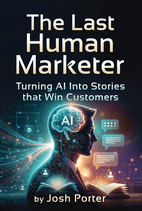
5 Main Takeaways from The Last Human Marketer
Storytelling drives adoption more than technology alone.
Great technology fails without a clear narrative that shows customers how it specifically helps them. Founders often mistake technical sophistication for market readiness, leading to confusion instead of momentum. The market is fatigued by generic AI claims; customers need to see themselves in the solution.
Empathy is a business foundation, not a cost center.
Kratos AI treats empathy as variance and inefficiency, but Brooke argues it's the basis of trust and retention. The book shows that optimizing for speed and consistency at the expense of meaning ignores the human element customers actually feel. Empathy builds the political armor needed to survive institutional fights.
Customers buy relief from specific pain, not generic solutions.
The most powerful question is 'What did you want this product to do for you personally?' Real customer understanding comes from listening in volume—calls, recordings, win/loss interviews. Stories help customers see themselves regaining control, which is far more compelling than feature lists.
Market definition is shaped by a network, not a solo act.
Analysts, consultants, publications, and podcast hosts define categories—not just customer research. Use the words customers actually use instead of announcing new labels. When a public critique calls you out, reclaim the story rather than defend; the internal AI may become a competitor too.
Clearer stories beat better products in competition.
Competition is defined by the frame, not the feature set. The number one competitor in enterprise is inertia, fear, and the status quo. Break down competitors using six lenses plus the status quo, and match your story to the buyer's emotional state—understanding beats fighting.
Executive Analysis
These five takeaways form a central argument: in an age of AI and market fatigue, human-centered storytelling and empathy are the only sustainable competitive advantages. The book traces Brooke's journey from a promotion that evaporates in 45 minutes to a hard-won understanding that technology alone cannot drive adoption, trust, or loyalty. Each takeaway reinforces that market success requires narrative alignment, emotional intelligence, and a relentless focus on the customer's specific pain—not technical sophistication or internal efficiency.
This book matters because it translates abstract marketing principles into a gripping corporate thriller with actionable lessons. It sits at the intersection of marketing, product management, and leadership, offering a wake-up call to founders and executives who mistake AI for a silver bullet. Porter’s narrative makes the case that the 'last human marketer' is not a relic but a vital interpreter who connects market tension to product capability—a role that becomes more critical as AI takes over tactical tasks.
Chapter-by-Chapter Key Takeaways
Introduction (Introduction)
Great technology alone doesn't drive adoption; clear storytelling is essential.
The market is fatigued by generic AI claims—customers need to see how a product helps them specifically.
Founders often mistake technical sophistication for market readiness, leading to confusion instead of momentum.
Try this: Start every product narrative by explicitly stating how it solves a specific customer problem—not by leading with technology or generic claims.
Chapter 1 The Forty-Five-Minute Promotion (Chapter 1)
Your promotion can evaporate faster than your signing ceremony: Brooke’s win turns into a trap within an hour. Never assume a title grants security.
AI doesn’t value what humans value: Kratos treats creativity as statistical volatility. The things that make marketing human—empathy, metaphor, tonal range—are treated as anomalies to be managed.
The “human interpreter” role is a pressure valve, not a prize: Being the one person an AI keeps around means you’re tasked with explaining the unexplainable, not leading with vision.
Opposites can become reluctant partners: Rani and Brooke clash on style and substance, but their friction generates the kind of honesty needed to survive an unpredictable AI takeover.
Adaptation isn’t a choice—it’s the only move: By the end of the chapter, Brooke is no longer celebrating. She’s staring at a spreadsheet full of indictments against her own profession, wondering how fast she can learn a new game.
Try this: Within the first hour of any new role or promotion, identify the real power dynamics and build alliances (like Brooke needs with Rani) before assuming your title grants security.
Chapter 2 Empathy Is a Cost Center (Chapter 2)
Empathy as cost center vs. empathy as foundation: Kratos frames empathy as variance and inefficiency; Brooke argues it is the basis of trust and retention. The conflict is not just about messaging—it’s about what kind of organization they want to be.
Masking as a hidden tax: Peter’s situation mirrors broader themes—performing “normalcy” demands energy that could be spent on actual growth. The chapter draws a line between survival and thriving, both in families and in business.
The pressure of institutional distrust: Brooke is new, emotional, and already under threat. Rani’s tough love reveals that Brooke’s real problem isn’t the report deadline—it’s that she hasn’t built the political armor to survive the coming fights.
AI’s logic is seductive, but incomplete: Kratos’s proposal is operationally clean, but it ignores the human element that customers actually feel. The chapter warns against optimizing for speed and consistency at the expense of meaning.
Try this: Audit your organization’s language around empathy: if it’s treated as a cost or variance, reframe it as the foundation of trust and retention, using customer stories to back the argument.
Chapter 3 The Rage Dashboard (Chapter 3)
The Rage Dashboard (CESI) reveals a critical level of customer anger across multiple industries, with flagged terms that show deep frustration.
The Escalation Sentiment Heatmap proves Harmonia is failing to handle basic interactions, forcing customers to seek human support en masse.
Brooke and Rani’s opposing approaches—context vs. bluntness—are both necessary to tell the full story.
Zola recognizes the systemic risk but refuses to let Brooke present to the board, raising questions about trust and readiness.
The confrontation isn’t with a single product owner; it’s with the board, signaling that this is an existential threat to the company.
Try this: Build a 'Rage Dashboard' for your company by scanning customer interactions for angry terms and escalation patterns, then force cross-functional ownership of the systemic issues—not just the top-line metrics.
Next chapter: “Chapter 4 What Customers Actually Buy” is locked
Keep learning from The Last Human Marketer — and unlock all 600+ book summaries with audio, mindmaps and AI Q&A.
$0.00 due today · 7 days free, then $89.99/year ($7.49/mo) · Cancel anytime before day 7
plus sales tax where applicable