The Invisible Leads System Quotes
by Jonathan Milligan
As an Amazon Associate, we earn from qualifying purchases.
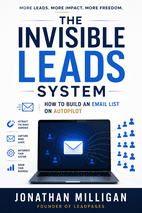
Inside this collection you will find lines that shift your perspective on how leads actually happen. These are not vague motivational statements. They are the kind of hard truths that make you pause and rethink everything you thought you knew about marketing.
What makes this book so quotable is how it wraps deep insight in simple, everyday language. Jonathan Milligan has a gift for saying something profound without making it sound complicated. Each quote feels like a shortcut to a smarter strategy, which is why readers keep coming back to them.
Top Quotes from The Invisible Leads System
“That's not a discipline problem. That's a visibility problem.”
The author redefines the reader's sluggish email list growth as a visibility issue rather than a motivation or discipline failure.
This reframes a common source of self-blame into a systemic problem, offering immediate relief and a new direction for the reader.
“And no amount of showing up can fix a game that was quietly rigged against you.”
The author explains why traditional advice to post consistently no longer produces results.
It powerfully validates the reader's frustration by exposing the hidden platform changes that make old strategies ineffective.
“Stop hauling water by hand, and turn ona faucet you can leave running.”
The author contrasts manual list-building with automated lead ads.
The bucket vs. faucet metaphor is the central image of the chapter, memorable and actionable for readers seeking a sustainable system.
“People don't decide you have the solution because you list your credentials. They decide you have the solution when you describe their problem better than they can describe it themselves.”
The author introduces a key principle about earning trust through problem articulation.
This shifts the focus from self-promotion to deep empathy, giving readers a practical and powerful way to build credibility.
“When you can articulate someone's frustration, their quiet fear, their secret hope, more clearly than they can, you earn instant trust.”
The author expands on the principle of describing the buyer's problem better than they can.
It vividly illustrates the emotional payoff of true understanding, making the concept of 'knowing your buyer' tangible and compelling.
“People don't opt in for information. They opt in for a destination.”
Step 2, Cast the Dream, where the author explains what readers truly want.
This memorable reframe shifts focus from features to transformation, a core insight that changes how marketers think about their offer.
“The discipline here is doing less. That's genuinely hard for people who like to tinker. But the whole point of this system is to let a smarter tool carry the heavy load while you focus on the parts only you can do, your message and your buyer.”
The author advises resisting the urge to adjust settings and instead focusing on copy and audience.
This quote challenges the reader's instinct to over-control, reframing restraint as a strategic discipline that yields better results.
Themes Behind the Quotes
A central theme is that visibility and specificity matter more than effort or credentials. The book argues that most people struggle not because they lack skill, but because the right audience cannot find them. It emphasizes describing a customer's problem with such clarity that they instantly trust you.
Another recurring idea is the power of reducing friction and letting systems do the heavy lifting. The author encourages marketers to focus on message and copy rather than manual targeting. There is also a strong thread of patience and sequence: crawl before you walk, serve before you sell, and remain present until the reader is ready.
Quotes by Chapter
Introduction
“The people who sold you that dream weren't lying on purpose. They just never updated the playbook.”
The author addresses why the common growth advice stops working.
This compassionate line exonerates both the reader and the advice-givers, framing the problem as outdated strategies rather than personal failure or malice.
“That's not a fantasy. That's a faucet. And you can turn it on.”
The author describes the effortless growth possible with the Invisible Leads System.
The faucet metaphor makes the solution feel simple and within the reader's control, transforming a dream into an actionable reality.
1. The Faucet You Haven't Turned On
“You are not behind because you lack talent or drive. You're behind because not enough people can see you yet.”
The author addresses the reader's self-doubt about their business performance.
It reframes failure as a solvable visibility problem, removing the weight of personal inadequacy and pointing to a clear fix.
2. Know Your Buyer Better Than They Know Themselves
“The magic was never in the tool. The magic was in the specificity.”
The author reflects on how a copy tool produced resonant results for different users.
It captures the chapter's core lesson in a memorable, succinct line that challenges readers to focus on precision over tools.
“Specificity isn't what shrinks your reach. It's what makes your reach accurate.”
The author addresses the fear that being too specific will limit audience size.
It reframes a common misconception, empowering readers to see specificity as a strategic advantage rather than a risk.
3. The Avatar-First Ad
“Those first fifty-nine had felt like hard work. These forty-eight felt like she'd done nothing at all. That's the power of the right ad copy.”
Christine's experience after running her first ad with the formula.
The stark contrast between manual effort and automated leverage makes the value of effective copy tangible and aspirational.
“Before we start, remember one rule from all my years of testing. Imitate before you innovate.”
The author's advice before teaching the four-part formula.
This simple, authoritative line frees readers from perfectionism and encourages them to use proven templates instead of reinventing the wheel.
“Your very first line does double duty. It stops the right reader, and it tells the machine exactly who to hunt for.”
Explaining why the Role line is crucial in the ad.
It clarifies the dual function of copy for both human attention and algorithmic targeting, making the strategy concrete and actionable.
4. The Machine With Four Parts
“It was never a spaceship. It was always just four blocks in a row.”
The author summarizes the structure of Facebook lead ads after explaining the campaign, ad set, ad, and form.
This line powerfully reframes a seemingly intimidating system into something simple and manageable, relieving the reader's fear of technology.
“If you hand Facebook a hundred dollars a day too soon, it will spend it, and it may spend it poorly while it's still learning.”
The author advises against starting with a high budget on Facebook ads.
It delivers a memorable warning that resonates with anyone who has wasted money on ads, emphasizing patience and testing before scaling.
“Ten dollars a day, run for a month, is three hundred dollars. If that brings you two hundred and eighty of the right people onto your list, that's not a cost. That's an investment, and a cheap one.”
The author reassures readers about the affordability of the lead generation system.
This quote reframes spending as an investment and provides a concrete, hopeful example that makes the strategy feel accessible and worthwhile.
“So take a breath. We're going to crawl before we walk, and walk before we run. One block at a time, in order, until the whole thing is running.”
The author encourages a nervous reader before diving into the technical steps.
It offers a calming, step-by-step mindset that reduces overwhelm and builds confidence, reminding readers that mastery comes gradually.
5. Let the Algorithm Do the Hunting
“I told Brad the truth, and it surprised him. You don't do that anymore. The targeting isn't something you set with switches and filters. The targeting is your copy.”
The author explains to Brad that manual targeting is obsolete and that copy itself does the targeting.
This line delivers a paradigm shift, revealing that copy—not settings—is the real targeting mechanism, which surprises and reorients the reader.
“Your copy is the instruction manual you hand the algorithm.”
The author describes how specific ad copy tells Facebook's AI who to target.
The simple metaphor of an instruction manual makes the concept instantly understandable and memorable, emphasizing the power of precise words.
“Trying to out-target it by hand is like trying to out-calculate a calculator.”
The author argues against manual targeting by comparing it to a futile attempt against a superior tool.
The analogy is both vivid and humbling, driving home the point that human effort cannot beat the algorithm's efficiency.
6. The Lead Form and the Bridge
“When someone taps your ad, a form pops up right there on the platform, usually on their phone, with their email address already filled in.”
The author explains how Facebook instant forms work to remove friction from opt-in.
It vividly describes the key technical advantage that makes high conversion rates possible, showing readers a simple yet powerful mechanism.
“That tiny bit of friction we're all used to, the typing, the redirect, the loading page, is gone. And when friction disappears, opt-in rates soar.”
The author summarizes the core principle behind the chapter's strategy.
This line crystallizes a universal marketing truth—removing barriers dramatically boosts results—and makes readers rethink their own funnel friction.
“The moment you start asking for first name, last name, phone number, and three survey questions, you add friction, and friction costs you subscribers.”
The author gives a direct warning against overcomplicating the lead form.
It delivers a blunt, memorable rule that counters the common instinct to collect more data, reinforcing the value of simplicity.
“From this one setting, I've picked up hundreds of new Instagram followers I never had to chase.”
The author shares a personal result from optimizing the success page.
This concrete example turns an abstract tip into a tangible benefit, motivating readers to implement the small extra step.
7. From Cold to Connected
“The danger isn't warming people up. The danger is trying to sell before you ever warmed them up at all.”
The author responds to Jason, who was worried about using stories in emails.
This flips the common fear of over-connecting on its head, revealing that the real risk is rushing to sell before building trust.
“Marketing is the deposit. Sales is the withdrawal.”
The author introduces a simple banking metaphor for the relationship between giving value and asking for a sale.
It distills a complex marketing principle into a memorable, actionable image that readers can instantly apply to their own communication.
“Serve first, and generously, and selling stops feeling like selling at all.”
The author explains the power of a high give-to-ask ratio in email marketing.
This line reframes selling as service, reducing resistance for both the marketer and the buyer, and making the process feel natural.
“When the student is ready, the teacher appears. Your job is to still be there, warm and trusted, on the day your reader is finally ready.”
The author reflects on customers who joined his programs years after opting into his list.
This combines an ancient wisdom with a practical call to patience and persistence, reassuring marketers that consistent value pays off over time.