The Housemaid's Secret Themes
by Freida McFadden
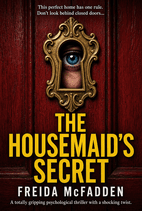
Under its twisty plot, this novel wrestles with how little we truly see of other people. It keeps circling the gap between staged appearances and messy reality, where wealth lets some characters control and hurt others. Surveillance becomes a quiet dread, and the past refuses to stay buried.
On this page you will find each major theme tied to specific moments from the book, like the performed abuse and the hidden cameras. The symbols are here too: the cracked headlight, the bracelet, the closed guest bedroom door, and the dictionary that hides more than words. Everything stays spoiler free.
Major Themes in The Housemaid's Secret
Deception and manufactured appearances
The thriller repeatedly shows that what looks like reality has been staged: abuse is performed, identities are borrowed, and the blood at a crime scene may be fake. The central shock arrives when Millie realizes that the man she knew as Douglas Garrick was not the dead man pictured on the news.
- Wendy paints fake bruises on her face and gets Russell to punch her so the split lip will make her abuse story convincing.
- Millie identifies Russell Simonds from LinkedIn as the man she shot, realizing the real Douglas Garrick had never been in the penthouse.
- Enzo suggests Douglas's death may have been staged and the blood faked, which makes Millie understand that Wendy tricked her.
Wealth, class, and greed
Money motivates characters on both sides of the class divide: Millie needs the job to survive while Wendy married Douglas to escape poverty. Wendy's scheme to keep Douglas's fortune collapses when Douglas changes his will to leave everything to charity, making greed the direct cause of her fall.
- Millie cleans Amber's penthouse and thinks about how the Degraws' bathroom is bigger than her whole South Bronx apartment.
- Wendy grew up doing homework by flashlight and treats the prenup's ten-million-dollar settlement as her safety net.
- Joe Bendeck tells Wendy that Douglas left everything to charity and she will inherit nothing.
Surveillance, control, and entrapment
Being watched is the novel's central source of dread, from Millie's sense of a follower to the hidden cameras inside Douglas's house. Watching is also a weapon of control: it lets Douglas catch Wendy's affair and lets the false narrative become evidence against Millie.
- Millie keeps spotting a black Mazda with a cracked right headlight and learns only later that Enzo was following her as a secret protector.
- Douglas tells Millie not to give Wendy any potatoes and to serve her only half a chicken portion, controlling what she eats.
- Wendy calls the penthouse her prison and says she is 'already there' when Millie warns her about prison.
Hidden identity and the inescapable past
Characters build present relationships on concealed histories: Millie hides her murder conviction and her vigilante past, Wendy hides an affair and a scheme, and Russell hides behind another man's name. When those secrets surface, they destroy trust and determine who is blamed for the murder.
- Millie does not tell Brock she was in prison as a teenager, and when he hears it at the police station he says he does not know who she is and stops representing her.
- Background checks keep exposing Millie's criminal record, so she has to accept the Garrick job after all other interviews fail.
- Millie realizes the man who hired her and whom she shot was Russell Simonds impersonating Douglas Garrick.
Moral responsibility and refusing to look away
Lectures about Kitty Genovese and Josh Bell pose the question of why witnesses do nothing, and Millie defines herself by acting instead. Her willingness to follow the blood trail, knock on Wendy's door, and help Wendy escape is what pulls her into the crime, while Brock repeatedly tells her to mind her own business.
- Millie thinks about Kitty Genovese and the bystander effect after finding a trail of blood droplets leading to Wendy's locked guestroom door.
- Millie argues that passersby ignored Josh Bell because stopping would have obligated them to help.
- When Wendy warns her to stay away, Millie says she never walks away and will do whatever it takes.
Violence, revenge, and underestimated women
Female characters use violence or the threat of it to seize power: Millie has killed before and shoots again, Wendy fakes victimhood while engineering murder, and Marybeth carries out a brutal revenge. The final narration reframes the ending as a contest Wendy loses by underestimating the woman she tried to frame.
- After shooting the man she knows as Douglas, Millie thinks 'Oh no. Not again,' connecting the killing to her teenage murder conviction.
- Marybeth cuts Russell's throat, forces Wendy to write a confession, and poisons her wine with digoxin before leaving her to die.
- Millie reveals that she gave Marybeth the digoxin and says Wendy 'underestimated an extremely dangerous person. Me.'
Symbols and Motifs
The black Mazda with the cracked right headlight
It represents ambiguous surveillance—a follower who seems like a threat but turns out to be a protector, mirroring the novel's uncertainty about who is watching and why.
- Millie notices the car outside her apartment, in the East Village, and on the road to Albany.
- Enzo steps out of the same car and admits he has been following her for three months to keep her safe.
The engraved diamond bracelet
It symbolizes ownership and possession in marriage, but the same romantic token is later twisted into false evidence of an affair.
- Douglas has the bracelet engraved 'To W, You are mine forever, Love D,' and Wendy calls herself his property.
- The police treat the bracelet as proof that Millie had an affair with Douglas.
The closed guest bedroom door
It is the boundary between the public facade of the household and the hidden suffering—or hidden scheme—inside, standing for everything Millie is forbidden to see.
- Wendy only opens the door a crack so Millie can see one red-rimmed green eye before it snaps shut.
- Millie has to threaten to call the police to make Wendy open the door and expose her bruised face.
The hollowed-out dictionary hiding a gun
It represents lethal violence concealed inside a harmless everyday object, just as Wendy hides murderous intent behind the mask of an abused wife.
- Wendy shows Millie the loaded gun hidden in the dictionary and suggests it as a way out.
- When the man she knows as Douglas attacks Wendy, Millie takes that same gun and shoots him, leaving her fingerprints on the weapon.