The Founder's Mindset Key Takeaways

by Gary S. Michel
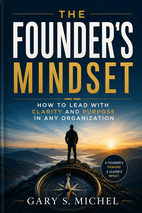
The Founder's Mindset by Gary S. Michel Book Cover

5 Main Takeaways from The Founder's Mindset

Clarity must be designed, not assumed

The book argues that complexity and friction arise not from size but from neglecting to protect clarity. Leaders must systematically build clarity into processes, principles, and priorities—using frameworks like the Clarity OS—rather than relying on heroic individual efforts to cut through confusion.

Ownership before authority drives real impact

A founder-minded leader takes responsibility without waiting for permission or a title. This proactive ownership, paired with clear boundaries and purpose, enables teams to act decisively and align autonomously, transforming compliance into commitment.

True speed comes from reducing friction, not haste

False speed—adding features, people, or dashboards—creates process debt that leads to bureaucracy and burnout. Real velocity is achieved through alignment and shared understanding, which eliminate delays and allow execution to flow naturally.

Scale culture by codifying founder intuition

As organizations grow, implicit founder instincts must become explicit team habits. By codifying purpose, principles, and priorities into everyday systems and rituals—like the future press release exercise—leaders ensure clarity persists beyond any individual.

Focus is a force multiplier, not a constraint

Saying no to constant novelty concentrates creative energy where it matters most. The discipline of enough protects teams from initiative overload and founder’s drift, turning clarity into amplified results and sustainable trust.

Executive Analysis

These five takeaways form the book’s central thesis: the greatest threat to organizational growth is not a lack of effort or resources, but the gradual erosion of clarity. Gary S. Michel argues that complexity is inevitable, but clarity is a choice—one that must be actively designed, protected, and scaled through systems, principles, and ownership behaviors. The Founder’s Mindset is not a nostalgic return to startup days but a disciplined framework for embedding purpose into every decision, so that growth scales value rather than confusion.

This book matters because it offers a practical antidote to the common traps of scaling: initiative overload, process debt, and blurred accountability. Unlike generic leadership guides, it provides a concrete operating system (Clarity OS) and actionable exercises like the future press release. It sits at the intersection of organizational design, culture building, and strategic execution—making it essential reading for founders, executives, and any leader seeking to build an organization that thrives under pressure and outlasts its original team.

Chapter-by-Chapter Key Takeaways

Foreword (Foreword)

  • Clarity must be systematically designed into processes, not left to individual heroics.

  • Founder-minded leadership is defined by ownership and personal accountability, not by position.

  • Taking responsibility before you have authority is a hallmark of this mindset—waiting for permission is optional.

Try this: Design clarity into your processes by establishing explicit ownership and accountability rules, rather than relying on individual heroics to cut through confusion.

Introduction (Introduction)

  • Complexity arises not from size but from neglecting to protect clarity.

  • Common symptoms of lost clarity: local optimization, silos, blurred accountability, activity without progress.

  • Typical responses (more structure, speed, oversight) worsen the issue without a guiding mindset.

  • The core gap is not a lack of effort—it's a missing founder's mindset.

Try this: Audit your organization for symptoms of lost clarity—local optimization, silos, blurred accountability—and resist adding structure or speed until you address the core mindset gap.

1. Why We Need the Founder’s Mindset (Chapter 1)

  • Innovation entropy is predictable: creative energy drifts toward disorder unless intentionally contained.

  • Activity is not momentum; adding features, people, or dashboards can mask a loss of clarity.

  • The root cause of stalled initiatives is often unmanaged complexity, not market timing or technology.

  • Clarity must be actively defended—it cannot be assumed as an organization grows.

  • Friction accumulates quietly; the founder’s mindset is a discipline of simplicity and purpose.

Try this: Identify one stalled initiative and trace its root cause to unmanaged complexity, then simplify the purpose and remove one source of friction this week.

2. What Is the Founder’s Mindset? (Chapter 2)

  • Ownership is proactive, accountability reactive. Clarity enables ownership by making purpose and boundaries understandable.

  • Culture must codify clarity. Implicit founder intuition must become explicit team instinct as the organization grows.

  • Sustainable speed comes from clarity, not haste. Organizations that scale well prioritize shared understanding over raw velocity.

Try this: Convert one implicit founder intuition into an explicit team principle by defining what ownership looks like and what boundaries enable proactive decisions.

4. The Illusion of Growth (Chapter 3)

  • False speed creates process debt that compounds into bureaucracy, burnout, and brand erosion.

  • True speed is the reduction of friction, achieved through alignment, not urgency.

  • Clarity is the foundation: without it, growth scales confusion rather than value.

  • Patagonia exemplifies depth-driven growth; WeWork illustrates the danger of expansion without purpose.

  • Protect clarity as a constraint—it governs every downstream decision and makes scaling durable.

Try this: Map a growth initiative to its friction points and replace an urgency-driven deadline with an alignment exercise that reduces confusion before accelerating execution.

5. Designing for Clarity (Chapter 4)

  • Clarity replaces control: when people understand the why and how behind decisions, they act with autonomy and alignment.

  • The Clarity OS framework—Purpose, Principles, Priorities—creates a shared mental model that cuts across silos and levels.

  • The future press release exercise forces specificity, aligns teams, and transforms vague aspirations into concrete, shared goals.

  • A culture of clarity doesn’t require more meetings or memos; it requires deliberate design that connects daily work to a common purpose.

Try this: Run a future press release exercise with your team to force specificity on a vague goal, then use your Purpose-Principles-Priorities framework to connect daily work to that shared outcome.

6. Scaling Clarity (Chapter 5)

  • Clarity scales when purpose is simple, principles are lived, and everyone knows the question to ask before acting.

  • Systems teach louder than statements—what you reward and tolerate defines your culture.

  • Sustaining clarity requires continuous renewal, not a one-time declaration; leaders must rearticulate purpose as conditions change.

  • The ultimate test of clarity isn’t documentation—it’s whether teams act decisively under pressure without waiting for approval.

Try this: Audit one system (reward, hiring, meeting) to ensure it teaches clarity—replace a vague approval process with a clear principle that empowers teams to act without waiting.

7. Leading Like a Founder, Even When You’re Not (Chapter 6)

  • Replace sign-offs with clear, actionable principles and real examples that guide judgment.

  • Commitment cultures outperform compliance cultures under pressure because intent, not just intensity, drives decisions.

  • Founder-like leadership is available at every level—start with curiosity, then translate purpose into permission for others to do the same.

Try this: Replace one approval sign-off in your team with a clear guiding principle and a real example that shows how to exercise judgment independently.

8. Execution with Clarity (Chapter 7)

  • Initiative overload is the enemy of execution. Tracking dozens of priorities drains energy without producing results. Focus is a force multiplier, not a constraint.

  • Reporting validates; instrumentation protects. Lagging reports explain past outcomes but miss the chance to correct course. Real-time signals empower teams to act when it still matters.

  • Clarity compounds through execution. When people see their daily work as a direct expression of purpose, compliance gives way to commitment. Each successful outcome builds both results and trust.

Try this: Reduce your team’s active priorities to three and replace one lagging report with a real-time signal that allows course correction before it’s too late.

9. The Discipline of Enough (Chapter 8)

  • Watch for founder’s drift: Even well-designed systems fail when the leader constantly resets priorities. Recognize your own ideation patterns.

  • Channel creativity deliberately: Instead of blurting ideas as directives, frame them as explorations. Create a rhythm for big thinking that doesn’t derail execution.

  • Focus is amplification, not restriction: Saying no concentrates creative energy where it matters most. Teams thrive on consistency, not constant novelty.

Try this: Identify one pattern of ‘founder’s drift’ where you constantly reset priorities, then channel that creativity into a scheduled exploration that doesn’t derail execution.

10. Leading Forward (Chapter 9)

  • Culture is the operating system for execution; design it deliberately through recurring rituals and honest communication.

  • Clarity sessions that guarantee straight answers turn passive employees into active owners.

  • Purpose sticks when people help create it—participation beats proclamation every time.

  • In a world of accelerating disruption, the Founder’s Mindset is a protective compass, not a sentimental throwback.

Try this: Design a recurring clarity session where you guarantee straight answers and invite team members to co-create purpose, turning passive employees into active owners.

11. The Founder’s Mindset for Customers (Chapter 10)

  • Clarity of purpose must be expressed through every customer touchpoint, not just marketing copy.

  • Customers feel safety and confidence when a brand’s actions consistently match its stated values.

  • Emotional trust comes from authenticity; logical trust comes from transparency.

  • In a crisis, transparency and accountability can strengthen trust—especially when they stand in stark contrast to industry norms.

  • Purpose defines the promise; simplicity delivers it. Confusion feels like neglect.

Try this: Map your customer’s journey against your stated purpose and fix one touchpoint where action contradicts values, turning confusion into felt safety.

12. The Founder’s Mindset for Investors (Chapter 11)

  • Purpose as a moat: Attract and retain long-term investors by refusing to compromise on core values, even when it conflicts with short-term expectations.

  • Earned optimism: Communicate with transparency and conviction; acknowledge challenges but anchor them in enduring purpose.

  • Bridge time horizons: Translate decade-long goals into quarterly proof points that investors can track and believe in.

  • Align incentives with intention: Reward behavior that reflects purpose, not just financial results.

  • Design for stewardship: Build systems and succession plans that embed clarity so deeply that it outlasts any individual leader.

Try this: Communicate one short-term trade-off to an investor by anchoring it in your long-term purpose, then align a quarterly incentive with that purpose rather than raw financials.

Conclusion (Conclusion)

  • Clarity must be embedded, not hoarded. It’s not enough for a founder or a small leadership team to understand the “why.” That clarity must be translated into shared stories, principles, and operational systems so it persists beyond any individual.

  • Teaching others to think with intention is the highest leverage act. The goal isn’t compliance; it’s building an organization where people independently make decisions that align with the founding vision.

  • Complexity is inevitable; clarity is a choice. Growth will bring messiness and entropy. The founder’s job is not to eliminate that complexity but to make sure it always bends toward purpose.

  • Legacy is not personal. The strongest mark a founder can leave is a set of reflexes—organizational habits that keep clarity alive even when the founding team has moved on.

Try this: Teach one team member to use the Clarity OS framework to solve a problem independently, embedding your founding reflexes into organizational habits that outlast you.

Continue Exploring