The English Bookstore in Bologna Themes
by Boo Walker
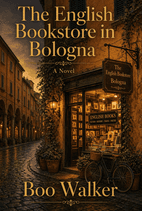
Underneath its plot, The English Bookstore in Bologna is really about people trying to rebuild themselves after loss, failure, and old family wounds. It asks whether you can start over, find community, accept love, and make art without hiding. Depression, guilt, and fear run through those questions, but so do small acts of care.
On this page, you'll find theme and symbol analysis with concrete moments: Bianca leaving Austin and writing again, Moira's book clubs versus Sandy's isolation, George's near-suicide, Sandy slapping George, Bianca pulling away from Corrado, and the George-Bianca father-daughter strain. It also traces the bookstore, the Bologna photograph, coral, and lists as recurring symbols.
Major Themes in The English Bookstore in Bologna
Reinvention and the search for identity
The novel follows characters who try to become new selves in Bologna: Bianca leaves Austin to 'begin again' and later starts writing 'This one's for me'; Harold invents Aroldo; George seeks purpose after Intel; Sandy considers Lisbon before staying. Reinvention is shown as both performance and genuine healing, often tied to Italy, ancestry, and rejecting the American rush.
- Bianca tells George she is 'healing, not broken' and later writes on a blank page with no agenda.
- Harold practices the Aroldo persona in the mirror and tells himself, 'You are Aroldo now.'
- George resolves not to take the pills when he gets home, to try again at life, and maybe return to Bologna in the fall.
Connection versus isolation, and found family
Moira pushes for book clubs and community while Sandy initially insists she only wants to keep the lights on; Harold, Bianca, and George each experience isolation in Bologna. By the end, the bookstore and its people become a chosen family, with Sandy calling Moira her best friend and Harold calling Sandy his 'Bolognese madre.'
- Moira's inaugural book club speech says expats need their people and that life is not much without connection.
- Sandy apologizes to Moira, admits Moira is her best friend, and says she is not selling the store.
- Sandy hugs George and Moira as her 'last icy walls' melt, reflecting it is better to be surrounded by those you love and heaps of books.
Depression, suicide, and loss of purpose
George's near-suicide after being forced out of Intel anchors the book's exploration of purposelessness; Bianca has a breakdown and admits she is depressed, while Sandy's grief over Jack and Harold's despair deepen the theme. Recovery is not simple, but honesty, family, and new commitments keep the characters alive.
- George sits with a lethal dose of Percocet, takes two handfuls, and thinks that without work there is no purpose and without purpose there is no point.
- George later says retirement almost killed him and thinks the darkness is only a few handfuls of pills and a light switch away.
- Sandy reveals Jack died in enemy action in Syria eight years ago and she keeps his cell phone active to hear his voicemail.
Love, fear of intimacy, and self-protection
Romantic love is repeatedly entangled with fear: Sandy slaps George after he kisses her, Bianca pulls away from Corrado, and Harold pursues Alice even as Moira offers real closeness. The novel frames love as risky and often awkward, but ultimately as 'trying' rather than perfection.
- Sandy tells Jack, 'Love always comes with an ending... I have to protect what little I have left.'
- Bianca lies with Corrado, resists his pleas for more, and hides under the sheets; later she goes naked to his apartment to apologize and commit.
- Bianca tells George, 'I don't want perfection, Dad. I want trying... Trying equals love.'
Parent-child love, guilt, boundaries, and reconciliation
George and Bianca's strained relationship drives much of the plot: he micromanages out of love, she demands space, and both eventually confess hidden pain. Faith, Harold's mother, and Sandy's memories of Jack extend the theme of parental love shadowed by guilt and fear.
- Bianca tells George, 'Will you please stop trying to fix me, Dad? I'm not broken; I'm healing,' and later asks him to go home.
- Faith reveals George is depressed and came close to killing himself, asking Bianca not to tell him.
- George confesses he told Corrado that Bianca and Corrado were not a good fit, admits past suicidal thoughts, and Bianca forgives him.
Writing, art, vulnerability, and self-acceptance
Bianca's failed self-help book and one-star reviews trigger shame and a breakdown, but writing becomes healing when she stops performing and writes for herself. The book club and Harold's public confession show art and honesty creating connection; Moira insists that once art is released, it belongs to the reader.
- Bianca reads a one-star review calling her book a panic-inducing 'over-self-actualizing' guide and throws the framed Bologna photo.
- Donna Bologna tells Bianca the book she wrote was not the book she was supposed to write and that what we resist is the direction we should go.
- Bianca publicly admits the book was about herself, disbands the Megawatters, tears a copy in half, and says no one needs to achieve megawatt-dom; Moira says the book changed her life and that art becomes the possession of the reader.
Symbols and Motifs
The English Bookstore in Bologna
A physical home for expat community and a symbol of Sandy's soured dream that becomes a lifeline and site of renewal. Scaffolding hides it when the story opens; by the end, it is thriving and hosting Bianca's launch.
- Sandy rides her Vespa past construction scaffolding that hides the shop.
- Sandy refuses Moira's request to 'supercharge' the store, then later gives her permission to start a book club and resurrect it.
- Fourteen months later, a line wraps around the block for Bianca's launch party, and Sandy refuses to cut it off, saying it is better to be surrounded by those you love and heaps of books.
The Bologna photograph
Represents Bianca's younger self, her lost promise to avoid American rushing, and her unresolved history with Corrado. Smashing it marks her breakdown; returning to Bologna reopens that past.
- Bianca studies the framed Bologna photograph showing her younger self with Corrado and recalls promising not to get sucked back into overworking and needing control.
- Bianca spins the frame across the room, shattering it after reading the one-star review.
- Bianca and Carol meet at Osteria del Sole, the same wine bar from the old photograph, and discuss Corrado's old promise.
Coral
A talisman of Sandy's hidden grief and maternal love for Jack, and of her resilience. Jack carried coral during deployments, and the army sent it to Sandy after his death.
- Sandy caresses coral in her pocket for strength during her dinner with Salvatore.
- Sandy reveals Jack died in Syria and remembers the coral he carried during deployments and that the army sent it to her after his death.
Lists
Sticky notes and to-do lists become a mode of connection and care, especially between Sandy and George, and a way to manage purposelessness. George's repairs keep him returning to the bookstore and to Sandy.
- Sandy gives George a sticky-note list of broken things in the bookstore, and he returns daily with his pink toolbox as the list keeps growing.
- George muses that he loves a woman who keeps lists.
- George makes an organized to-do list at Bianca's apartment in Chapter 13.