The Efficient Frontier of Teaming Quotes
by Bryan Powell
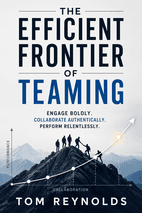
The lines you will find here are not the usual leadership platitudes. They are sharp, honest observations that get at the real tension inside teams: how to push for performance without losing the human element. What makes this book so quotable is its refusal to settle for easy answers. Instead, it offers a framework built on balance, respect, and intentionality. These are the kind of quotes that stick with you long after you put the book down, the kind you want to underline and share with a teammate over coffee.
Top Quotes from The Efficient Frontier of Teaming
“How do we perform at a high level without losing ourselves or each other in the process?”
Janet M. Harvey, CEO of inviteCHANGE, poses the central question that drives decades of work with leaders and teams.
It captures the universal tension between high performance and human well-being, making it a rallying cry for leaders seeking sustainable success.
“Teams are not problems to be solved; they are living systems to be cultivated.”
Janet describes the efficient frontier where human energy and performance reinforce each other.
It reframes teams from mechanical problems to organic systems, inspiring a leadership shift from control to stewardship.
“Engagement without authenticity becomes compliance, and authenticity without engagement becomes drift.”
Janet explains why integration of engagement and authenticity is essential for sustainable performance.
The parallel structure makes it memorable and powerfully illustrates the pitfalls of treating these elements as separate.
“Performance without connection is unsustainable—and that connection without performance is insufficient.”
The authors conclude their rationale for writing the book, summarizing the core tension.
This parallel structure crisply captures the duality of effective teaming, making it easy to remember and quote in any leadership discussion.
“You can’t separate performance from psychology.”
This is the concluding insight of a section contrasting mechanical vs. human team systems.
It distills the book's core thesis into a single, memorable line, challenging leaders to treat team performance as inherently psychological rather than purely operational.
“Diversity isn’t a philosophical ideal. It’s a strategic advantage.”
Author summarizing research evidence on diverse teams.
It reframes diversity from a nice-to-have into a core business imperative, making the argument actionable and compelling.
“A star wants to see themselves rise to the top. A leader wants to see those around them rise to the top.”
Attributed to Simon Sinek, quoted in the 'Case Example: Mark's Transformation' section.
It beautifully captures the shift from self-centered ambition to servant leadership, resonating with anyone striving to build a culture of ownership.
Themes Behind the Quotes
Several interconnected themes run through these quotes. The most central is the idea that high performing teams must balance two forces: authenticity and engagement. One without the other leads to either compliance or drift. Another major theme is that leadership is not a title or a solo act. It is a shared capacity that emerges from trust, safety, and mutual respect across the whole team. Performance and connection are not tradeoffs; they are mutually reinforcing. Finally, the quotes emphasize that the best teams do not happen by accident. They require deliberate cultivation of environment, diversity as a strategic asset, and accountability rooted in respect rather than fear.
Quotes by Chapter
Foreword
“One of the most persistent myths in organizational life is that leaders must choose between caring about people and driving results.”
Janet addresses a common false choice that plagues many leaders.
It exposes a debilitating dichotomy and liberates leaders to embrace both care and results as complementary forces.
Introduction The One Challenge Every Team Faces
“Teams weren't failing for lack of intelligence, talent, or intent. They were failing because they didn't know how to balance two foundational forces: authenticity and engagement.”
The authors explain the common pattern they observed across teams in various industries.
This line reframes failure as a skill gap rather than a talent gap, making it both humbling and actionable for leaders.
“That balance, we came to believe, is the beating heart of effective teaming.”
The authors introduce their central thesis on authenticity and engagement.
The metaphor 'beating heart' gives emotional weight to a conceptual idea, making it memorable and emphasizing that balance is essential, not optional.
“What teams need isn't more structure or slogans. They need leaders who understand how to guide them through the discomfort of growth toward sustainable, high-performance collaboration.”
The authors argue against simplistic solutions in modern workplaces.
This quote challenges conventional wisdom by dismissing both rigid structure and empty motivation, offering a deeper, more human-centered leadership vision.
Chapter 1 The Limits of Legacy Leadership
“The harder I pushed for execution, the more disengaged the team became.”
The author describes his early leadership mistake of doubling down on structure and efficiency.
It captures the counterintuitive truth that overemphasis on execution can undermine engagement, a lesson many leaders learn the hard way.
“What looked like success from the outside often felt hollow within.”
The author reflects on teams that appear successful but lack genuine connection.
This line exposes the gap between external metrics and internal team well-being, challenging superficial definitions of success.
“The gap between what a team is capable of and what it consistently delivers.”
The author introduces the concept of teaming inefficiency.
It succinctly defines a core problem the book addresses, making it memorable and actionable for leaders.
“Your ability to scale as a leader is directly tied to your ability to scale the team’s capacity to lead.”
From the author's reflection on a leader who resisted empowering others.
This line reframes leadership growth as a function of team development, challenging the myth that leaders must do it all themselves.
Chapter 2 The Efficient Frontier of Teaming
“The most effective teams don't eliminate risk; they manage it skillfully through shared purpose, high trust, and distributed leadership.”
This appears in the introduction where the author adapts modern portfolio theory to team dynamics.
It reframes risk from something to be avoided into a resource that can be harnessed through intentional team practices, offering a fresh and empowering perspective.
“Teams that reach the highest point of this frontier do so intentionally. They don’t arrive there by accident, charisma, or hope and wishing alone. And they don’t stay there without discipline.”
This describes the deliberate effort required for teams to achieve optimal performance.
It counters the common myth that great teams just happen, emphasizing that sustained excellence demands continuous intentional work and discipline.
“Ou can't build high- functioning teams without engaging the human levers underneath the surface.”
This insight emerges after a team member's honest confession during a coaching session revealed that process changes alone weren't enough.
It powerfully reminds leaders that technical fixes fail without addressing the emotional and relational foundations, making it a rallying cry for authentic team development.
Chapter 3 One Team, Many Thoughts: Celebrating the Differences of Thought and Experience
“We say we value diverse thought, but we're wired to seek familiarity.”
From the introduction discussing the hidden tension of teamwork.
This line captures the universal cognitive bias that contradicts our stated intentions, making readers reflect on their own behavior.
“We stopped relying on crisis to make us a team.”
Telecom team leader Greg reflecting on the changes after implementing the Three Commitments.
This concise insight highlights the unsustainable reliance on external pressure for team cohesion and the power of intentional practices.
Chapter 4 Seeing Each Other Clearly: Creating Synergy on Your Team
“Teams thrive when every individual feels seen, respected, and understood.”
Opening of the chapter discussing the foundation of high-performing teams.
This line succinctly captures the essential human need for recognition and respect, which is the bedrock of team synergy.
“That is the heart of synergy: psychological safety anchored in mutual awareness.”
After describing the best teams the author has experienced.
It provides a clear, memorable definition of synergy that ties psychological safety to mutual understanding.
“When people understand these patterns, they stop taking differences personally. They see them as assets to harness rather than obstacles to manage.”
After explaining the DISC personality framework.
This insight reframes conflict as opportunity and empowers teams to leverage diversity constructively.
“Teams that outperform are rarely those with the most talent on paper. They are the ones who learn to see each other clearly without judgment and commit to working together as whole, complex human beings.”
Conclusion of the chapter summarizing the path to synergy.
It delivers a powerful counterintuitive message about performance, emphasizing clarity and acceptance over raw talent.
Chapter 5 Cultivating Ownership
“If you want ownership, you can’t demand it. You must create an environment that is safe enough to step up.”
From the section 'The Ownership Mindset', discussing the leader's role in fostering ownership.
It flips the common misconception that ownership can be forced, emphasizing instead the leader's responsibility to build psychological safety, which is both profound and actionable.
“Accountability only works when it's anchored in respect, not fear.”
Appears in the 'Positive Accountability' section, referencing Douglas Smith and Jon Katzenbach's work.
This concise statement reframes accountability from a punitive tool to a respectful partnership, challenging leaders to examine their approach.
“Delegation is transactional. Empowerment is transformational.”
Repeated multiple times in the chapter, notably in the 'Empowerment: Moving Beyond Delegation' section.
The stark contrast between delegation and empowerment is memorable and easily applied, making it a simple yet powerful leadership mantra.
Chapter 6 It’s Not About You: The New Model of Leadership
“At its most impactful, leadership is a dynamic, collective capacity expressed through a team’s relationships, mindsets, and practices.”
From the introduction to the Collective Leadership Model in Chapter 6.
This line redefines leadership as a shared, evolving capability rather than a fixed role, challenging traditional hierarchies. It resonates because it shifts the focus from individual authority to relational dynamics, a core theme of the chapter.
“It is about recognizing that leadership emerges through the quality of interactions and the shared commitment to purpose, not merely through position or authority.”
From the section contrasting collective leadership with hierarchical models.
This succinctly captures the essence of the new model—leadership as a product of connection and purpose rather than title. It inspires teams to look beyond formal roles and cultivate trust through everyday interactions.
“When every team member practices leadership, they take initiative, offer perspective, and hold themselves accountable so that the team becomes more than the sum of its parts.”
From the discussion on moving from individual to collective capacity.
It paints a vivid picture of an empowered team where everyone contributes, making the abstract concept of collective leadership tangible. The phrase 'more than the sum of its parts' is memorable and motivational, emphasizing synergy.