The Efficient Frontier of Teaming — Interactive Mindmaps

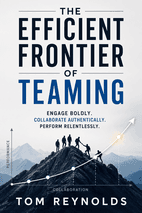
The Efficient Frontier of Teaming by Bryan Powell Book Cover

by Bryan Powell

Bryan Powell's The Efficient Frontier of Teaming provides a systems-oriented framework for leaders to balance authenticity and engagement, transforming good teams into high-performing ones through practical tools like the Team Contract and Bullseye Method. Written for leaders at all levels navigating hybrid work and low engagement.

On Insta.page you also get an Apply This Book tool that lets you combine insights from up to 3 books to solve your specific situation.

Chapter mindmaps

Free preview: chapters 1–4 are fully interactive. Click any node to expand or collapse. Subscribe to unlock the rest.

Chapter 1: Foreword

Key concepts: Foreword

1. Foreword

The Gap Between Competence and Connection

  • Leaders can do everything right yet still face fatigue
  • High performance without losing self or others is key
  • The missing piece is wholeness, not technical fixes
  • Generative work creates conditions for evolution, not optimization

From Doing Better to Being Whole

  • Most leadership focuses on improvement, not being
  • Generative Wholeness™ honors full human presence
  • Beliefs and fears shape the system around leaders
  • Wholeness creates energy that amplifies performance

Teaming as a Critical Capability

  • Complex problems require intentional collaboration
  • Teaming cultivates living systems, not rigid models
  • Efficient frontier balances human energy and performance
  • Generative questions replace blame with ownership

Coaching as Stewardship, Not Expertise

  • Leaders listen for emerging patterns, not fixes
  • Insight is co-created, not delivered from above
  • Self-awareness extends into relational and systemic impact
  • Hold complexity and tension without collapsing into control

Engagement and Authenticity Integration

  • Caring for people and driving results are not tradeoffs
  • Engagement without authenticity becomes compliance
  • Truth-telling and high standards build resilience
  • Pausing before pushing aligns energy for sustainable performance

Chapter 2: Introduction The One Challenge Every Team Faces

Key concepts: Introduction The One Challenge Every Team Faces

2. Introduction The One Challenge Every Team Faces

The Core Challenge: Balancing Authenticity and Engagement

  • Teams fail due to imbalance, not lack of talent
  • Authenticity means trust, safety, and belonging
  • Engagement means accountability, ownership, and results
  • Optimal performance requires both forces maximized together

The Efficient Frontier of Teaming Model

  • Inspired by investment concept of balancing risk and reward
  • Over-index on accountability creates rigid, fear-driven cultures
  • Over-index on authenticity risks permissiveness and conflict avoidance
  • Sweet spot is where both forces are maximized

Why This Problem Is Urgent Now

  • Hybrid work has frayed team connection
  • Burnout has sapped motivation and energy
  • Diverse, dispersed teams need intentional leadership
  • Old command-and-control approaches no longer work

What the Book Delivers: Practical Roadmap

  • Real coaching conversations and diagnostic tools
  • Maturity model: Dependent, Collaborative, Aligned, Empowered
  • Bullseye Method for goal setting and frameworks
  • Goal: help teams find and stay on their efficient frontier

How the Journey Unfolds Through the Book

  • Opens with diagnostic look at dysfunctional teams
  • Maps spectrum of team development stages
  • Covers essential ingredients like trust, purpose, and feedback
  • Ends with implementation tools like team contracts and KPIs

Chapter 3: Chapter 1 The Limits of Legacy Leadership

Key concepts: Chapter 1 The Limits of Legacy Leadership

3. Chapter 1 The Limits of Legacy Leadership

The Teaming Inefficiency Problem

  • Good people operate below potential without dysfunction
  • Tasks completed but ideas withheld and tensions unspoken
  • Collaboration is negotiation, not co-creation
  • Gap between capability and consistent delivery is core issue

Optimal vs. High Performance

  • High performance is outcome-driven and unsustainable
  • Optimal performance is process-driven and adaptable
  • Efficient frontier balances trust, authenticity, and engagement
  • Focus on working effectively with current resources

Drivers: Engagement and Authenticity

  • Sustained engagement and interpersonal authenticity are key axes
  • Psychological safety enables speaking openly and admitting mistakes
  • Authenticity without engagement lacks execution
  • Both high creates exponential performance

Leadership Shift: Context and Calibration

  • Move from command-and-control to context-and-calibration
  • Leader becomes gardener, designing environment and clearing obstacles
  • Empowerment scales leadership capacity, not loss of control
  • Teams are living systems needing energy, feedback, and rest

Team Maturity and Conflict Capability

  • Four levels: Dependent, Collaborative, Aligned, Empowered
  • Great teams are conflict-capable, not conflict-free
  • Psychological safety built before crisis enables adaptation
  • Collective accountability emerges from high engagement and authenticity

Chapter 4: Chapter 2 The Efficient Frontier of Teaming

Key concepts: Chapter 2 The Efficient Frontier of Teaming

4. Chapter 2 The Efficient Frontier of Teaming

The Teaming Inefficiency Gap

  • Most teams aren't broken, just underdeveloped
  • Gap between current output and actual capability
  • Driven by underutilized insight and hidden tension
  • High performers speak truth faster and build micro-trust

Two Critical Levers: Engagement & Authenticity

  • Engagement: focused energy, effort, emotional commitment
  • Authenticity: safety to express truth and vulnerability
  • Teams often optimize one without the other
  • Both high produce innovation and resilience

Four Team Types on the Frontier

  • Dependent: low engagement, low authenticity, authority-driven
  • Collaborative: high authenticity, low engagement, supportive but inconsistent
  • Aligned: high engagement, low authenticity, goal-driven but brittle
  • Empowered: high both, challenge without diminishing

Four Core Conditions for Team Development

  • Direction and Leadership: clarity and decision-making
  • Trust and Authenticity: psychological safety and truth-telling
  • Alignment and Accountability: roles, expectations, follow-through
  • Ownership and Adaptability: responsibility and learning

Diagnostic Tool and Scoring

  • 48 questions, twelve per condition, scale 1-5
  • Scores range 12-60 per condition
  • Real insight from pattern across all four conditions
  • Teams stall from imbalance, not lack of talent

Authenticity and Engagement Forces

  • Authenticity = Trust + Ownership
  • Engagement = Direction + Alignment
  • High performance requires both forces in balance
  • Growth comes from precision, not pressure

Reaching the Efficient Frontier

  • Structure must support trust and mutual accountability
  • Leadership must evolve from control to cultivation
  • Identify which condition carries and which limits
  • Prioritize one or two high-leverage shifts

Continue exploring The Efficient Frontier of Teaming