The Efficient Frontier of Teaming Key Takeaways

by Bryan Powell
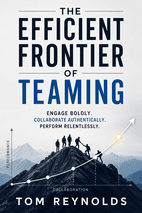
The Efficient Frontier of Teaming by Bryan Powell Book Cover

5 Main Takeaways from The Efficient Frontier of Teaming

Balance authenticity and engagement for peak team performance

The book's central insight is that teams thrive only when they simultaneously cultivate trust, safety, and belonging (authenticity) and accountability, ownership, and results (engagement). Pushing too hard on either side creates dysfunction—either comfort without progress or pressure without connection. Leaders must use the Efficient Frontier model to diagnose where their team is out of balance and make precise adjustments.

Teams are living systems, not machines to be optimized

Bryan Powell argues that suppressing conflict or imposing rigid processes kills long-term adaptability. Instead, leaders should embrace friction as data and create conditions for self-organization. The Generative Operating System (GOS) starts with self-awareness and relational awareness before any systemic change, treating the team as a dynamic ecosystem that needs nurturing, not controlling.

Precision beats pressure: find constraints, not force fixes

Rather than demanding more effort or layering on new initiatives, high-performing leaders identify where the team system is compensating or constrained. Using the four conditions (Direction, Trust, Alignment, Ownership) and the diagnostic tool, leaders can pinpoint exactly which lever to pull—reducing the need for sweeping change and increasing the likelihood of sustainable improvement.

Transformation starts with leader vulnerability and self-awareness

Every chapter reinforces that leaders must model the behaviors they want to see—sharing their own strengths and growth areas, admitting mistakes, and owning their past. This vulnerability sets the tone for psychological safety and empowers others to do the same. The book provides practical tools like the Coaching Update Form and quarterly retrospectives to embed this into daily practice.

Build teaming habits through rituals, not one-time events

Sustainable high performance comes from consistent, small practices—gratitude huddles, team contracts that are revisited quarterly, visible goal bullseyes, and structured reflection. These rituals create shared language and accountability, turning abstract values into concrete behaviors. The book emphasizes that culture is maintained by frequency, not intensity, and that perfection is less important than repetition.

Executive Analysis

These five takeaways converge on a single thesis: the most effective teams are those that deliberately and continuously balance the human need for authenticity with the organizational demand for engagement, using a precise, system-aware approach rather than blanket fixes. Powell rejects both the old command-and-control model and the purely feel-good culture movement, instead offering a dynamic framework where leaders act as stewards of living systems—diagnosing constraints, modeling vulnerability, and embedding rituals that make high performance a daily choice rather than a seasonal event.

This book matters because it moves beyond abstract theory into actionable tools—team contracts, measurement flywheels, coaching updates, and the Bullseye Approach—that any leader can apply immediately. It sits at the intersection of organizational psychology, agile leadership, and systemic coaching, filling a gap left by books that focus only on culture or only on metrics. For leaders navigating hybrid work, burnout, and diversity challenges, Powell provides a clear path from dysfunction to sustainable high performance without sacrificing humanity for results or vice versa.

Chapter-by-Chapter Key Takeaways

Foreword (Foreword)

  • The gap between competence and connection: Doing everything right on paper doesn’t guarantee thriving teams; the missing piece is wholeness.

  • Generative work creates conditions, not fixes: It cultivates living systems rather than optimizing machines.

  • The GOS layers start with being, not doing: Self-awareness and relational awareness precede systemic impact.

  • Teaming is a critical capability: No single leader can solve today’s complex problems alone; intentional collaboration is essential.

  • Engagement and authenticity are not a tradeoff: True performance lives in the integration of both.

  • Coaching as stewardship, not expertise: Generative leaders listen for what’s emerging and co-create insight.

  • Transformation begins with awareness: Before strategy or action, noticing what is real holds the key.

Try this: Shift your leadership mindset from fixing problems to cultivating wholeness—start by noticing what is real in your team rather than jumping to solutions.

Introduction The One Challenge Every Team Faces (Introduction)

  • The core challenge every team faces is balancing authenticity (trust, safety, belonging) with engagement (accountability, ownership, results).

  • The Efficient Frontier of Teaming is a practical model for visualizing and reaching the optimal balance between these two forces.

  • Modern workplace conditions—hybrid work, burnout, diversity—make this balance more critical and harder to achieve without intentional leadership.

  • This book provides concrete tools, real-world coaching examples, and a step-by-step framework to help leaders move teams from dysfunction to sustainable high performance.

Try this: Diagnose your team's current balance of authenticity and engagement using a simple self-assessment, then identify one concrete adjustment to move toward the Efficient Frontier.

Chapter 1 The Limits of Legacy Leadership (Chapter 1)

  • Empowerment isn’t loss of control—it’s a strategy for scaling leadership capacity.

  • Teams are living systems; suppressing friction reduces long-term performance.

  • The most effective teams balance high engagement with high authenticity.

  • Change begins with reflection: own your past experiences, share them, and take concrete steps to bring your authentic self and raise collective engagement.

Try this: Replace the urge to control with the intention to empower—share your own past experiences first to model vulnerability and invite others to do the same.

Chapter 2 The Efficient Frontier of Teaming (Chapter 2)

  • Teams stall from imbalance among four core conditions: Direction, Trust, Alignment, and Ownership.

  • These conditions organize into two forces: authenticity (Trust + Ownership) and engagement (Direction + Alignment). High performance emerges when both mature in balance.

  • The diagnostic reveals team type patterns—Dependent, Collaborative, Aligned, or Empowered—each requiring a specific focus for growth.

  • Growth comes from precision, not pressure. Identify where the system is compensating and where it is constrained.

  • Action steps include honest self-assessment, team discussion about authenticity and engagement, and using the diagnostic to prioritize one or two high-leverage shifts.

Try this: Apply the Efficient Frontier diagnostic with your team to identify which of the four conditions (Direction, Trust, Alignment, Ownership) is most constrained, then make one precise change instead of pushing harder.

Chapter 3 One Team, Many Thoughts: Celebrating the Differences of Thought and Experience (Chapter 3)

  • Sameness feels safe but kills innovation and adaptability. The first step is to make hidden biases visible through team mapping.

  • The Three Commitments—Know Thyself, Appreciation, Be Curious—must be practiced daily, not just discussed at off-sites.

  • Crisis can temporarily force alignment, but lasting trust requires deliberate structures like team contracts and regular reflection.

  • Effective diversity work goes beyond demographics to include diversity of thinking style, experience, and personality.

  • Vulnerability from leaders (sharing strengths and growth areas first) sets the tone for the entire team’s openness and authenticity.

Try this: Map the hidden diversity of thought, experience, and personality on your team using a simple exercise, then commit to three daily practices: Know Thyself, Appreciation, and Be Curious.

Chapter 4 Seeing Each Other Clearly: Creating Synergy on Your Team (Chapter 4)

  • Start by acknowledging where strengths have been stifled — this builds trust and relevance.

  • Discussion should be a two-step process: first identify the pain, then imagine the cure.

  • Envisioning a strengths-aware future forces the team to define concrete changes in outcomes, not just feelings.

  • The qualitative (trust, engagement) and quantitative (speed, innovation) gains are both real and measurable when people feel seen.

Try this: Start a team discussion by first acknowledging where strengths have been stifled, then co-create a vision of what it looks like when everyone feels seen—focus on concrete outcomes, not just feelings.

Chapter 5 Cultivating Ownership (Chapter 5)

  • Replace punitive accountability with supportive curiosity: “How can we help you?”

  • Positive accountability requires three steps: mindset, co-created standards, and quarterly reviews.

  • Delegation is transactional; empowerment is transformational. Give people authority, not just tasks.

  • Foster the five characteristics of empowerment: competence, self-organization, effectiveness, meaningful contribution, and trust.

  • Ownership leads to deeper connection, better decision making, and more innovation.

  • Regularly ask yourself: Am I inviting ownership or demanding compliance?

Try this: Replace punitive accountability with supportive curiosity by asking 'How can we help you?' and give team members authority, not just tasks—regularly check if you're inviting ownership or demanding compliance.

Chapter 6 It’s Not About You: The New Model of Leadership (Chapter 6)

  • Appreciation must be structured and regular, not spontaneous; small practices like gratitude huddles build trust and reduce turnover.

  • Adaptability thrives when teams use decision-making thresholds and embrace imperfect experiments rather than waiting for certainty.

  • Ownership shifts from individual accountability to shared responsibility through practices like collective retrospectives.

  • The model is a living system—start with one small practice, let it become a habit, and watch the culture transform.

  • Leadership is about creating conditions for others to lead, not holding all the answers yourself.

Try this: Institutionalize appreciation with a daily or weekly gratitude huddle, use decision-making thresholds to encourage imperfect experiments, and hold collective retrospectives to shift from individual to shared responsibility.

Chapter 7 The Safe Space: Creating an Environment of Trust and Psychological Safety (Chapter 7)

  • Psychological safety isn’t built in a day; it’s cultivated through consistent, repeated practice.

  • The most powerful shifts happen when teams learn to disagree without disconnecting and choose curiosity over judgment.

  • Every tool in this chapter is an invitation, not a fix—showing up differently is a choice you keep making.

  • Trust and safety must eventually connect to accountability for the culture to sustain and evolve.

  • Honest reflection on current signals, rewards, and personal modeling of safety is the starting point for real change.

Try this: Cultivate psychological safety by practicing disagreement without disconnection—choose curiosity over judgment daily, and regularly reflect on what signals you're sending about safety.

Chapter 8 The Case for Purpose (Chapter 8)

  • Embed purpose into performance reviews, hiring, resource allocation, and recognition programs.

  • Leaders must model purpose consistently; contradictions breed cynicism.

  • Quarterly purpose retrospectives and story-spotlighting prevent drift and spark growth.

  • Sustain purpose through onboarding, decision filters, adaptation, and celebration.

  • Avoid purpose fatigue, overreliance on executives, and incentive misalignment.

  • Action steps: define your top five values, craft a mission and vision, and build strategies to support your team’s success.

Try this: Embed purpose into performance reviews, hiring, and recognition; run quarterly purpose retrospectives and avoid contradictions between stated values and your own behavior.

Chapter 9 Measuring the Right Things (Chapter 9)

  • Redesign meetings that feel useless instead of canceling them—shorter, tighter, outcome-focused

  • The measurement flywheel: Clarity → Aligned Metrics → Visible Scoreboards → Behavioral Adjustment

  • When the flywheel breaks, don't add more—diagnose the broken link and rebuild

  • Integration steps (Rocks, Time, Calendar, Scoreboard, Reflection) embed measurement into culture

  • The goal is not more dashboards but better conversations about the numbers that matter

Try this: Redesign a meeting that feels useless by making it shorter and outcome-focused, then build a measurement flywheel starting with clarity—diagnose the broken link if metrics don't drive better behavior.

Chapter 10 Defining How We Work Together (Chapter 10)

  • A team contract defines how the team behaves, separate from mission (purpose) and vision (destination).

  • Co-creation is non-negotiable: the team must build it together to own it.

  • Focus on concrete behaviors, not vague values—specificity builds accountability.

  • Keep the contract alive through repetition, visual cues, quarterly health checks, and onboarding rituals.

  • When the contract breaks, prioritize repair over rewriting; normalize drift and address it with curiosity, not shame.

  • Leaders modeling vulnerability and adherence set the tone for the entire team.

  • Great teams don't happen by chance—they happen by choice, and the team contract is that choice made visible.

Try this: Co-create a team contract with concrete behaviors (not vague values), keep it alive through visual cues and quarterly health checks, and when it breaks, repair with curiosity not shame.

Chapter 11 Igniting Potential: Building a Culture of Coaching (Chapter 11)

  • Shift accountability to team members using tools like the Coaching Update Form to make sessions productive and owned.

  • Build sustainability through ritualization, measurement, leader modeling, and peer networks—not one-off training.

  • Normalize imperfection—consistency matters more than perfection, and vulnerability builds trust.

  • Own your development as a team member by being proactive, creating a road map, and communicating progress consistently.

  • Reflect quarterly on where you’re embedding coaching, receiving feedback, and holding space for growth.

  • Remember: Coaching cultures multiply trust and unlock human potential—they are co-created, not imposed.

Try this: Use a Coaching Update Form to shift accountability to team members, ritualize coaching through regular check-ins, and normalize imperfection—consistency matters more than perfection.

Chapter 12 The Bullseye Approach (Chapter 12)

  • The bullseye creates a shared developmental identity, not just a task list.

  • Publicly displaying goals builds team pride and cross-departmental momentum.

  • “Adopt, Adapt, Abandon” turns each goal into a low-friction learning experiment.

  • The method shifts development from HR-driven events to a leader-led, continuous rhythm.

  • Getting stuck is data, not failure—it reveals the real underlying challenges.

  • Mastery is accessible to anyone willing to reflect, experiment, and evolve together.

Try this: Display the team's developmental goals publicly using a Bullseye chart, treat each goal as a learning experiment with 'Adopt, Adapt, Abandon,' and see getting stuck as valuable data, not failure.

Chapter 13 There Is No Finish Line (Chapter 13)

  • The Efficient Frontier is a continuous pursuit, not a final destination.

  • Leading requires shifting from control to facilitation through curiosity, collaboration, appreciation, adaptability, and ownership.

  • Culture is sustained by consistent rituals and shared language, not by volume or edicts.

  • Transformational leaders listen more, build trust first, and make leadership a daily discipline.

  • Sustainable success depends on psychological safety, clear goals, and coaching as a core leadership tool.

Try this: Commit to making leadership a daily discipline of curiosity, collaboration, and facilitation—sustain culture through consistent rituals and shared language, knowing there is no finish line.

Continue Exploring