The Daily Laws — Interactive Mindmaps

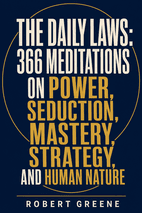
The Daily Laws by Robert Greene Book Cover

by Robert Greene

Buy on Amazon

As an Amazon Associate, we earn from qualifying purchases.

Robert Greene's The Daily Laws organizes a year of short daily readings into 19 thematic parts, moving from self-discovery to confronting mortality. Drawing on twenty-five years of research, it offers ambitious readers practical wisdom on power, mastery, strategy, and human nature through historical figures and anecdotes.

On Insta.page you also get an Apply This Book tool that lets you combine insights from up to 3 books to solve your specific situation.

Chapter mindmaps

Free preview: chapters 1–4 are fully interactive. Click any node to expand or collapse. Subscribe to unlock the rest.

Chapter 1: Part 1 - Chapters 1 to 13

Key concepts: Part 1 - Chapters 1 to 13

Part 1 - Chapters 1 to 13

The Reality Problem

  • Inherited false beliefs about work, success, and conflict drive unnoticed self-sabotage
  • Ancient survival instincts misfire on subtle modern social dangers
  • Become a radical realist: test beliefs against lived experience

The Year's Arc

  • First quarter: silence outside voices and discover your Life's Task
  • Second quarter: read workplace politics and outwit manipulators
  • Third quarter: persuade by entering others' minds and self-interest
  • Final quarter: study motivations, including your own, through mortality

January: The Life's Task

  • Uniqueness shows early as gut-level pulls, like Curie's fascination with instruments
  • Loyalty belongs to the Life's Task, not to any company
  • Hyperintention: desperate effort pushes goals away; relax and focus on craft

Anomalies as Openings

  • Peculiar interests mark outliers and reveal hidden niches
  • Ramachandran's appetite for oddity led to phantom-limb discoveries
  • Strangeness is a source of power, not a defect to sand off

Models of Mastery

  • Coltrane and Graham found wordless callings and reinvented their forms
  • Mastery requires love bordering on religious devotion plus years of practice
  • Greene kept his book's odd structure despite pressure to conform

Chapter 2: Part 2 - Chapters 14 to 34

Key concepts: Part 2 - Chapters 14 to 34

Part 2 - Chapters 14 to 34

Limits as a Source of Calling

  • Limitations met head-on can provoke creative responses.
  • Ignore weaknesses; drill small strengths until confidence spreads.
  • Natural gifts can be a curse; the gifted rarely learn diligence.

Avoiding the False Path and Confronting the Shadow

  • Careers chosen for money, fame, or approval lead to decay.
  • Notice errors early and rebel against external pressures.
  • Integrate the shadow: assert yourself, care less about opinions, offend unjust critics.

Purpose, Goals, and Mastery

  • A calling provides direction once given by religion; all callings are equal.
  • Build a ladder of descending goals from long-term vision to daily microgoals.
  • Mastery is not linear: enter a field, adjust toward attractive side routes, recognize niche by childlike excitement.

Trusting the Learning Process

  • Manage boredom, impatience, fear, and confusion to keep observation alive.
  • Persistence builds fluency and reveals hidden connections.
  • Years of fidelity lead to internalized mastery and the ability to break rules.

Discovering a Life's Task

  • The Life's Task requires continual introspection and effort.
  • Experiment with skills and options that fit your personality.
  • Knowing your uniqueness helps avoid other pitfalls.

The Ideal Apprenticeship

  • Masters undergo a 5-10 year self-directed chrysalis phase.
  • Treat apprenticeship as a voyage of youth and adventure.
  • Seek challenges beyond comfort zone; difficulty measures progress.

Language Immersion as a Model for Skill Acquisition

  • Classroom study without stakes yields little; real-world need drives rapid fluency.
  • Daily intense interaction, avoiding native language, accelerates learning more than years of study.
  • Embrace mistakes and ridicule; self-mockery earns respect and builds confidence.
  • One month of immersive practice can surpass years of formal education.

Chapter 3: Part 3 - Chapters 35 to 57

Key concepts: Part 3 - Chapters 35 to 57

Part 3 - Chapters 35 to 57

Apprenticeship as Transformation

  • Choose placement by learning potential, not salary or title.
  • Low or no pay is tuition for training and living on less.
  • Apprenticeship transforms mind and character toward mastery.

Learning by Submitting

  • Absorb field's inherited rules before attempting to rewrite them.
  • Acquire portable skills through doing, repetition, and feedback.
  • Sustained practice (~10,000 hours) produces qualitative brain change.

Mentors and Resistance

  • Earn mentor's attention by supplying help they actually need.
  • Practice weakest elements first; become your own harshest critic.
  • Double concentration and set standards above others'.

Time and Life's Task

  • Protect hours for the Life's Task by clearing commitments.
  • Avoid skipping steps or relying on talent or technology.
  • Focused attention, not distracted scanning, reverses powers.

Dependence, Purpose, and Knowledge

  • Make others depend on your usefulness to avoid being discarded.
  • Surround yourself with people whose skills fill what you lack.
  • Study at double or triple intensity to gain coup d'oeil.

Chapter 4: Part 4 - Chapters 58 to 76

Key concepts: Part 4 - Chapters 58 to 76

Part 4 - Chapters 58 to 76

Surpassing the Mentor

  • Adapt mentor's ideas into your own voice, not copy them.
  • Glenn Gould subtly changed Guerrero's musical ideas over time.
  • Leonardo and Louis XIV asserted distinct styles while apprenticing.
  • Breaking away too soon risks losing essential knowledge.

Self-Directed Apprenticeship

  • No one hands you direction; actively seek broader knowledge.
  • Read beyond requirements, mingle widely, add outside schooling.
  • Build skills around deep interests via trial and error.
  • Avoid committing early to one narrow career path.

The Creative Mind

  • Mastery means internalizing a subject until it lives in you.
  • Craftsman's mindset keeps work central, not money or fame.
  • Complacency kills creativity; stay curious and flexible.
  • Creative process: dream freely, build wide knowledge, resist comfort, slow down.

Patience and the Long Apprenticeship

  • Impatience leads to weak basics and derivative work.
  • Audiences sense missing rigor and lose interest.
  • Ten years absorbing, testing, mastering yields a unique voice.
  • Love learning for its own sake, not for quick recognition.

Knowledge, Focus, and Failure

  • Exceptional creators have practiced expertise and lifelong motivation.
  • Hold theories loosely; even best ideas will look naive later.
  • Intense focus like Proust's turns experiences into material.
  • Failures and malfunctions reveal flaws only execution exposes.
You've reached the end of the free mindmaps

Read less, remember more

See every chapter of The Daily Laws as an interactive mindmap — and unlock all 800+ book summaries with audio and AI Q&A.

$0.00 due today · 7 days free, then $89.99/year ($7.49/mo) · Cancel anytime before day 7

plus sales tax where applicable

Continue exploring The Daily Laws