The Curious Mind of Elon Musk Quotes
by Charles Steel
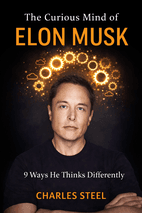
Inside this collection you will find the raw, unfiltered thoughts of a man who thinks bigger than most. These are not polished corporate statements but the kind of lines that jump out at you and stick in your head long after you put the book down. Charles Steel has captured Elon Musk at his most candid, where curiosity drives everything and the stakes feel cosmic.
The book earns its quotability because it blends personal vulnerability with grand ambition. You get existential doubts sitting next to calls for interplanetary expansion. The quotes feel alive because they come from real conversations, interviews, and social media posts, not from a script. Whether you agree with him or not, each line makes you stop and think.
Top Quotes from The Curious Mind of Elon Musk
“What is life without purpose? But there is a purpose! It is to expand to the stars and thereby understand the Universe.”
Elon Musk replying on X to a Wall Street Journal article about him.
This quote encapsulates Musk's cosmic sense of purpose and his belief that humanity's goal is to expand to the stars and understand the universe, which is a central theme of his life and work.
“My motivation, if I've got a religion of any kind,” says Musk, “is a religion of curiosity .. . I'm trying to understand the universe or at least set things in motion such that, at some point, civilization understands the universe far better than we do today.”
Elon Musk describes his personal philosophy during an interview.
This line captures Musk's core driving force—curiosity as a quasi-religion—and his grand ambition to expand human understanding, inspiring readers to see exploration as a meaningful pursuit.
“Once you know the right question to ask,” he posted on X, “the answer is often the easy part, as my hero, Douglas Adams, would say.”
Musk shares a lesson from Douglas Adams on social media.
It distills the chapter's central theme—embracing uncertainty by focusing on asking better questions rather than seeking final answers—a mindset that empowers critical thinking.
“You need to feel life. The sensory experience of life. You can't get too caught up in the cold calculus of the cortex. You need to feel it in the limbic system, ask yourself, what does your heart say?”
Elon Musk, describing the need to balance intellect with emotion.
This line resonates because it reveals Musk's human side, urging people to listen to their hearts despite his reputation as a rationalist. It's a memorable call to embrace both logic and feeling.
“Science is discovering the essential truths about what exists in the Universe, engineering is about creating things that never existed.”
Musk borrows this definition from Theodore von Karman to distinguish between science and engineering.
It perfectly captures Musk's belief that engineering is the act of bringing new realities into existence, framing his life's work as a creative and transformative force.
“When you put your blood, sweat, and tears into creating something, building something, it’s like a child.”
Musk said this when speaking about Tesla and SpaceX as though they were his offspring.
This emotional metaphor reveals the deep personal investment Musk has in his companies, making his relentless drive feel more human and relatable.
“Shallow empathy is caring about criminals, but deep empathy is caring about the victims of the criminals.”
Musk, in a 2024 statement, distinguishes between different forms of empathy.
This provocative redefinition challenges conventional empathy, resonating with readers who prioritize consequences over intentions.
Themes Behind the Quotes
A powerful thread running through these quotes is the search for purpose on a cosmic scale. Musk frames human existence as a mission to expand consciousness and explore the universe, turning existential dread into a driving force for progress. This is paired with a relentless emphasis on curiosity and questioning, where the scientific method becomes almost a sacred tool for avoiding dogma and finding better questions to ask.
Another central theme is the tension between cold logic and human feeling. Musk acknowledges the need to engage the limbic system, to feel life deeply, while also making hard, rational choices to protect civilization. Responsibility appears again and again: responsibility to future generations, to truth, and to action over passive empathy. The quotes reveal a mind that balances big picture thinking with gritty, hands on creation.
Quotes by Chapter
Introduction
“In order to be highly motivated, you have to have some philosophical foundation.”
Elon Musk expressing his belief about the need for a philosophical basis to drive motivation.
It reveals his intellectual approach to life, emphasizing that deep curiosity and a personal philosophy are the drivers of his extraordinary drive and ambition.
1. Embrace Uncertainty
“I did have this existential crisis when I was around twelve about what's the meaning of life? Isn't it all pointless? Why not just commit suicide? Why exist?”
Musk reflects on his teenage depression and existential despair.
It reveals the profound vulnerability behind Musk's later achievements, making his story more relatable and demonstrating that even the most successful people grapple with dark questions.
“Bringing anxiety/fear to the conscious mind saps it of limbic emotional strength.”
Musk explains his method for dealing with fear and anxiety.
This practical insight offers a psychological tool for managing overwhelming emotions, resonating with readers who struggle with anxiety and want to confront it rationally.
2. Test & Learn
“America is a nation of explorers. People came here from other parts of the world that chose to give up the known in favor of the unknown.”
Musk's romantic view of the United States, expressed later in life.
It reflects his own immigrant journey and his admiration for risk-taking and the pursuit of the unknown.
“If you don’t want to wallow in your own suffering, you have to look outward toward reality, not inward.”
From the section contrasting Musk's philosophy with irrationalist thinkers.
It offers a practical, outward-focused mindset for overcoming hardship, resonating with readers seeking resilience.
“Fundamental to the Scientific Method,” Musk says, “is that the ‘science’ is always subject to question and never settled! Upon reexamination, we will discover that, in some cases, long-accepted ‘scientific wisdom’ was wrong.”
Musk explaining his view of the scientific method.
It highlights the humility and continuous questioning at the heart of his thinking, encouraging a mindset of relentless improvement.
3. Increase Consciousness
“If the answer is the universe, and we can ask better questions by understanding it better, then to the degree we can expand the scope and scale of consciousness and knowledge, we should do that.”
Musk’s philosophy is described as building upon his reverence for the universe and the scientific method.
This line crystallizes Musk's core mission: expanding consciousness and knowledge as a moral imperative. It resonates because it frames curiosity as an active, purposeful duty.
“The goal is to be useful by taking “the set of actions that maximize the probability that the future will be good for civilization.””
Musk’s framework for moral action is explained in the chapter.
It succinctly captures Musk's utilitarian approach to life and decision-making. Readers find it powerful because it reduces complex ambition to a simple, measurable objective.
“Ultimately, man should not ask what the meaning of life is, but rather he must recognize that it is he who is asked. In a word, each man is questioned by life; and he can only answer to life by answering for his own life; to life he can only respond by being responsible.”
This is a passage from Viktor Frankl's Man's Search for Meaning, which Musk admires.
The inversion of the question of life's meaning into a personal call to responsibility is deeply inspiring. It resonates because it empowers individuals to shape their own purpose through action.
“The lesson I drew from that is you should try to take the set of actions that are likely to prolong civilization, minimize the probability of a dark age and reduce the length of a dark age if there is one.”
Musk describes what he learned from Isaac Asimov's Foundation series.
It reveals Musk's long-term, civilization-scale thinking and his proactive stance against decline. Readers are struck by how he translates science fiction into a personal strategy for saving humanity.
4. Make Stuff
“I would go bonkers. I would have to be on serious drugs . . . I'd be super-duper bored. I like high intensity.”
Musk said this after selling PayPal, explaining why he couldn't retire to a beach.
It underscores his obsessive work ethic and need for constant challenge, making his ambition feel both extreme and authentic.
“Kids are the best. I'm doing my best to encourage more people to become parents and ideally have three or more kids, so humanity can grow.”
Musk said this while discussing population collapse and the importance of reproduction.
This controversial statement highlights Musk's belief that creating life is as vital as creating technology, tying his personal philosophy to demographic sustainability.
5. Use Markets
“Elon starts with a mission and later finds a way to backfill in order to make it work financially. That's what makes him a force of nature.”
Reid Hoffman, PayPal alumnus and LinkedIn founder, said this about Musk before they fell out.
This captures Musk's unique approach of starting with a mission and then figuring out the financials, which sets him apart from typical entrepreneurs.
“He dreams about things, and his dreams have got a foundation . . . It is a dedication to solving the impossible and, every now and then, they will do it.”
Warren Buffett, chairman and CEO of Berkshire Hathaway, remarked on Musk's approach in 2023.
Buffett's acknowledgment of Musk's ability to ground dreams in reality highlights the rare combination of vision and execution.
“The outcome of any given company is the vector sum of the people within it. Improve the alignment of the individual vectors and their amplitude and the outcome will improve accordingly.”
Musk uses this physics analogy to explain his philosophy on company culture and performance.
This quote encapsulates Musk's belief in the importance of aligning and maximizing the contributions of individuals, a core principle of his leadership.
“Generalized self-driving is a hard problem, as it requires solving a large part of real-world Al. Didn't expect it to be so hard, but the difficulty is obvious in retrospect. Nothing has more degrees of freedom than reality.”
Musk reflecting on his underestimation of the difficulty of self-driving technology.
This quote captures Musk's rare admission of humility and the profound complexity of real-world AI, resonating with anyone who has faced unexpected challenges.
6. Explore Space
“I believe it should be curiosity about the Universe—expand humanity to become a multiplanet, then interstellar, species to see what's out there.”
Musk posted this at age fifty-one in the summer of 2022.
It encapsulates Musk's core philosophy that exploration and curiosity drive humanity's purpose, framing space expansion as a literal and inspiring goal.
“I am accumulating resources to help make life multiplanetary & extend the light of consciousness to the stars.”
Musk replied to Bernie Sanders on Twitter in 2021 after being criticized for his wealth.
This line boldly justifies his wealth accumulation as a means to a cosmic end, revealing his deep-seated belief in space colonization as an existential mission.
“If the future does not include being out there among the stars and being a multi- planet species, I find that incredibly depressing.”
Musk said this during a TED Talk in 2017, displaying his emotional connection to space exploration.
It reveals the personal despair Musk feels about a future limited to Earth, making his drive for space feel urgent and deeply human.
“I'm not trying to be anyone's savior . . . I am just trying to think about the future and not be sad.”
Musk said this at the end of the same TED Talk interview, reflecting on his motivations.
This vulnerable confession strips away the superhero image, showing that his grand ambitions stem from a simple desire to avoid despair about the future.
7. Oppose Dogma
“The reason I do the latter, admittedly ineptly at times, is because I think it is necessary to counteract corrosion of civilization.”
Musk, writing in 2024, explains why he engages in politics despite finding it painful.
It reveals Musk's sense of duty and the high stakes he perceives, resonating with readers who feel compelled to speak out against societal decay.
“While a dogma is a belief that cannot be questioned, Musk’s dogma—the scientific method—is that you have to question your beliefs; this is the only thing that cannot be questioned.”
The narrator articulates Musk's core philosophical principle.
This encapsulates Musk's paradoxical worldview, emphasizing relentless questioning as the only absolute, which appeals to those who value intellectual rigor.
“I find it remarkable,” he said, “that sociopolitical views, even among very smart humans, are almost always a function of tribal belongingness, rather than reason.”
Musk comments on the tribal nature of political and social beliefs.
It highlights a universal frustration with groupthink and appeals to anyone who values independent thinking over conformity.