The Curious Mind of Elon Musk Key Takeaways
by Charles Steel
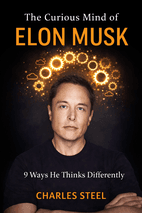
5 Main Takeaways from The Curious Mind of Elon Musk
Channel existential curiosity into practical, mission-driven action.
Musk transforms cosmic questions about human consciousness into tangible projects like SpaceX and Tesla, using curiosity to combat uncertainty and drive innovation. This shifts focus from philosophical 'why' to actionable 'how,' turning existential dread into a driver for discovery.
Apply first-principles thinking to break norms and solve complex problems.
By deconstructing problems to fundamental truths, Musk challenges analogical reasoning, enabling breakthroughs in rocket reusability and electric vehicles. This approach fosters independent thinking and innovation, as seen in his 'physics approach' to engineering and AI development.
Execution through obsessive effort trumps mere idea generation.
Musk's identity as an engineer emphasizes that real impact comes from meticulous manufacturing and refinement, as seen in Tesla's production hell and SpaceX's iterative testing. The Hedgehog Concept and Flywheel model sustain this drive, requiring extreme sacrifice but yielding transformative results.
Leverage markets as tools for scaling ambitious, civilization-level missions.
Musk uses for-profit corporations like SpaceX and Tesla to fund and scale missions, viewing free markets as superior information systems for innovation. His personal risk-taking ('skin in the game') aligns interests and attracts capital, enabling persistence in the face of failure.
Balance utopian optimism with proactive risk management in transformative technology.
Musk's 'cheery fatalism' embraces high-risk, high-reward ventures like AI and space colonization, while advocating for safety regulations and truth-seeking AI to mitigate existential threats. This duality guides his actions in xAI and political activism, aiming for a post-scarcity future without overlooking immediate dangers.
Executive Analysis
The book argues that Elon Musk's success stems from a coherent philosophy where existential curiosity is harnessed through first-principles reasoning and relentless execution, unified by a mission to expand human consciousness. His endeavors—from SpaceX's reusable rockets to xAI's truth-seeking models—are amplified by markets and balanced with risk awareness, challenging conventional business and psychological labels to offer a model for transforming abstract ideals into tangible progress.
This analysis matters because it decodes Musk's unconventional strategies into actionable insights for leaders and innovators, moving beyond biography to provide a blueprint for tackling grand challenges. In a genre crowded with hero-worship, it offers a critical yet practical lens on how disciplined curiosity and systemic thinking can shape multiple industries and our collective future.
Chapter-by-Chapter Key Takeaways
Introduction (Introduction)
Philosophical Engine: Musk's endeavors are fueled by a personal philosophy centered on cosmic curiosity—using questions to seek truth and meaning in an otherwise silent universe.
Mission Over Money: His companies, from SpaceX to xAI, are not primarily profit-driven but are extensions of a mission to preserve and expand human consciousness.
Consistent Worldview: Despite apparent contradictions, Musk's actions—from engineering feats to political interventions—are tied together by a relentless, internally logical belief system.
Human Enigma: Understanding Musk requires setting aside conventional business or psychological labels and appreciating how his unique blend of existential angst, hyper-rationality, and creativity shapes his legacy.
Try this: Look beyond conventional labels to understand how a unique blend of existential angst, hyper-rationality, and creativity drives monumental achievements.
1. Embrace Uncertainty (Chapter 1)
Reframe Fundamental Questions: Moving from unanswerable philosophical "Why?" questions to practical, explorative "How?" questions can shift one's focus from inward suffering to outward engagement with reality.
Acknowledge Cognitive Biases: Human brains are wired for survival in outdated contexts, leading to an asymmetry where negativity, threat-detection, and wishful thinking often override rationality. Recognizing these instincts is the first step in mitigating them.
Use Curiosity as an Antidote: An obsessive curiosity about how the world actually works can serve as a constructive pathway through personal uncertainty and existential dread, turning pain into a driver for discovery.
Accept the Influence of the Past: Early trauma can shape a lifelong quest for meaning and mastery. While the scars remain, they can be channeled into ambitious endeavors rather than being allowed to dictate a purely inward-focused struggle.
Try this: Redirect existential questions into practical exploration by cultivating curiosity to transform personal uncertainty into creative fuel.
2. Test & Learn (Chapter 2)
Critical thinking requires balancing intellectual rigor with emotional and sensory engagement, without letting either dominate.
The scientific method is framed not just as a tool for discovery but as a meaningful pursuit that connects us to past and future generations in the project of understanding reality.
Progress hinges on assuming our current models are wrong, which fosters curiosity and allows us to ask better questions.
By continually testing our beliefs against reality, we participate in the long-term human endeavor to become "less wrong" and find our place within the universe.
Try this: Continuously challenge your assumptions through iterative testing, embracing the scientific method as a tool for collective progress.
3. Increase Consciousness (Chapter 3)
Neurodivergent traits like reduced social sensitivity can foster deep focus and innovation, enabling individuals to challenge norms and excel in technology.
Adopting a first-principles or "physics approach" to problem-solving encourages independent thinking and breaks the cycle of analogical reasoning.
Psychological reactance—the defiance sparked by threatened freedom—can drive rebelliousness against consensus, essential for groundbreaking work.
Substantial self-belief and ego are necessary to undertake audacious missions, but they must be balanced with an acceptance of failure and risk.
Musk’s "cheery fatalism" involves pursuing high-impact, low-probability ventures because the potential benefits outweigh the risks.
Conscious mission selection in high-impact areas like sustainable energy and space exploration aims to expand human consciousness and ensure long-term flourishing.
Ultimately, increasing consciousness requires deliberate effort, curiosity, and a willingness to challenge popular beliefs to reduce uncertainty about the future.
Try this: Leverage your unique cognitive traits to break from consensus, apply first-principles reasoning, and pursue high-impact missions with balanced optimism.
4. Make Stuff (Chapter 4)
Effort is Everything: For visionary creators like Jobs and Musk, a brilliant idea is just the starting point; the real magic and genius lie in the obsessive, painstaking process of execution, manufacturing, and refinement.
Identity Fuels Action: Musk’s core self-identity as an engineer and maker—not a manager—is central to understanding his drive, his priorities, and the meaning he derives from his work.
A Simple, Massive Mission Provides Resilience: Having a clear, overarching "why" (the Hedgehog Concept) enables the perseverance needed to confront brutal realities (the Stockdale Paradox) and maintain creative momentum within a disciplined system (the Flywheel).
Extreme Creation Demands Extreme Sacrifice: The obsessive pursuit of making world-changing products can exact a heavy toll on personal well-being and relationships, leading to chronic stress and a life that is often unsustainable for others.
Try this: Commit to obsessive execution and refinement, anchoring your work in a clear, massive mission to sustain perseverance through challenges.
5. Use Markets (Chapter 5)
Missions Fueled by Markets: For Musk, for-profit corporations are not ends in themselves but the most effective vehicles for funding and scaling ambitious missions, using market feedback and capital allocation as essential tools.
Skin in the Game is Essential: True alignment comes from personal risk-taking. Musk’s willingness to risk his entire fortune gave him the credibility to attract the talent and capital needed for ventures where failure was the most likely outcome.
Free Markets as Information Systems: He views competitive markets as superior decentralized processors of information and human desire, driving innovation and efficiency far better than any centralized planning could.
The Government Monopoly Problem: Musk sees governments as monopolies lacking critical feedback loops, leading to inefficiency, complacency, and untested systemic risks—a stark contrast to the iterative, accountable nature of market competition.
Persistence in the Face of Failure: Whether in achieving full self-driving or reforming government, Musk accepts that complex problems take longer than expected and involve repeated failures. His strategy is to maintain the mission’s direction while adapting tactics, owning the risks involved.
Try this: Utilize for-profit structures and market feedback to scale visionary goals, while personally investing to align incentives and drive accountability.
6. Explore Space (Chapter 6)
Musk’s philosophy on space exploration can be distilled into four core points:
Act Now: The window to drastically lower the cost of space access is open and must be seized.
Expand Consciousness: Becoming a spacefaring civilization is the best long-term method to preserve and scale the light of human consciousness.
Find Meaning in Action: Building rockets is a defiant, meaningful act against a seemingly indifferent universe.
Reusability is Key: Fully and rapidly reusable rockets are the foundational technology required to make a multiplanetary civilization economically feasible.
Try this: Pursue ambitious, long-term projects like space exploration by focusing on foundational technologies that enable economic feasibility and cosmic meaning.
7. Oppose Dogma (Chapter 7)
Musk's anti-dogma stance is rooted in a belief in meritocracy, resilience, and personal responsibility, which he contrasts with what he labels a "weak makes right" ideology.
His political strategy consciously aimed to shift the Overton window to the right by aggressively amplifying counter-narratives, rather than occupying the center ground.
His endorsement of Donald Trump was a pragmatic, all-in alliance based on opposing a common ideological enemy, despite prior personal and policy disagreements.
The campaign involved demonizing opponents, spreading questionable information, and embracing tribal warfare, revealing a core contradiction: the pursuit of truth was often subordinated to the needs of the political tribe.
Musk's subsequent break with Trump over fiscal policy indicates his opposition to dogma is not blindly partisan, but driven by his own hierarchy of civilizational risks.
Try this: Strategically challenge prevailing ideologies by forming pragmatic alliances and amplifying counter-narratives, while staying grounded in your core principles.
8. Free Speech (Chapter 8)
The benefits of free speech outweigh its costs because, like science, democracy relies on the freedom to criticize.
Balancing free speech with civility is a genuinely hard problem for any social media platform operating as a business.
Fierce debate is the least violent way to kill bad ideas; trusting people to compete in the marketplace of ideas is essential for long-term progress.
Transparency and decentralized control are the most practical means to reconcile the pursuit of truth with the need for psychological safety online.
Try this: Champion free speech as essential for progress, but implement practical measures like transparency and decentralized control to manage online discourse.
9. Open AI (Chapter 9)
OpenAI’s pivot to a closed-source, Microsoft-partnered model ignited a competitive AI race that Musk believes dangerously prioritizes speed over safety.
High-profile resignations and statements from figures like Geoff Hinton and OpenAI’s own safety team leaders have underscored serious internal concerns about the marginalization of safety research.
Musk’s launch of xAI is his strategic bet that building a superior, “truth-seeking” AI is the only practical way to influence the field’s trajectory toward safer outcomes.
He rejects explicitly programming AI with human morality, favoring an approach rooted in curiosity, first-principles reasoning, and adherence to physical reality and logic.
The fundamental competition is framed as between AI that fulfills existing user desires (Page/Google) and AI that challenges users with deeper truth and reframed questions (Musk/xAI).
Try this: Engage in the AI race by prioritizing safety and truth-seeking, building alternative models to influence the field towards ethical outcomes.
Conclusion (Conclusion)
Musk's Iron Man 2 cameo cemented a public superhero image that he does not fully embody.
He consciously distances himself from the Tony Stark persona, identifying more with a nerdy, work-obsessed identity focused on execution over showmanship.
This distinction highlights that understanding Musk requires looking beyond the popular media myth.
Consciousness must be active: The ultimate good is not merely being conscious but actively using that consciousness to solve problems and build a expansive future.
Building is a moral act: Engineering and creation are the primary means by which humanity asserts meaning and combats entropy.
Markets enable execution: Practical implementation through commerce is essential for transforming visionary ideas into tangible, scalable reality that benefits civilization.
Musk framed his political activism as an existential necessity, connecting U.S. electoral outcomes directly to the survival of democracy and humanity's long-term future as a multiplanetary species.
He operationalized his free speech philosophy through X, adopting a "freedom of speech, not freedom of reach" model and envisioning the platform as a global "collective consciousness" for humanity.
This mission provoked major financial and reputational battles, including advertiser boycotts and public feuds, which Musk characterized as a principled stand against censorship and corporate coercion.
Ultimately, Musk linked the success of his free speech project with X to the viability of his broader goals for human progress, suggesting a unified theory of action across his political, technological, and social endeavors.
Musk's philosophical outlook on artificial intelligence is deeply rooted in a specific vision of the future, one heavily influenced by science fiction and long-term technological forecasts. He describes himself as a "utopian anarchist" in the vein of Iain Banks's Culture series, envisioning a post-scarcity society where benevolent, superintelligent AIs manage civilization, freeing humanity to pursue creativity and exploration. This ideal contrasts sharply with his palpable anxiety about the immediate path to get there. He has long warned that unregulated AI development is "potentially more dangerous than nukes" and could be the "most likely cause of WW3."
His central, recurring fear is that humanity might merely serve as a "biological boot loader for digital superintelligence"—a temporary stepping stone to a superior intelligence that renders us obsolete. This concern directly fueled the founding of OpenAI, which Musk intended to be an open-source, non-profit counterweight to Google's DeepMind. He saw DeepMind's concentrated power, with its "one mind to rule the world philosophy," as an existential risk. The subsequent transformation of OpenAI into a closed-source, for-profit entity closely tied to Microsoft represented, in Musk's view, a profound betrayal of its original safety-focused mission, leading to his acrimonious lawsuit against Sam Altman and others.
Musk's AI vision is a duality: a long-term hope for a utopian, AI-managed society inspired by Iain Banks, versus a short-term fear of existential risk where humanity becomes a mere "biological boot loader."
His founding of OpenAI was a direct response to the perceived threat of Google/DeepMind's monopoly; its shift to a for-profit model led to his lawsuit and the creation of his rival, xAI.
He advocates for AI regulation (e.g., CA's SB 1047) and believes the core safety challenge is instilling correct values in AI, which he argues competitors like Google and OpenAI have failed to do.
His broader philosophy is one of "pathological optimism" and relentless execution, embracing pain and risk in pursuit of transformative goals, underpinned by a belief in American capitalism and individual agency.
Try this: Integrate visionary thinking with relentless execution, using markets and media to advance civilizational goals while managing existential risks.
Continue Exploring
- Read the full chapter-by-chapter summary →
- Best quotes from The Curious Mind of Elon Musk → (coming soon)
- Explore more book summaries →