The Court of Venus Themes
by Bel Banta
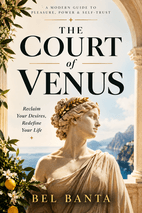
Under the plot, The Court of Venus is really about power as a web of spies, lies, and magic, where people are pieces and queens are made or destroyed by succession. It keeps circling memory and grief, since dead friends, tutors, and queens haunt loyalties and suspicions, while identity stays fluid through changed bodies, names, and disguises.
On this page you'll find those themes traced through concrete moments: Roland managing King Richard, Bianca's suspicions about Hal and Prospero, disputed proof and forged invitations, executions and the need for an heir, and magic as control, healing, spying, and emotional drain. Recurring symbols include the forged letter, the knife, animal transformations like the mouse and white cat, and the abandoned gallery with missing portraits.
Major Themes in The Court of Venus
Power, court politics, and manipulation
The court is shown as a web of spies, lies, and magical influence, where rulers and courtiers use people as pieces. Roland manages King Richard through deception and magic, while Guildfords and Fulke Roet scheme for succession and control.
- Roland sits on the king's throne, announces the king is ill, and the court bows.
- Roland says he tells the king when to wake and when to eat, lies that courtiers desire him, and moves people 'a little to the right, up toward center.'
- Ambrose says 'Court is a web... Spiders who weave and flies who are caught.'
- Charles Guildford proposes putting another Guildford girl before the king if Cecily fails, and the Guildfords dismiss Ambrose's murder as necessary.
- Fulke Roet is the king's nephew and potential heir who keeps spies, parades mistresses, and bides his time waiting for King Richard to die.
Memory, grief, and the haunting past
Dead friends, tutors, and queens haunt the present and shape the characters' loyalties and suspicions. The narrative repeatedly returns to memories of childhood, Hal's death, and the executions that emptied the court.
- Bianca remembers Roland, Hal, and Prospero as children; Hal's old chambers are now redecorated with Roland's initials and carmine velvet.
- Roland shares his memory of receiving Prospero's note about Hal's death and repairing the road beneath Hal's coffin.
- Bianca tracks the stag to the glade where Hal died and nudges its fear so it escapes Roland's crossbow.
- In an abandoned gallery, Bess remembers Gertrude, Alice Seton, and Eleanor Guildford from missing portraits and thinks 'So much death.'
- Roland says, 'I wish we could go back,' and Mouse, in her old rooms, sees Hal's ghost in every detail and thinks of the three of them falling asleep in each other's arms.
Identity, disguise, and transformation
Characters repeatedly change bodies, names, and appearances, using magic to spy, hide, and survive. Identity is fluid and strategic, but disguises can also be seen through or become a trap.
- Mouse remembers posing as Oswyn in the stables, then later shifts into Bess's body and practices walking with her shorter legs.
- The narrator shapeshifts into Joan, shrinking her breasts, lengthening her nose, and practicing Joan's hopeful expression in the mirror until it is believable.
- Roland recognizes Bess despite her disguise, says she almost fooled him, and pulls her into the hall.
- Bess concealed her Moonborn gifts as a small rebellion against Gregory and his wife.
- Roland says he is trying to hold the king's face in place and maintain the mask.
Death, succession, and the cost of queenship
The court is defined by executions, mysterious deaths, and the urgent need for an heir. Queens and heirs are made and destroyed as political necessities, and the dead accumulate around the throne.
- Roland recounts Hal's death, Gertrude's execution, Eleanor's marriage and execution, and Prospero's death, saying he begged the king to spare Prospero and Eleanor.
- King Richard executed Gertrude, Prospero, and Eleanor; he is near death and paranoid.
- Eleanor Guildford married King Richard after Gertrude and lasted a single year on the throne; she was killed hours after Prospero was executed.
- Cecily Guildford is the new queen and fox, and Bess reflects on the deaths that have emptied the court.
- Charles Guildford proposes putting another Guildford girl before the king if Cecily fails to bear the king's child.
Magic, illusion, and power
Magic is a tool of control, healing, masking, spying, and emotional manipulation, but it also drains and exposes its users. Different magical natures—Moonborn, Marsborn, Mercury, Sunborn, Planetborn—shape court politics.
- Roland admits the magic on the king drains him, masks the king's decay, and may last days or weeks.
- Bianca enters Roland's memory as proof and experiences his grief over Hal's death and funeral.
- During tutoring, the narrator manipulates Prospero's emotions, making him laugh and sob until he ends the lesson.
- Jasper secretly raises the wine level in Cosmo's goblet.
- The Marsborn woman says she could set Cecily back on the king and rip through Roland's bond with her.
Suspicion, proof, and betrayed trust
Bianca is driven by suspicion over Hal's and Prospero's deaths, while Roland demands proof of a Guildford plot. Forged invitations, hidden spies, and conditional bargains make trust nearly impossible.
- Bianca presses a knife to Roland's throat and accuses him over Prospero's death; Roland says the king sent Prospero to the Tomb, not him.
- Roland denies writing Bianca's letter, says Prospero spoke her name before his neck hit the block, and Bianca says she burned the letter.
- Bianca confronts Roland about Hal's death and still suspects the Guildfords; Roland says he wants proof of a Guildford plot.
- Roland warns Bess that her maid is a Guildford spy and that Cecily will hear if Bess takes someone to bed.
- Roland proposes Bianca impersonate Joan Rockford at the masque to spy on the Guildfords.
Symbols and Motifs
The forged letter
Represents Bianca's desire to be wanted, Roland's manipulative reach, and the impossibility of trusting court invitations. Its burning shows her attempt to destroy the hold it has on her.
- Bianca receives a letter in the night, recognizes Roland's handwriting, burns the paper, and packs to leave.
- Roland denies writing Bianca's letter.
- Roland accuses her of trusting a forged invitation, and she admits she wanted to believe he invited her.
The knife
Represents threat, mistrust, and the fragile line between protection and violence in the court. It passes between Bianca and Roland as both weapon and warning.
- Bianca presses a knife to Roland's throat and accuses him over Prospero's death.
- Roland warns Mouse about the coronation tournament and the court's bloodlust, then gives her a knife for safekeeping.
Animal transformation (the mouse and the white cat)
Represents hidden power, secret observation, and freedom to move unseen through the palace. As animals, Bianca/Mouse and Bess can spy, escape notice, and see clearly in the dark.
- The narrator transforms into a mouse and spies on the Guildfords in the queen's chapel.
- Bess shapeshifts into a white cat, follows Roland and the king, and reflects on the court's dead queens in an abandoned gallery.
- Bess loves her cat form and prefers to see clearly in the dark.
The abandoned gallery and missing portraits
Represents the erased, dead, and replaced women of the court, and the cost of royal power. It is a space where memory, history, and death gather.
- Bess enters an abandoned gallery and remembers past court figures and queens from missing portraits—Gertrude, Alice Seton, Eleanor Guildford.
- Bess reflects on Cecily Guildford, the new queen and fox, and on the deaths that have emptied the court.
- Bess spends hours as a cat watching the gardens and night, thinking of the dead.