The Comfort Crisis Quotes
by Michael Easter
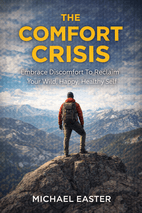
This collection brings together some of the most striking lines from Michael Easter's book on why embracing discomfort might be the key to a better life. You will find quotes that challenge modern assumptions about happiness, success, and what it means to feel alive.
The book is endlessly quotable because it mixes raw personal stories with sharp observations about human nature. Every line feels earned from real experience in the wild or from deep research, making it easy to share and hard to forget.
Top Quotes from The Comfort Crisis
“But a radical new body of evidence shows that people are at their best—physically harder, mentally tougher, and spiritually sounder—after experiencing the same discomforts our early ancestors were exposed to every day.”
The author introduces scientific findings that support the value of discomfort.
It offers a compelling, evidence-based counterpoint to modern avoidance of hardship, inspiring readers to reconsider their relationship with discomfort.
“Our common problem today is that our environment has changed, but our wiring hasn't.”
The author explains the evolutionary mismatch between modern comforts and ancient human instincts.
This line succinctly captures the central thesis of the chapter, highlighting the dissonance between our ancestral programming and contemporary life.
“It explains that as we experience fewer problems, we don't become more satisfied. We just lower our threshold for what we consider a problem.”
Levari summarizing the conclusion of his research on problem creep.
This is the core insight of the chapter—a succinct, powerful explanation of why progress often fails to increase satisfaction, resonating with anyone who has felt stuck in a cycle of perpetually shifting expectations.
“Today's comfort is tomorrow's discomfort.”
Levari applies the concept of comfort creep to modern life.
A razor-sharp, aphoristic summary of the chapter's thesis that haunts the reader with its truth and simplicity, making it highly quotable and shareable.
“Rule number one is that it has to be really fucking hard. Rule number two is that you can’t die.”
Dr. Marcus Elliott explaining the two rules of a misogi challenge.
The stark simplicity and raw honesty make this line instantly memorable, capturing the core philosophy of embracing extreme difficulty while respecting safety.
“Failure now is that you fuck up a PowerPoint presentation and your boss gives you a bad look.”
Elliott contrasting modern trivial failures with the life-or-death stakes faced by our ancestors.
Humorously blunt, it exposes how comfortable life has inflated our fear of minor setbacks, making the case for embracing real risk.
“In a study conducted by scientists at the University of Virginia, a quarter of women and two-thirds of men chose to shock themselves rather than be alone with their thoughts.”
The author cites research illustrating people's extreme discomfort with solitude.
The shocking statistic vividly underscores how deeply uneasy most people are with silence and self-reflection, making a compelling case for the value of learning to be alone.
Themes Behind the Quotes
A central theme is the mismatch between our ancient biology and today's world of constant ease. Our brains still expect a certain level of hardship, but modern life removes it, leaving us restless and anxious. The quotes explore how seeking discomfort whether through physical challenge, solitude, or risk can restore a sense of purpose and presence.
Another theme is the redefinition of failure and success. In a comfortable world, a minor mistake feels catastrophic, while real growth happens at the edge of our limits. The book argues that true resilience comes from voluntarily facing hard things, not from avoiding them. Nature and our own bodies become the ultimate teachers in this process.
Quotes by Chapter
One: 33 Days
“Nature can always throw rougher stuff at you. Meaner animals, taller cliffs, lower temperatures, wider rivers, and more snow, rain, wind, and sleet.”
The author reflects on the unpredictability and unforgiving nature of the wilderness.
This stark reminder of nature's relentless power humbles the reader and underscores the importance of respecting the wild, resonating with those seeking authentic challenges.
“There might be a million ways to die in the West, but there are 2 million in the Alaskan backcountry.”
The author lists the dangers of the Alaskan wilderness expedition.
The dark humor and exaggeration make this line instantly memorable, effectively conveying the extreme risk and remoteness of the journey.
“The coming five weeks are an all-in proposition. Unlike, say, hiking the Pacific Crest or the Appalachian Trail, deep in the Alaskan backcountry you can’t decide you're too cold and hungry and wander a couple miles off-trail to a highway where you can Uber to the nearest diner for a hot cup of coffee and a stack of flapjacks.”
The author contrasts the Alaskan expedition with more accessible outdoor adventures.
This vivid comparison highlights the utter lack of modern conveniences in the wilderness, emphasizing the total commitment required and making readers appreciate the rarity of such an experience.
Two: 35, 55, or 75
“I was a tongue-chewing idiot drunk and career fraud, and everything around me was a damn mess that was only getting messier with each ensuing weekend.”
The author describes the moment of clarity he experienced after a night of heavy drinking.
This brutally honest self-assessment captures the painful realization that addiction has made you a fraud and a mess, resonating with anyone who has faced a similar wake-up call.
“No one gets sober on a Friday evening. It's a Sunday-morning-coming-down kind of a decision.”
The author reflects on the timing and mindset required to decide to quit drinking.
The line is memorable and true—change often comes not in moments of celebration but in the wreckage of a hangover, making it universally relatable.
“My mind was like a hard rubber ball shot from a cannon into a concrete room.”
The author describes the chaotic, manic state of his thoughts during early sobriety.
This vivid metaphor perfectly conveys the frantic, bouncing, and trapped feeling of a rewiring brain, giving readers a visceral sense of the struggle.
“I felt a long-forgotten peace and confidence in the 5 a.m. quiet and mist.”
The author recounts finding solace in early morning walks with his dog after getting sober.
The imagery of quiet dawn offers a hopeful counterpoint to the chaos, showing that discomfort can lead to rediscovering simple, profound joys.
Three: 0.004 Percent
“Constant comfort is a radically new thing for us humans.”
The author summarizes the unprecedented nature of modern comfort after describing 2.5 million years of human evolution.
It delivers a stark, memorable truth that challenges the reader's assumption that comfort is normal, making it a powerful call to question our daily habits.
“Life span might be up. But health span is down.”
The author contrasts the increase in average life expectancy with the decline in years lived in good health due to modern lifestyle diseases.
This short, rhythmic juxtaposition perfectly encapsulates the paradox of modern comfort, making it both quotable and thought-provoking.
Four: 800 Faces
“When they ran out of stuff to find they would start looking for a wider range of stuff, even if this was not conscious or intentional, because their job is to look for threats.”
David Levari describes his intuition about TSA agents' behavior to explain the concept of problem creep.
This vividly captures the unconscious shift in standards when problems become scarce, making the abstract concept of threshold adjustment relatable through a familiar airport security experience.
“As the threatening faces became rare, the study participants began to perceive neutral faces as threatening.”
Levari's study on 800 faces where participants judged threat levels as the number of threatening faces decreased.
It starkly demonstrates how our perception of threats changes based on frequency, providing a concrete and memorable example of 'prevalence-induced concept change.'
Five: 20 Yards
“But if you eat meat, your barrier to entry is likely going into the grocery and swiping a credit card. You don't know anything about the animal. How it lived, where it came from, or what kind of life it had. Well, I know.”
Donnie responds to the narrator's question about why he hunts, during a dinner conversation in camp.
It challenges the ethical disconnect in modern meat consumption, making readers confront the reality behind their food choices and the value of direct participation in the food chain.
“I felt more alive than I had since my early days of sobriety, when I realized I had a whole new life ahead of me.”
The narrator reflects on his state of mind after the close encounter with the elk and Donnie's decision not to shoot.
It powerfully links the raw, uncomfortable experience of being in nature to a profound personal transformation, resonating with anyone seeking clarity and renewal.
“I'm a hunter. When you peel back all the layers, I think humans basically evolved from single-celled organisms, into apes, into humans. We are animals. And we are fundamentally hunting and gathering animals.”
Donnie explains his philosophical view on human nature while sitting in his tent during the trip.
It reframes hunting as a fundamental human activity, urging readers to reconsider their own disconnect from ancestral instincts and the natural world.
Six: 50/50
“Because I can tell you that nothing great in life comes with complete assurance of success.”
Elliott during a trail run, discussing how the human brain overestimates the consequences of failure.
A universal, counterintuitive truth that challenges the modern craving for safety and resonates deeply with anyone pursuing meaningful goals.
“Misogis can show you that you had this latent potential you didn’t realize, and that you can go further than you ever believed.”
Elliott summing up the transformative power of misogi challenges.
Inspirational and hopeful, this line encapsulates the promise of self-discovery through deliberate hardship.
Seven: 50. 70. Or 90.
“To finish it with a lot left is not really doing it right. You want to explore what your potential is out on the edges.”
Elliott, the misogi evangelist, explains the philosophy of the challenge.
It encapsulates the core ethos of the misogi—pushing to your absolute limit to discover what you're truly capable of, rather than playing it safe.
“The same space of time seems shorter as we grow older....In youth we may have an absolutely new experience, subjective or objective, every hour of the day.”
Psychologist William James writes about the perception of time in his 1890 work The Principles of Psychology.
This insight resonates because it explains why life feels faster as we age and highlights the timeless value of novelty and learning.
“We all suck at new things. But clumsily exiting our comfort zones offers way too many upsides to ignore.”
The author reflects on his own awkwardness while preparing for the Alaskan hunt.
It normalizes the discomfort of starting something new and reframes it as a worthwhile, growth-oriented endeavor.
“New situations kill the mental clutter. In newness we're forced into presence and focus.”
The author describes how stepping outside routine clears the mind.
This line powerfully connects novelty to mindfulness, showing that adventure can be a natural remedy for mental noise.
Nine: 101 Miles
“A call to something untamed seems to exist deep inside humans.”
The author reflects on the universal yearning for wild spaces after citing a Gallup poll showing most Americans prefer to live in rural areas.
This line captures the primal, almost instinctual pull toward nature that contradicts modern urban convenience, resonating with anyone who feels a tug away from civilization.
“Fear is apparently a mindset often felt prior to experience.”
The author has an epiphany while flying in a small plane over the Arctic, realizing his flight terror vanished once he was immersed in the experience.
It distills a common human truth—that anticipation of discomfort is often worse than the reality—and encourages readers to push past their fears.
“The social narrative of how a man at 30-something should look, act, and carry himself just doesn’t hold up when you remove society from the story.”
The author, alone in the Arctic tundra, reflects on how solitude frees him from societal expectations.
This line powerfully challenges social pressure and the performative aspects of modern life, offering a liberating perspective on identity and self-acceptance.