The Beautiful Game of Leadership Key Takeaways
by Jorge Titinger
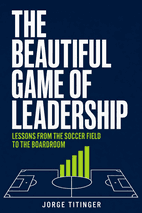
5 Main Takeaways from The Beautiful Game of Leadership
Leadership Is a Practiced Discipline, Not a Title
Titinger treats leadership as owning responsibility beyond yourself and building trust in ordinary moments—joining the lunchtime game, listening before speaking, and absorbing coaching. The move from peer to pilot is a change of profession: you are measured by what the team delivers and the capability you leave behind, not by your own output. Repeated, corrected fundamentals and recovery from failure matter more than native talent.
Build Trust by Lowering Status and Raising Standards
Make yourself ordinary where people compete, invite candor, and correct privately while keeping expectations demanding. Belonging and inclusion only work when practiced daily and paired with high standards. Mentors and leaders leave a mark by modeling the discipline and accountability they ask of others.
Staff for Real Difference and Push Decisions Downward
Assemble thinkers, doers, creators, analyzers, and critics rather than a roster of similar strengths, then screen trust through consistency and proven competence. Push authority to the lowest capable level and refuse to be the bottleneck; measure yourself by whether people can decide without you. Keep idea networks and execution networks distinct, contributing to both before you need them.
Use Real Stakes, Live Feedback, and Disposable Strategy
Competition needs real stakes and a constructive edge, with the strongest deployed where they can change outcomes, not spread evenly. Set a visible scoreboard with leading indicators and a shared vocabulary for excellent work so you can adjust while there is still time. Treat strategy as contestable and disposable on an 18-to-24-month horizon; assign rivals to attack it and retire hit products deliberately.
Drill Fundamentals, Then Lead Through Chaos and Legacy
Repeat fundamentals until automatic, but put a coach beside every drill so repetition embeds correction rather than error. When conditions turn chaotic, lean on collective discipline, rehearsal, and confidence in teammates instead of waiting for a flawless plan. After formal roles end, keep serving through board work, mentoring, teaching, or backing founders, judging the work by how much faster others grow.
Executive Analysis
The five takeaways form a single argument: leadership is a craft of deliberate practice, not a rank. Trust is built before authority by lowering status and raising standards; teams outperform when leaders staff for difference, push decisions downward, and use real stakes and feedback to keep judgment honest; and sustainable performance comes from repeatedly corrected fundamentals, an adaptable strategy, and service beyond one’s own tenure. Titinger’s sports-to-business lens ties these together as one never-ending season of preparation, coaching, recovery, and collective discipline.
Practically, the book gives new managers a transition manual: stop being the best individual contributor, design a complete team, fix incentives before slogans, and measure yourself by the decisions others can make without you. For senior leaders, it is a disciplined playbook for turnarounds, contestable strategy, and legacy work that grows other people. It belongs beside sports-coaching leadership memoirs and execution-focused management books, but its distinctive contribution is the vivid, repeatable model of leadership as a beautiful game—demanding, relational, and never finished.
Chapter-by-Chapter Key Takeaways
Foreword By James C. Morgan (Foreword)
Leadership shows up in how a person prepares, listens, and builds trust before holding a title, not in the rank itself.
The habits behind sustained success in sport or business are built through repetition, absorbing coaching, and recovering from failure rather than through native talent.
Belonging and inclusion matter only when they are practiced daily, and they work best when paired with demanding expectations.
Mentors leave their deepest mark by modeling the discipline and accountability they ask of others, because people learn to lead by carrying responsibility themselves.
Try this: Practice leadership before you have a title by preparing, listening, building trust, and treating failure as coaching; pair daily belonging with demanding expectations, and mentor by modeling the discipline and accountability you ask others to carry.
Introduction (Introduction)
Treat leadership as a discipline anyone can take up by owning responsibility for something beyond personal gain, not as a title reserved for formal positions.
Use the gap between your background and the room you are in as leverage; unfamiliarity can become influence when carried with modesty and self-honesty.
Build teams around a shared purpose and repeated fundamentals, because coordinated trust lets a group move faster and more cohesively than rivals with greater resources.
Work from an adaptable framework rather than a fixed recipe, since opponents and markets will always produce conditions no checklist anticipated.
Expect progress through setbacks and continual learning; the goal is to keep going and broaden the mix of thought and experience, not to produce a flawless season.
Try this: Take ownership of a purpose beyond yourself, use unfamiliarity as leverage with humility, and build a team around repeated fundamentals and an adaptable framework; expect setbacks, keep learning, and widen the mix of thought and experience.
Chapter 1 | The Rookie Years (Chapter 1)
Make yourself ordinary where people work and compete: take the joke at your own expense, join the lunchtime game, and let the hierarchy go quiet for an hour. Familiarity breeds trust faster than stature does.
Design the setting around how people actually perform, not around how you want them to look. A dress code imposed from above buys conformity and pays for it in output.
Set the standard for the work and leave the how to the person doing it. Cooperation offered freely outlasts compliance that was ordered.
Repeat nothing without correction. Repetition cements whatever it embeds, so put a coach next to every drill and fix the technique before it hardens.
Keep stakes in the game. Hand out medals to everyone and the pull to improve drains away; let the strongest start and make the rest earn their way on.
Try this: Make yourself ordinary enough to build trust, design the setting for real performance, and set standards while leaving the how to the doer; repeat drills only with correction, and keep real stakes so the strongest earn their way in.
Chapter 2 | Training Days (Chapter 2)
Set the default expectation at high performance rather than issuing demands for top grades; children internalize a standard more readily when excellence is treated as ordinary than when it is imposed as a rule.
Build competition with real stakes and a constructive edge: require everyone's effort, let the decisive contest carry the honor, and deploy your strongest people where they can change the outcome rather than spreading them evenly.
Treat a competitor's mishap or a technological shift as an opening only after you have planned how to use it; discontinuity rewards preparation and allocation, not mere recognition.
Lead with encouragement and private correction: give people another explanation and protect their dignity, because a climate of fear suppresses the questions and experimentation that mastery requires.
Measure schooling by whether it prepares a student for life beyond local borders; rigorous external standards and mission-driven international programs widen the paths a young person can take.
Try this: Set high performance as the default, create constructive competition with real stakes, and deploy your strongest people where they can change outcomes; encourage publicly, correct privately, and judge learning by rigorous external standards that prepare people for life beyond local borders.
Chapter 3 | Entering the Minor Leagues (Chapter 3)
Treat leadership as captaining rather than starring: read each person's strengths, lift the group toward a shared goal, and listen as much as you speak.
Build institutions on radical trust backed by selection and self-discipline; let a substantive conversation outlast a bell, since maturity is the point and a lesson plan can be made up later.
Expect warmth and restraint to be misread when cultures meet, and arrange encounters so the misreading instructs rather than wounds.
Judge a detour by its compounding returns rather than its delay; two years that yield cultural range, academic acceleration and a settled purpose can outweigh the time they cost.
Follow the discipline your mind actually grasps, and be willing to leave home for it when local institutions cannot supply the training, holding to the conviction that education remains the strongest lever for human advancement.
Try this: Captain rather than star by reading strengths, listening, and building radical trust backed by selection and self-discipline; arrange cross-cultural encounters to instruct, and judge detours and educational moves by their compounding returns rather than delay.
Chapter 6 | The Difficult Shift from Peer to Pilot (Chapter 6)
Treat the move into leadership as a change of profession, not a change of rank. You're now measured by what the team delivers and by the capability you leave behind, not by the quality of your own output.
Staff for coverage, not resemblance. Assemble thinkers, doers, creators, analyzers and critics, because a roster of brilliant people who share the same strength can't do what a complete team does.
Screen trust on three questions before handing over real responsibility: does this person mean what they say, does their behavior repeat, and is their competence proven in this specific domain?
Fix boundaries and incentives before you write a culture deck. Name the behaviors that are off limits no matter how strong the scorecard, and confirm that pay and promotion reward the collaboration you claim to want, because people follow whichever rules carry the money.
Push authority to the lowest level you can and refuse the role of bottleneck. When someone asks you to decide for them, revisit their last three calls and let the record show that their judgment already held.
Try this: Treat your first leadership role as a new profession: staff for coverage rather than resemblance, screen trust through consistency and proven competence, fix boundaries and incentives before culture language, and push decisions to the lowest capable level.
Chapter 7 | Taking Ownership (Chapter 7)
Measure yourself by whether the people around you can decide without you, and audit whether you still act like the owner of a technical subsystem or lean on formal authority instead of building genuine connection.
Give specialists room to know their position better than you do, and replace vague direction with clear standards, because ambiguity is the expensive kind of kindness.
Build two separate networks and keep them distinct: one for the people you trade ideas with, one for the people who help you finish work; contribute to both before you need something from them.
Audit your team's repeated questions by walking through their past successes with them, and set leading indicators so a long project has a visible scoreboard before the end.
Treat your current strategy as disposable on an eighteen-to-twenty-four-month horizon, and do not let a merger or culture clash leave the org chart you negotiated in place while talent and market share drain away.
Try this: Measure your ownership by whether others can decide without you, give specialists clear standards and room, and build separate idea and execution networks while contributing before you need them; use successes to audit repeated questions, set leading indicators, and treat strategy as disposable every 18 to 24 months.
Chapter 8 | Legacy Season (Chapter 8)
Treat a late-career turnaround as a fixed-term championship run, not a victory lap: set the restoration target, repair any reporting you cannot trust, and measure progress against the gap you inherited.
Replace any direct report you would not hire into that role today, and do it early; a rescue team must be yours in standards and ownership, not just in title.
Put the sales leader where the market is, in front of customers, and move on when the person's real strengths do not match the role's real demands.
Keep strategy contestable: assign an internal rival group to attack the plan, revise it as customers and competitors move, and retire your own hit products on a deliberate schedule before a rival does.
In board or advisory work, govern rather than command: supply field-wide perspective, mentor executives without taking over, and treat an outsider's vantage as an asset rather than a gap.
Try this: Run a late-career turnaround as a fixed-term championship: repair reporting, replace direct reports you would not hire today, and put the sales leader in front of customers; keep strategy contestable with an internal rival, retire hit products deliberately, and govern from the board rather than command.
Conclusion | The Never-Ending Season (Conclusion)
Establish a shared vocabulary for what excellent work looks like and a live feedback mechanism that tells you whether you are winning while there is still time to adjust.
Treat the relational side of leadership as the operating system beneath technical skill: when the problem is human, stop slicing it into smaller pieces and use influence, listening and presence to move it.
Staff for difference rather than familiarity, placing people where their distinctive strengths change the game and building the trust that lets them contribute without hiding parts of themselves.
After your current role ends, stay engaged through board work, mentoring, teaching or backing founders, and judge the work by how much faster other people grow because of it.
Drill the fundamentals until they are automatic, then lean on collective discipline, rehearsal and confidence in your teammates when conditions turn chaotic rather than waiting for a flawless plan.
Try this: Build a shared vocabulary and live feedback loop, treat relationships as the operating system beneath technical skill, and staff for difference so distinctive strengths can show up; drill fundamentals until automatic, then use collective discipline in chaos, and keep serving through board work, mentoring, or backing founders after the role ends.