The Airbnb Story Quotes
by (Journalist) Leigh Gallagher
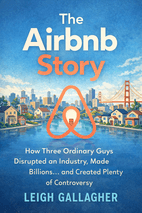
This collection brings together the most memorable lines from Leigh Gallagher's account of Airbnb's rise. You will find moments of raw honesty, bold ambition, and unexpected wisdom from the founders and key players. What makes this book so quotable is its ability to capture the startup journey in vivid, relatable language. These quotes are not just about business; they are about human connection, resilience, and the power of an idea to reshape how we live and travel.
From the thrill of early uncertainty to the challenges of scaling a global community, each line offers a snapshot of a defining moment. Whether you are an entrepreneur, a traveler, or simply curious about how a simple concept became a cultural force, these quotes will inspire and provoke thought.
Top Quotes from The Airbnb Story
“There's something I need to tell you. We're going to start a company one day, and they're going to write a book about it.”
Joe Gebbia says this to Brian Chesky over pizza shortly after Chesky's graduation from RISD.
It captures the audacious self-confidence and prophetic vision that would later become a self-fulfilling prophecy for Airbnb's founding.
“It's like jumping off a cliff and assembling the airplane on the way down.”
Brian Chesky quoting Reid Hoffman, partner at Greylock Partners, to describe the startup journey.
This metaphor vividly captures the chaotic, high-risk nature of building a company from scratch, making it instantly memorable and relatable to entrepreneurs.
“Airbnb had gone from being called the “eBay for space” in Silicon Valley elevator-pitch parlance to becoming a standard that other start-ups were modeled after: Boatbound pitched itself as the Airbnb of boats, dukana was to be the Airbnb of equipment, and DogVacay was the Airbnb for dogs.”
The author describes Airbnb's evolution from a simple pitch to a benchmark for other startups.
This line captures how Airbnb transcended its original comparison to eBay and became a template for an entire generation of startups, demonstrating its outsized influence on the sharing economy.
“Uber is transactional; Airbnb is humanity.”
Elisa Schreiber of Greylock Partners said this in the chapter's opening.
It perfectly encapsulates the core difference between a transactional service and Airbnb's focus on human connection and community.
“There's care. There's a sense of belonging. Not ‘service,’ but belonging. That's the core of the company.”
Brian Chesky, speaking during an interview in a Washington, D.C. Airbnb listing.
This line distills Airbnb's brand promise into a simple, emotional mantra—emphasizing human connection over transactional hospitality.
“Pessimists are usually right, but it's the optimists who change the world.”
Brian Chesky paraphrasing Thomas Friedman when asked if he is overly idealistic.
It captures the tension between realism and idealism, inspiring entrepreneurs to remain optimistic despite criticism.
“We are ordinary guys. And this isn't that crazy of an idea.”
Chesky describes the founders' self-perception early in Airbnb's journey, downplaying their own vision.
The humility and relatability of this statement contrast with the company's immense success, making it an inspiring underdog narrative.
Themes Behind the Quotes
One central theme is the relentless optimism and willingness to embrace uncertainty. Founders repeatedly show they are willing to jump into the unknown and build their solution along the way. Another theme is the shift from a purely transactional business to one rooted in hospitality and belonging. The company's mission to create a world where you can belong anywhere runs through many of these lines.
Additionally, the quotes reveal the personal stakes involved. Founders take failures and bad experiences deeply to heart because they believe in creating a better world. There is also a recurring idea that the company's true strength lies not in its technology but in the millions of ordinary people who open their homes and create genuine connections. Finally, the quotes highlight the importance of continuous learning and adapting, as well as the humility of recognizing that even a world changing idea starts with ordinary people.
Quotes by Chapter
The Hustle
“This road, to San Francisco, looked only like possibility.”
Brian Chesky driving up the coast after deciding to move in with Joe Gebbia and start a company.
This line beautifully encapsulates the hope and new beginning that define the entrepreneurial spirit, contrasting sharply with his earlier despair.
“I was both in the living room and in the slide deck at the same time.”
Amol Surve, Airbnb's first guest, noticing that he was featured in Chesky and Gebbia's pitch while sitting in their apartment.
The witty observation highlights the blurry line between the founders' hustle and their product, and it captures the serendipitous, immersive nature of Airbnb's earliest days.
“If you launch and no one notices, you can keep launching. We kept launching, and people kept writing about it. We thought we'd just keep launching until we got customers.”
Brian Chesky advises other entrepreneurs on the tactic of repeatedly relaunching to gain attention.
This line encapsulates the relentless, scrappy hustle that defined Airbnb's early days, inspiring readers to persist through obscurity and keep iterating publicly.
Building a Company
“When you're dying, you're not thinking, ‘What do I want to be when I grow up?’ You're thinking, ‘How do I not die?”
Airbnb cofounder Brian Chesky reflects on the survival mindset before the company achieved product/market fit.
It perfectly expresses the raw, desperate focus of early-stage startups, making the struggle relatable and the eventual success feel earned.
“There is also the most important constituency in the Airbnb story, and it lies outside the four walls of its headquarters: the hosts and the travelers; in other words, the millions of people who turned Airbnb from a company into a movement.”
The author emphasizes the role of Airbnb's community beyond its corporate offices.
This passage powerfully reframes Airbnb's success as a grassroots movement fueled by its users, reminding readers that the company's true strength lies in its decentralized, people-powered network.
Airbnb Nation
“We're not rich, but we're comfortable, we're lifelong learners, we're healthy, and we're curious.”
Michael Campbell, a retired nomad living full-time on Airbnb, said at the 2015 Airbnb Open.
It embodies the adventurous spirit of Airbnb's most devoted users and shows that the platform enables a fulfilling, unconventional lifestyle regardless of age.
“How do you take hospitality, which in many ways had gotten very corporatized, and take it back to its roots?”
Chip Conley explains his fascination with the challenge of democratizing hospitality, which led him to join Airbnb.
It encapsulates the mission to restore personal, human-centered service in an industry that had become impersonal and standardized, resonating with anyone seeking authenticity.
“Nobody knew what to do, what the experience was. ‘Are you the psycho killer? Or am I the psycho killer?”
Jonathan Morgan, an early Airbnb host, describes the uncertainty and humor of the platform's early days.
The darkly comic question captures the raw, unpolished nature of the early sharing economy and the vulnerability both hosts and guests felt, making it both relatable and memorable.
The Bad and the Ugly
“But the people coming to your house don't look like golfers.”
A neighbor warned Barbara Loughlin during the fake golf party scam.
The understated, ironic observation signals the deception unfolding and becomes a memorable emblem of how easily trust can be exploited on the platform.
“I take them very, very personally. I am very idealistic about the notion that you're helping to create this version of the world that's better, and that people are going to be better in it. If something is antithetical to that, let alone a bad experience . . . that just stops you in your tracks.”
Airbnb CEO Brian Chesky speaking about the tragic deaths on the platform.
This quote reveals Chesky's emotional investment and the moral weight he carries, showing how personal failures clash with his utopian vision for the company.
“But my story is just as important, if not more so, than all the other stories used to sell the platform.”
Zak Stone, whose father died in an Airbnb rental, speaking about his experience.
It powerfully asserts that the company's narrative of trust and belonging must also account for its worst failures, demanding accountability beyond marketing.
“We're dealing with people entering a home, and you can't predict people's behaviors.”
Airbnb spokesman Nick Shapiro explaining why incidents are inevitable.
This line succinctly encapsulates the core challenge of a platform that relies on strangers—the inherent unpredictability of human behavior in private spaces.
Air Rage
“We don't have much differentiation if it's a corporate rental,” he says. “It feels like a hotel. There's less belonging.”
Chesky explains why Airbnb does not want large-scale commercial operators on the platform.
This quote distills Airbnb’s core brand promise of belonging and authenticity, contrasting it with the impersonal nature of traditional hotels.
“Bad politics drive bad policy.”
Chris Lehane, Airbnb's global head of public policy, after the New York short-term rental bill was passed.
A sharp, cynical aphorism that captures the company's frustration with how political maneuvering can produce harmful regulations.
“It's like you're building a car, building the road, building rules, people are throwing rocks at you—it’s great!”
Chris Lehane describing the chaotic challenge of building Airbnb's regulatory framework.
A vivid metaphor that conveys both the excitement and the adversarial nature of pioneering a disruptive business model.
Learning to Lead
“It's kind of like the old Robert McNamara saying— there's no learning curve for people who are in war or in start-ups.”
Brian Chesky explains why there is no time for a formal learning curve as CEO of a hypergrowth company.
This quote vividly captures the intense, high-stakes environment of startups, likening them to war, and resonates with entrepreneurs facing relentless pressure.
“He feels it all the way through,” he says. “I think he would be doing what he's doing if he didn’t get paid a dime for it.”
Warren Buffett praises Brian Chesky's deep, intrinsic passion for Airbnb's mission.
This endorsement from a legendary investor underscores the authenticity and purpose-driven leadership that sets Chesky apart from typical founders.
“Brian’s biggest strength is that he is a learning machine,” says Reid Hoffman. “It’s a skill set for all successful entrepreneurs—the phrase I use is ‘infinite learner'—and Brian is the canonical example of that.”
LinkedIn cofounder Reid Hoffman identifies what makes Chesky unique among CEOs.
The phrase 'infinite learner' encapsulates a core trait of successful founders, and Hoffman's praise reinforces the chapter's theme of relentless self-improvement.
Epilogue
“The end business goal, our mission, is to create a world where you can belong anywhere.”
Airbnb CEO Brian Chesky explains the company's ultimate purpose when asked how the new Trips product fits into business goals.
This line encapsulates Airbnb's aspirational ethos beyond mere transactions, resonating with readers who seek deeper meaning in commerce.
“History has a way of being more wise and more truthful than the present, because the present is cloudy and foggy.”
Chesky reflects on the controversy surrounding Airbnb, expressing confidence that future judgment will vindicate the company.
The poetic phrasing offers a timeless perspective on truth and controversy, making it a memorable reflection for any disruptive enterprise.
“The mandate of a public company is to act in the best interest of your shareholders. But the problem is, you don't pick your shareholders.”
Chesky voices his unease about the constraints of being a public company and the potential conflict with long-term vision.
This candid admission captures a central tension in Silicon Valley between private ideals and public market pressures, striking a chord with entrepreneurs and investors.