The AI Advantage for Entrepreneurs Quotes
by A. C. Knapp
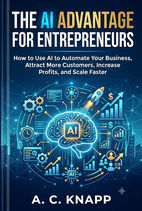
This page gathers some of the sharpest lines from The AI Advantage for Entrepreneurs. You will find quotes about prompts, time management, customer trust, automation, and the human role in a business powered by AI. They are short enough to save, share, and actually use.
What makes the book quotable is how practical its statements are. The author does not stay at the level of big ideas. He takes the everyday choices of an entrepreneur and frames them in a way that is easy to remember. That combination of clarity and usefulness is why these lines stick with readers.
Top Quotes from The AI Advantage for Entrepreneurs
“Al does not need to be perfect to be valuable. If it can give you a useful starting point, organize scattered notes, or reduce a task from forty minutes to ten, it has already created leverage.”
From the chapter’s early explanation of why AI is a practical tool for small business owners.
It removes the pressure to make AI perfect and frames it as a time-saving tool, which makes adoption feel accessible.
“The real skill is no longer knowing how to program. It is knowing how to give clear instructions.”
From the section describing what entrepreneurs need to master in the AI era.
It empowers non-technical founders and shifts the focus to communication, which is a skill they already use daily.
“The goal is not to remove every small task from your day. The goal is to stop small tasks from deciding how your entire day goes.”
From the section on replacing busy work with smart work.
It gives a realistic, human-centered vision of automation: AI is not about eliminating everything, but about regaining control of your time.
“A useful draft that takes three minutes can be better than a perfect message that takes forty.”
From the guidance on choosing your first low-risk AI task.
It reframes perfectionism as a cost and makes the case for accepting AI imperfections in exchange for speed.
“You are not just saving time. You are changing what a business of your size can handle.”
From the closing section on building an AI command center.
It elevates AI from a time-saver to a growth lever. This is a memorable, inspiring finish that makes the foundation feel worthwhile.
“The Al oversees the predictable tasks. You manage irreplaceable relationships.”
Appears in the discussion of AI support automation for routine questions.
It gives readers a clear, motivational split: automation handles repetition, humans handle relationships.
“Real efficiency is not about removing your personal touch. It is about scaling it.”
From the conclusion on preserving human connection while scaling.
It reframes efficiency as amplification rather than loss, relieving the fear that automation will make a business feel impersonal.
Themes Behind the Quotes
One main theme is using AI as a practical lever rather than a magic fix. The quotes keep coming back to the idea that small efficiencies compound. A faster draft, a clearer prompt, or a smoother routine can free up attention for the work that actually moves a business forward. This is not about replacing people. It is about reducing friction so the owner can focus on relationships and strategy.
Another theme is the balance between automation and human judgment. The book keeps returning to systems, workflows, and speed, but always with the caution that quality and trust matter. The entrepreneur needs to set the direction while the tool handles the repeatable parts. That balance turns efficiency into something sustainable, and it also keeps the personal touch intact as the business grows.
Quotes by Chapter
Chapter 2: Building Your AI Foundation
“The goal is not to automate everything overnight. It is to see where your time is leaking so you can stop working harder without growing income.”
From the section on tracking time before choosing AI tools.
It reframes automation as a strategic fix for wasted hours, not a rush to replace everything. This resonates because it promises smarter work and growth, not just busywork removal.
“Instead of asking, “What is the most advanced Al tool?” ask, “Which tool fits the task I actually need help with this week?””
From the section on selecting tools that fit your business.
It cuts through shiny-object syndrome and makes tool selection practical. Readers remember to start with the problem, not the hype.
“A tool should not create a new routine you have to manage. It should remove friction from a routine you already have.”
From the section on avoiding tool overload.
This line captures the real test of any new software. It resonates because it warns against letting tools become extra work.
Chapter 3: Using AI to Attract More Customers
“The goal is not to remove your voice from your marketing. It is to let Al manage the repeatable parts so you can focus on strategy, relationships, and offers that grow the business.”
This appears in the opening section on content marketing with AI.
It reframes AI as a tool for freeing up human energy rather than replacing the owner's voice. This directly addresses the fear many small business owners have about losing authenticity.
“Your brand is more than your logo, colors, or fonts. It is the way customers feel and understand your business every time they see your content, read your emails, or talk with you.”
This appears in the Al-Powered Branding section.
It makes branding feel personal and accessible, not corporate or visual only. Readers can immediately see why consistency in tone matters.
“The best lead magnet is not always the longest one. A clear one-page checklist that answers a real customer question can often work better than a long guide no one finishes.”
This appears in the section on building lead magnets faster.
It challenges the instinct to create bigger and more elaborate offers. The line helps readers focus on usefulness over volume.
“The lead magnet starts the relationship; the follow-up turns attention into trust.”
This closes the section on building lead magnets faster.
It is a memorable, simple summary of the entire lead generation process. It reminds readers that capturing attention is only the beginning.
Chapter 4: Increasing Sales with Artificial Intelligence
“The real question is not whether Al can speed up your sales process. It is whether you can guide it well enough to create messages that sound like your business and help move the sale forward.”
From the section on writing high-converting sales copy with Al.
It reframes Al as a tool that only works when the entrepreneur provides clear direction. This empowers readers instead of making them fear being replaced.
“The best sales systems feel simple to the customer. They do not notice the templates, reminders, or Al drafts behind the scenes. They only notice that your response is clear, timely, and easy to act on.”
This appears in the discussion of turning a clogged sales process into a smoother system.
It captures the ideal customer experience when behind-the-scenes automation works well. The image of invisible support makes the goal feel practical and attainable.
“Customer objections are not always unwelcome news. They often mean the buyer is interested but still needs clarity, proof, or reassurance before deciding.”
This opens the section on handling customer objections.
It flips a common business frustration into a positive signal of buyer interest. Readers are encouraged to prepare helpful responses instead of feeling discouraged.
“The most expensive tool is not always the one with the highest price. It is the one you stop using because it does not fit your daily business.”
This appears in the discussion of evaluating Al tool costs and conversion rates.
It is a memorable twist on how business owners should judge software value. The line stays with readers when they compare tools.
Chapter 5: Automating Daily Operations
“If the task is unclear in your own mind, Al will usually make the confusion faster instead of fixing it.”
This appears in the opening section on administrative automation.
It reframes AI as a magnifier of your own clarity rather than a magic fix, which makes readers pause and improve their prompts.
“A vague prompt gives you text to rewrite. A structured prompt gives you a draft you can quickly review, saving time every time you use the tool.”
It is from the discussion of why prompt quality determines whether automation saves time.
It captures the exact pain of weak AI prompts and gives a memorable contrast that pushes readers toward structure.
“The goal is not to let Al make financial decisions for you. The goal is to reduce the writing, sorting, and explaining work so you can make decisions with clearer information and less stress.”
This appears in the section on AI for financial productivity.
It reassures readers that automation supports judgment instead of replacing it, reducing fear around financial tasks.
“Speed is helpful only when accuracy is protected.”
This is from the financial review section of the chapter.
It is a concise warning that resonates in high-risk tasks, where fast automation is worthless if it leads to errors.
Chapter 6: Delivering Exceptional Customer Experiences
“No night shift. No long delay. No lost opportunity because you were asleep.”
From the section on AI support tools answering after-hours inquiries.
It turns being offline into the opposite of lost opportunity, making 24/7 service feel concrete and desirable.
“Fair or not, responsiveness has become part of how customers judge your professionalism.”
From the Support Automation section on response speed.
It names a harsh shift in customer expectations and makes responsiveness a matter of professionalism, not convenience.
“Long-term relationships are built through steady, useful contact, not constant selling.”
From the section on building long-term relationships through follow-up.
It reframes follow-up as service, not pressure, and helps entrepreneurs avoid sales burnout.
Chapter 7: Making Smarter Business Decisions with AI
“If a task takes time but does not improve sales, service, speed, or quality, it may be a suitable candidate for Al support or a clearer process.”
From the section on measuring business performance, where the author explains how to review where effort goes.
It gives entrepreneurs a simple litmus test for deciding what to automate, cutting through hype and focusing on value.
“The best tool is not the most expensive or advanced one. It is the one that works smoothly with the systems you already use and does not take hours to maintain.”
From the discussion on identifying growth opportunities and choosing tools.
This line reframes tool selection around fit and sustainability rather than features, which resonates with owners who have abandoned complicated software.
“Scalability is not something to fix later. Build workflows to handle growth from the start, or you may spend months rebuilding systems that should have worked from day one.”
From the section on spotting hidden problems early in an automated workflow.
It captures the common trap of ignoring capacity until volume breaks a system, urging entrepreneurs to design for growth before they need it.
“Do not wait until customers complain to investigate. If response speed slows, error counts rise, or more work keeps coming back to you, treat that as an early warning sign and fix the system while the problem is still small.”
From the early warning signs part of the hidden problems section.
It empowers business owners to act on small internal signals instead of reacting after customer trust is damaged.
Chapter 8: Scaling an AI-Powered Business
“Systems manage the routine work, while you guide the direction. That is the key lesson from scaling an Al-powered business: systems run the repeatable parts, and you run the systems.”
The author states this in the conclusion as the core lesson of the chapter.
It captures the entire book's thesis in a single memorable line, encouraging owners to build systems instead of exhausting themselves.