Swan Song Book Club Questions
by Charles Spencer
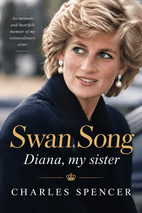
These questions assume everyone has finished the book and contain spoilers, including the ending.
Swan Song opens up rich discussion about family, grief, public duty, and the stories people tell about Diana. Charles Spencer's memoir invites readers to weigh private memories against public mythology, and to think about sibling loss, media pressure, and the choices made by those closest to her.
Use these questions however your group likes: pick a few for a focused hour, or work through them in order. There are no right answers, just room for personal reactions, disagreement, and maybe a few difficult memories of your own.
Family, Childhood, and Sibling Loss
- 1.In the prologue Charles walks with Diana and his sisters behind their father's ashes, joking that one of the four will attend the funerals of the other three; five and a half years later he marches behind Diana's body. How does that juxtaposition frame the book's story of sibling loss?
- 2.Diana waits on Park House's front doorstep after her mother promises to return, but her mother never does; later Diana tells Carlos she finds it hard to complain or stand up for herself. How do you connect those two moments in understanding Diana's character?
- 3.Mary Clarke called Diana's childhood happy and secure, while Diana spoke of a 'deep sadness' and insufficient love. Which account of Diana's early life did you find more persuasive in the book, and why?
- 4.Diana tells her father she cannot go through with the wedding because Charles clearly does not love her, but her father refuses to allow her to break the engagement. Did you agree with his decision, or do you think he failed her?
- 5.Raine secretly marries Diana's father, remodels Althorp, relegates the children to attic bedrooms, and blocks them from visiting after his stroke, yet Diana later clasps Raine's hand at the funeral and becomes friendly with her. What did you make of Diana's changing relationship with Raine?
Marriage, Public Spectacle, and Private Pain
- 6.At the wedding breakfast Diana has a headache, hardly eats, and seats Carlos at her right hand; later the book says she remembered 29 July 1981 as the saddest day of her life. How does that private misery sit against the public fairytale of St Paul's?
- 7.Diana asks Charles for the Garden House at Althorp for her and her sons, and he agrees before withdrawing the offer over police security concerns and offering Wormleighton Manor instead. Did Charles make the right call, or should he have found a way to give Diana the refuge she wanted?
Media, Manipulation, and Blame
- 8.Jane calls Charles in the middle of the night to say Diana has been in a car crash, then finally tells him, 'That's it... It's curtains... Duch is dead,' while commentators initially speak dismissively of Diana. How does that sequence capture the book's themes of truth versus media invention?
- 9.Martin Bashir uses forged bank statements and fabricated claims about MI5, Prince Charles, Patrick Jephson, and Tiggy Legge-Bourke to reach Diana. How does the book present her decision to do the Panorama interview: as manipulation, self-destructive courage, or both?
- 10.Carlos warns Diana that Bashir does not add up and is not to be trusted, but she proceeds with the Panorama interview anyway and Carlos later calls it his eternal regret. Did Charles/Carlos do enough to protect her, or was the warning doomed to fail?
- 11.Diana is pursued by paparazzi at Malaga airport and by Brendan Beirne, William later says most of the time Diana cried was to do with press intrusion, and Phil Hall eventually admits media responsibility for her death. How does the book assign blame for the treatment Diana endured?
Royal Duty, Grief, and Legacy
- 12.Prince Charles insists that William and Harry walk behind Diana's coffin, while Charles refuses and later agrees only if Prince Philip walks beside them. What does this conflict reveal about royal duty versus family protection?
- 13.Charles delivers a eulogy that criticizes the press and calls Diana 'the most hunted woman of the modern age'; the Queen later says he spoke as a brother with every right to say what he felt. Did the eulogy help the family's grief or complicate it?
- 14.The Queen offers posthumously to restore Diana's HRH title, and Charles rejects it as pointless because Diana is dead. Did you agree with his refusal, or should the title have been restored as a symbolic apology?
- 15.The book ends with Diana buried on the island at the Round Oval, the Royal Standard replaced by the Spencer crest, and Nelson Mandela later laying a wreath and calling her 'a very, very great lady.' How does that ending balance Spencer family memory with Diana's global legacy?