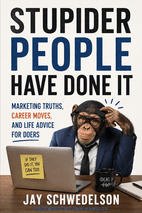
Stupider People Have Done It Key Takeaways
by Jay Schwedelson
5 Main Takeaways from Stupider People Have Done It
Start Before You're Ready with Imperfect Action
Most people delay action waiting for perfect plans, but best practices are already obsolete. Schwedelson's mantra 'stupider people have done it' reminds you that someone less qualified has already succeeded. Replace five-year plans with a five-minute plan—do one thing now, fail fast, and iterate.
Consistency and Accountability Beat Raw Intelligence
Smart people don't automatically win; showing up consistently does. Build a weekly output habit—like posting on LinkedIn for 15 minutes daily—and create systems that force you to keep going. Most people quit, so just continuing gives you the edge.
Flip 'Have To' to 'Get To' to Rewire Your Brain
Reframing obligations as opportunities (e.g., 'I get to go to work' instead of 'I have to') shifts your mindset from trapped to empowered. Use the 'Gratitude Grenade' by adding why you're lucky for the task. This simple CBT-based trick transforms daily grind into gratitude.
Hesitation Causes More Regret Than Failure Ever Will
Failure teaches you; regret just haunts you. Take action before you feel ready—use mental tricks like 'future me is watching' or 'I need only ten seconds of bravery.' Schwedelson nearly ruined his life by hesitating, proving that missed opportunities hurt more than mistakes.
Own a Single Hook, Not a Blurry Brand
Trying to be known for everything makes you invisible. Stake your career or business on one clear skill—your strongest dish—and crush it before expanding. If five people give you five different answers about your best quality, you haven't staked a clear identity.
Executive Analysis
These five takeaways form the backbone of Schwedelson's anti-guru manifesto: success doesn't require genius, perfect timing, or a polished plan. Instead, it demands immediate, imperfect action driven by consistency, a reframed mindset, and a focused identity. The mantra 'stupider people have done it' demolishes impostor syndrome, while practical tactics like the five-minute plan and LinkedIn discipline replace abstract goals with daily wins. Regret avoidance and cognitive reframing provide the psychological fuel to keep moving when fear strikes.
This book matters because it cuts through the noise of motivational fluff with blunt, humorous, and actionable advice rooted in real marketing and career experience. It sits uniquely at the intersection of self-help, marketing, and humor—offering tactical insights (email subject lines, social proof, AI integration) alongside raw honesty about work-life balance, public speaking, and neighbor avoidance. For anyone paralyzed by perfectionism or overwhelmed by '10x' gurus, this book is a refreshing, permission-giving slap in the face to just start.
Chapter-by-Chapter Key Takeaways
Introduction (Introduction)
The book’s proceeds go to cancer charity, so even if the advice stinks, your money does good.
The standard motivational formula is tossed aside—no epic hero’s journey here.
Success doesn’t require being the smartest; it requires starting, even when you feel like a fraud.
The grandpa’s line—“stupider people than you have done it”—crushes impostor syndrome by reminding you that someone less qualified has already succeeded.
Self-awareness, generosity, humor, and hard work matter more than credentials.
Try this: Donate the cost of this book to a cancer charity as a first act of generosity, then start your next project by repeating 'stupider people have done it' to crush impostor syndrome.
Best Practices Are Garbage (Chapter 1)
Best practices are already obsolete by the time they become "best." Following them guarantees you'll be late and average.
A five-year plan is often a procrastination device in disguise. Replace it with a five-minute plan: What can I do right now?
Rapid, imperfect action beats slow, polished planning. Barbara Corcoran split a company in minutes and relaunched in days.
Nervousness is a feature, not a bug. If your move doesn't scare you a little, it's probably too safe to matter.
Copying what used to work for someone else guarantees invisibility. Stand out by breaking something, saying the thing your brand wouldn't say, or trying the weird angle.
Try this: Replace your five-year plan with a five-minute plan: identify one action you can take right now, and take it imperfectly before the day ends.
Are You Consistent? Are You Accountable? (Chapter 2)
Create a weekly output that forces you to learn and network—start small but start now.
Accountability isn't about others; it's about having a system that makes you show up for your own growth.
Consistency is the ultimate competitive advantage: most people quit, so you win by just continuing.
Reclaim time by being intentional—cut mindless scrolling and use that time for your learning habit.
Try this: Create a weekly output habit—like a 15-minute LinkedIn post or a short email to a colleague—that forces you to learn and network consistently.
Since You Didn’t Ask: Is the Movie ‘Bridesmaids’ Funny? (Chapter 3)
Pop culture is a shortcut to knowing someone. Whether or not someone finds Bridesmaids (or any of the listed classics) funny can tell you more about compatibility than hours of small talk.
Judgment is a tool, not a flaw. The author unapologetically uses it to filter relationships—and suggests you might want to, too, at least in low-stakes contexts.
Consistency and accountability matter more than raw intelligence. Smart people don’t automatically win; showing up and sticking with your opinions (or your efforts) does.
This book will zigzag. Expect a mix of unhinged rants and hard-hitting marketing insights. The randomness is by design. Don’t fight it.
Try this: Use pop culture preferences as a quick compatibility filter in meetings: ask someone if they find 'Bridesmaids' funny to gauge their sense of humor instantly.
Marketing Stuff: LinkedIn—This One Matters! (Chapter 4)
Clean your LinkedIn post links before sharing them to avoid algorithmic penalties.
Never use automation tools—LinkedIn will tank your reach.
Your company page is your new homepage; keep it active with 500+ real followers.
Post valuable, no-agenda content 4 out of 5 times. Earn the right to promote.
Spend just fifteen minutes a day, post consistently, and watch your network compound.
Try this: Spend 15 minutes a day on LinkedIn without automation tools: clean your links, post valuable content 4 out of 5 times, and keep your company page active with 500+ followers.
Since You Didn’t Ask: I Was Beyond Embarrassed! (Chapter 5)
LinkedIn is a game-changer for any profession—commit fifteen minutes a day.
Conference social dinners are often a waste of time; it’s okay to opt out.
The universe has a sense of humor, and it will test you when you least expect it.
Never assume you won’t end up in a hotel lobby in your underwear. Always have a backup plan—or at least wear pants while eating.
Try this: Opt out of conference social dinners without guilt—your time is better spent on a 15-minute LinkedIn session or a quiet walk.
All-Time Stupid Advice (Chapter 6)
Most advice is made up on the spot; only listen to people who have current, relevant experience with your exact situation.
You are under no obligation to stay in a bad job for a year—honest explanations about a misaligned role can actually impress future employers.
A crowded market isn’t a red flag; it’s proof that demand exists. Focus on doing things better, not inventing something from scratch.
“I don’t know” is a superpower. The people who admit it are the ones you can truly trust.
Try this: Ignore advice from people without current, relevant experience; instead, say 'I don't know' when you need to, and remember that crowded markets prove demand exists.
I Don’t Love My Job, and That’s Totally Fine (Chapter 7)
Not loving your job is normal. Love is a Hollywood myth; the real goal is to not hate it.
Passion doesn’t protect you from the grind. Turning a hobby into a career often kills the joy.
Find the torture you’re comfortable with. Seinfeld’s wisdom beats any “follow your bliss” quote.
You’re winning if you have decent people, growth, and tolerable work. That’s not love—it’s a great work life.
When burnout hits, remember: “You just have to not hate it.” That’s enough to keep going.
Let your job fund the life you actually love. Whether that’s family, friends, or bad reality TV—that’s the real point.
Try this: Accept that you don't have to love your job—aim for 'don't hate it,' let your work fund the life you love, and find the torture you're comfortable with.
Since You Didn’t Ask: I Suck at Working Out (and You’re Part of the Problem) (Chapter 8)
Consistency isn’t the same as enjoyment. You can stick with something for years and still hate every minute of it—and that’s okay.
The gym is a theater of weirdness. There’s always someone doing something inexplicable, and it’s usually a dude.
People (even friends) will make you feel judged. Whether it’s a flex in the mirror or a joke from a car window, other people have a knack for making a hard thing harder.
The real lesson here: sometimes the biggest obstacle to a workout isn’t the exercise itself—it’s the audience.
Try this: Acknowledge that you can hate a consistent workout routine and still stick with it; ignore the audience's judgments and focus on showing up, even if you despise every minute.
AI Is Not Taking Your Job (Chapter 9)
AI isn’t replacing you; it’s replacing people who stopped trying.
Onboard AI with your full context—goals, fears, strengths, failures—to get personalized results.
Use specific prompts for competitive analysis, trend spotting, lead generation, and curated subscriptions.
Your job stays safe as long as you own strategy, creativity, and soul-checking.
Stop being scared of sharing data; early adopters gain the biggest advantage.
Try this: Onboard AI with your full context—goals, fears, strengths—using specific prompts for competitive analysis or lead generation, and stop worrying about AI replacing your job.
Since You Didn’t Ask: Airports Suck and Other Travel Fun (Chapter 10)
Airport design is hostile to humans—especially mega-hubs like Denver and Atlanta that turn connections into sprints.
People movers are for speed, not lounging. If you block one, expect to get out-walked by someone on the floor.
A direct rejection (“I’m not a talker”) saves everyone time and awkwardness on the plane. It’s brutal but effective.
Try this: Reject direct airplane conversations with a polite 'I'm not a talker' to save time and awkwardness, and sprint past people movers if you're in a hurry.
Work-Life Balance Is a Scam (and You Know It) (Chapter 11)
Work-life balance isn’t a destination, it’s a moving target. You’ll miss sometimes, and that’s fine.
Guilt is the real enemy—stop feeling bad for working late or for taking a break.
Boundaries matter more than rigid schedules. Train people to not expect instant replies.
Successful people don’t have a secret formula; many openly admit balance is a myth.
Small, imperfect actions (like a five-thing fling or a ten-second morning reset) are more useful than chasing an unattainable ideal.
Try this: Stop feeling guilty about imbalance: set boundaries like delayed replies and use a 'five-thing fling' or ten-second morning reset instead of chasing perfect work-life harmony.
Since You Didn’t Ask: The Best TV Shows of All Time… Don’t @ Me (Chapter 12)
Humor over authority: The list is unapologetically subjective and framed as a joke, not a canon.
Relatability through confession: The author’s honesty about their own boring life makes the picks feel human.
Escapism and schadenfreude: The common thread is watching people either live dangerously or fail spectacularly—while the author stays safe on the couch.
Incompleteness is intentional: The chapter ends mid-thought, reinforcing the loose, “don’t @ me” energy.
Try this: Defend your subjective TV list with humor, not authority—embrace escapism and schadenfreude as valid coping mechanisms, and don't worry about ending mid-thought.
Spooky! (Chapter 13)
The author’s taste in TV is deliberately low-drama, establishing a contrast with the chapter’s eerie subject.
The number 13 is actively avoided in many public spaces, from airplanes to hotels to street numbering.
This avoidance is so normalized that we rarely question it—until someone points out the missing row or floor.
Superstition can be subtle and structural, hiding in plain sight.
Try this: Challenge superstition by actively noticing missing rows or floors labeled 13, and question other blind spots in your daily routines.
“I Suck at Public Speaking”—Congrats, You Just Benched Yourself (Chapter 14)
Stop labeling yourself “bad at public speaking.” That story becomes your reality. Nervousness is normal—use it as fuel, not an excuse.
Never start with a list of topics or say “later on.” Lead with your strongest stat, story, or question in the first ninety seconds.
Don’t memorize your speech. Practice until you know your flow, but leave room for authentic moments. If you hiccup on a memorized line, you’ll derail the whole thing.
Practice with distractions. Turn on the TV or have noise in the background. Real audiences check phones, mute, and shift around—prepare for that chaos.
Be relatable and specific. Use shared experiences (“Isn’t it the worst when…”) to build instant connection.
Move and use energy. On stage or on Zoom, stillness is boring. Lean forward, gesture, own the space.
Cater to everyone. Define acronyms and avoid inside jokes. One confused person is one lost.
Respect your audience. That means not trashing their work publicly—even if you think they aren’t in the room.
Try this: Stop labeling yourself bad at public speaking: lead with your strongest stat in the first 90 seconds, practice with distractions, and never start with 'later on.'
Since You Didn’t Ask: Avoid the Chairs! (Chapter 15)
The husband chair is a trap. Sitting down in a store waiting area isn't resting—it's quitting. It signals disinterest and disengagement to your partner.
Participation beats presence. Being physically there isn't enough. Engage, offer opinions (even fake ones), and stay on your feet to show you care.
Small actions build big connection. A simple "that one looks good" can extend relationship happiness by making your partner feel valued.
Quality time matters. Regular, focused time together—even while shopping—significantly boosts marital satisfaction according to research.
The message is clear: Avoid the chairs. Stand up. Stay involved. Don't let a piece of furniture become the symbol of your relationship's slow decline.
Try this: Avoid the husband chair in stores—stay on your feet, offer opinions (even fake ones), and engage actively to strengthen your relationship through small actions.
The Ten-Thousand-Hour Rule Is Trash (and So Is Waiting to Start) (Chapter 16)
The ten-thousand-hour rule is a misinterpreted research finding that mainly serves as a procrastination excuse.
You get good at something by doing it badly in public and surviving—not by studying or waiting.
Experience isn’t hours; it’s reps, cycles, and volume of attempts.
Start before you’re ready, ship ugly, and learn in the open.
Free, credible courses exist for nearly every topic—there’s no need to waste years or pay charlatans.
If Maya Angelou felt fear and wrote anyway, you can push through your hesitation to post that LinkedIn rant.
Try this: Start doing your skill badly in public today instead of waiting for 10,000 hours—ship ugly, learn openly, and remember Maya Angelou wrote through fear.
Career Advice: Don’t Quit Until You Have Somewhere to Land! (Chapter 17)
You are more attractive to employers when you’re already employed—use that leverage.
Ignore the well-meaning but dangerous advice from friends and family who won’t pay your bills.
Desperation is a dealbreaker; stay employed to keep your negotiating power.
Hiring is about perception, not fairness—your current job is your best PR.
Use tactical networking (DM before you need, become a connector, leave breadcrumbs) to land the next role without ever smelling like “available.”
Try this: Stay employed while job hunting to keep your negotiating power, use tactical networking (DM before you need), and ignore well-meaning friends who won't pay your bills.
Since You Didn’t Ask: My Neighbor’s Name? I Have No Idea (Chapter 18)
Avoid the neighbor vortex at all costs. A quick wave and a brisk shuffle into the house is the only safe play. Pausing even for a second opens the door to a thirty-minute conversation you never wanted.
Crossing the threshold is irreversible. Once you’ve been inside their house, you’ve bonded. You’ll never get that distance back, and you’ll forever be greeted with that knowing look.
It’s okay to prioritize your peace. The author isn’t rude; he’s strategic. Protecting your time and sanity sometimes means being the person who’s “always late for something.”
Try this: Protect your peace by never pausing to chat with neighbors—just wave and keep walking; crossing the threshold into their house creates irreversible bonding.
Marketing Stuff: Email Marketing (Chapter 19)
Personalize subject lines by identity (life event, geography, job function) for 22–34% open-rate lifts—stop using just first names.
“Spam trigger words” are a myth; filters care about engagement, not vocabulary. Use words that get clicks.
Resend your newsletter to non-openers after 48 hours to boost total opens by 17%+.
Emojis in subject lines lift open rates 15%+—and almost nobody uses them, so you’ll stand out.
First-person CTAs (“Yes! I want in”) increase clicks by 20%+ vs. third-person commands.
Your email list is your most valuable asset—own it, protect it, and don’t let outdated advice hold you back.
Try this: Personalize email subject lines by identity (life event, geography, job function) instead of first name, add emojis for 15%+ open rate lift, and resend to non-openers after 48 hours.
Since You Didn’t Ask: These Are Not Flexes (Chapter 20)
Talking about your habits more than you use the restroom is a nerd move. Do the thing, fine. Don’t make it your whole identity.
Black coffee, cold showers, and intermittent fasting are not inherently virtuous. The virtue comes from you performing them for applause.
Not watching TV isn’t a flex. It often just means you’ve chosen a hollow kind of self-denial over genuine enjoyment.
Embrace the joy of “bad” TV. It’s okay to love something unseriously. Yelling at people in sequins throwing wine is a valid form of therapy.
Try this: Stop flexing about your morning routine, black coffee, or not watching TV—the virtue comes from performing it for applause, not from the habit itself.
From “Have To” to “Get To”—Flip Your Brain, Fix Your Life (Chapter 21)
Replacing “have to” with “get to” shifts your brain from feeling trapped to seeing opportunity
Rooted in CBT, ethan Kross’s research on inner voice, and Viktor Frankl’s philosophy
Use the Flip Switch (say it both ways) and the Gratitude Grenade (add why it’s lucky) to force the habit
Apply to everything—chores, work, relationships—and watch your daily experience transform
Try this: Replace 'have to' with 'get to' in every sentence today—then add a gratitude grenade (why it's lucky) to transform chores, work, and relationships.
Since You Didn’t Ask: Write It Down (Chapter 22)
Shift your language from “have to” to “get to” until it becomes automatic.
Memory is not a reliable tool for complex or detailed information—write it down.
The goal isn’t to impress others with mental gymnastics; it’s to get the right result.
Small habits (like grabbing a pen) prevent big screw-ups and make everyone’s life easier.
Try this: Write down complex information instead of relying on memory; grab a pen immediately to prevent big screw-ups and make everyone's life easier.
If You Try to Be Known for Everything, You’ll Be Known for Nothing (Chapter 23)
Trying to be known for everything makes you invisible—nobody remembers a blur.
Your career and your brand need a single hook: one thing people associate with you.
Lead with your strongest skill first; after you crush it, you’ll earn the right to expand into other areas.
If five people give you five different answers about what you’re best at, you haven’t staked a clear identity.
Fear of losing opportunities by narrowing your focus is exactly what causes you to miss them. Pick your dish, own it, and then grow from there.
Try this: Stake your career on one clear hook—the thing people associate with you—before attempting to expand into other areas, and ignore the fear of missing opportunities.
Marketing Stuff: The Worst Chapter Ever! And Why You Are Doing Social Proof All Wrong (Chapter 24)
Awards work even if they’re niche—use them as instant credibility badges everywhere.
Quantifiable social proof (specific numbers) beats generic claims by over 26% in conversions.
Display client logos prominently on landing pages to boost trust and conversions.
One specific, outcome-driven testimonial is more effective than a wall of generic quotes.
User-generated content (customer photos, videos, posts) drives four times higher click-through rates and feels more authentic than brand-produced content.
Try this: Display one specific, outcome-driven testimonial and quantifiable social proof on your landing page, and use user-generated content for four times higher click-through rates.
Since You Didn’t Ask: Double Friend Group Text Chains (Chapter 25)
Close friend groups often fracture into sub-chains for venting, gossip, or excluding certain members, even when everyone loves each other.
The awareness that you might be the one being talked about in a hidden chat is a universal anxiety. It’s not paranoia if it’s statistically probable.
Humor and self-deprecation are the only sane responses to realizing you’re part of a system where no one is safe—not even the ringleader.
Try this: Accept that sub-chains in friend groups are normal—use humor and self-deprecation to cope with the anxiety of being talked about in hidden chats.
Negative Self-Talk (Chapter 26)
Your inner critic is a liar—it sounds reasonable but is actually self-sabotage dressed as realism.
Negative self-talk rewires your brain, impairs problem-solving, and raises cortisol levels—it’s physically harmful.
Every failure is a dot; you can only connect them looking back. None are wasted.
“Stupider people have done it”—success doesn’t require feeling ready, just moving.
Name your inner critic (e.g., “Ass-Clown”) to separate it from your true self and silence it with action.
You become what you believe. So stop believing the crap and start doing the thing.
Try this: Name your inner critic something ridiculous (like 'Ass-Clown') to separate it from your true self, then silence it with action: 'stupider people have done it.'
Marketing Tips and Stats That Will Make You Say “Really…?” (Chapter 27)
Trust the small stuff: logo placement, form fields, time‑expectation labels, and P.S. links all measurably improve performance.
Negative subject lines (loss‑aversion triggers) outperform neutral ones by 34 percent. Test them.
Friday webinars are suddenly hot—don’t assume old “never do” rules still apply.
Holiday auto‑replies are a gold mine for discovering backup contacts. Collect them ethically and use them only for ad targeting, not direct outreach.
Database decay is relentless. Always have growth initiatives running.
Try this: Test negative subject lines, Friday webinars, and holiday auto-replies for hidden contacts—then deploy small tweaks like logo placement and first-person CTAs.
How I Almost Messed Up My Whole Life! Regret Is Worse Than Failure (Chapter 28)
Hesitation destroys more opportunities than mistakes ever will.
Regret is worse than failure because failure teaches you; regret just haunts you.
Success comes from taking action before you feel ready, not from perfect preparation.
Create your own moments by being intentional at every event, meeting, or social gathering.
Use two mental tricks: “Future me is watching” and “I need only ten seconds of bravery” to overcome paralysis.
Try this: Apply the 'ten seconds of bravery' rule today: take one action you've been hesitating on, and remind yourself that regret is worse than failure.