Storyworthy Interactive Mindmaps for Storyworthy (Free)

Storyworthy — Interactive Mindmaps

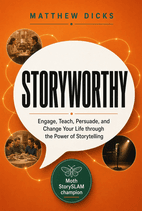
Storyworthy by Matthew Dicks Book Cover

by Matthew Dicks

Matthew Dicks's Storyworthy argues that small everyday moments make the best stories, teaching readers to notice and capture them through tools like Homework for Life, Crash & Burn, and the First Last Best Worst grid, then shape them using the five-second moment, stakes strategies, and the but-and-therefore principle. Written for reluctant performers, attorneys, salespeople, leaders, and anyone seeking better conversation or connection.

On Insta.page you also get an Apply This Book tool that lets you combine insights from up to 3 books to solve your specific situation.
Chapter mindmaps

Free preview: chapters 1–4 are fully interactive. Click any node to expand or collapse. Subscribe to unlock the rest.

Chapter 1: Foreword by Dan Kennedy

Key concepts: Foreword by Dan Kennedy

Foreword by Dan Kennedy

Ordinary Moments as Story Material

  • A dramatic life isn't required to be a storyteller
  • The smallest moments often make the best stories
  • The work is to notice ordinary moments and keep them

Stories Shape Thought and Self

  • People decide through stories, not numbers (Kahneman)
  • Writing is how Ani DiFranco becomes herself
  • The stories we tell can shape the life that follows

Storytelling as Human Need

  • Storytelling is a basic human need (Alan Rickman)
  • It sharpens when people feel badly governed and powerless
  • It gives dignity and a sense of agency

Chapter 1. My Promise to You

Key concepts: Chapter 1. My Promise to You

Chapter 1. My Promise to You

Beyond the Stage

  • Storytelling benefits work, relationships, and everyday conversations.
  • A reluctant workshop participant reveals the broader promise.
  • Skills apply far beyond performance or entertainment.

From Resistance to Teaching

  • Author initially resisted teaching a workshop.
  • First workshop: ten people, six evenings, local library.
  • Teaching now reaches diverse professionals and performers.

Diverse Students, Diverse Goals

  • Students include attorneys, salespeople, clergy, and novelists.
  • Some seek better dates, interviews, or family communication.
  • Others preserve Holocaust stories or help patients reframe lives.

Practical Method, Not Rulebook

  • No settled curriculum; storytelling is more art than science.
  • Method includes lessons, model stories, and exercises.
  • Step-by-step instructions help locate and craft meaningful material.

The Promise of Results

  • Every student following instruction becomes effective and entertaining.
  • Payoff includes clearer explanations and stronger small talk.
  • Follow the method to become capable, engaging storytellers.

Chapter 2. What Is a Story? (and What Is the Dinner Test?)

Key concepts: Chapter 2. What Is a Story? (and What Is the Dinner Test?)

Chapter 2. What Is a Story? (and What Is the Dinner Test?)

Personal Narrative: True Stories Told by the People Who Lived Them

  • Personal stories require honesty, openness, and risk-taking.
  • Folktales entertain but tellers stay hidden; personal stories reveal the self.
  • Elysha's Chili's story shows storytelling's power before performance.

Change: The Essential Ingredient of a Story

  • A story must show change over time, from one self to another.
  • Change can be tiny and need not be improvement, but must happen.
  • Stories without change are anecdotes: fun but forgettable.

Your Story: Tell Your Own, Not Someone Else's

  • Listeners prefer your raw, real story over someone else's better one.
  • Another's story works only as your side, with you at the center.
  • Example: Matt tells his side of Bengi's grudge release.

The Dinner Test: Keep It Conversational

  • Stage version should sound like telling a friend at dinner.
  • Avoid theater, purple prose, and unattributed dialogue.
  • Memorize beats, opening/closing lines, and laugh lines, not full script.

Key Takeaways: Practical Rules for Storytelling

  • Tell stories from your own life; show what was at stake.
  • Build around before-and-after; if no change, keep it short.
  • Leave out drinking recaps, vacation itineraries, cuisine, and destination charm.
  • Rehearse only key beats, first/last lines, and laugh lines.

Chapter 3. Homework for Life

Key concepts: Chapter 3. Homework for Life

Chapter 3. Homework for Life

The Power of Small Moments

  • Dramatic events run out; ordinary moments connect better with audiences.
  • Small moments are everywhere but slip by unnoticed.
  • A dinner-table scene about a secret hunger resonated more than near-death stories.
  • Audiences relate to universal experiences like secrets, shame, and love.

The Homework for Life Practice

  • Each night, ask: what five-minute story from today would I tell onstage?
  • Record a sentence or two in a spreadsheet with date and story.
  • Keep it small to maintain daily and catch old memories.
  • The spreadsheet allows sorting and revisiting moments.

Unlocking Forgotten Memories

  • The practice brings back forgotten memories, like seeing Measleman the dog.
  • A rain-soaked memory led to a new understanding of his father's loss.
  • His list of untold story ideas now exceeds five hundred.
  • Other storytellers claim they have no more stories, which he finds impossible.

Transformative Effects

  • A workshop student felt important and part of a larger story after three months.
  • The practice changes how time feels; days creep, weeks feel like months.
  • Any spreadsheet entry takes him right back to the moment.
  • It requires commitment (five minutes nightly) and faith (change comes slowly).

Capturing Last Times

  • Clara asked to be picked up; he realized he was the last person to lift her as a child.
  • Without the practice, such moments would be lost.
  • Capture moments that mark a last time with someone you love.
  • These moments pass without announcement.
You've reached the end of the free mindmaps

Next chapter: “Chapter 4. Dreaming at the End of Your Pen” is locked

See every chapter of Storyworthy as an interactive mindmap — and unlock all 600+ book summaries with audio and AI Q&A.

$0.00 due today · 7 days free, then $89.99/year ($7.49/mo) · Cancel anytime before day 7

plus sales tax where applicable

Continue exploring Storyworthy