Start With Yourself Quotes
by Emma Grede
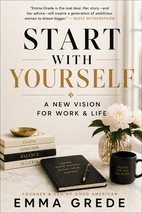
This collection brings together some of the most striking lines from Emma Grede's 'Start With Yourself'. They are not meant to be gentle. Instead they land like a friendly but firm wake up call. You will find straight talk about taking control, setting boundaries, and choosing yourself first. The book is full of moments that make you stop and think.
What makes these quotes so quotable is their raw honesty. Grede doesn't sugarcoat. She shares hard earned lessons about anger, fear, and the myth of perfection. Her words stick with you because they feel true. They remind you that you have everything you need, and that the only way forward is to start with yourself.
Top Quotes from Start With Yourself
“If we're going to change the world, we have to start with ourselves. We have to get on our own teams and choose ourselves first. We have everything we need.”
The author delivers her closing call to action in the introduction.
It serves as a memorable, empowering mantra that reframes self-prioritization as the foundation for broader change, motivating readers to begin internally.
“Boundaries are the distance at which I can love you and me simultaneously.”
Author quotes trauma therapist Prentis Hemphill.
It beautifully redefines boundaries as an act of love for both oneself and others, resonating with readers seeking healthy relationship dynamics.
“Perfection is not the goal, forward motion is.”
The author emphasizes the importance of taking action over getting things exactly right.
This succinct line liberates readers from the paralysis of perfectionism and encourages continuous progress.
“No one has made me happier than I make myself.”
After discussing the habits and rituals she relies on for joy.
It's a powerful, self-affirming reminder that happiness is an internal responsibility, not something to wait for from others.
“You can do all the things—you just can't do them all at the same time.”
The author reflects on trade-offs and the impossibility of simultaneous perfection.
This line offers a liberating truth that counters the pressure to multitask and be everything at once.
“Start with yourself. Putting yourself first is self-care, self-care that is not about a spa day.”
The author encourages women to prioritize their own career and financial future over nurturing others.
It redefines self-care as strategic ambition, empowering readers to invest in their own long-term freedom.
“Nobody knows what they’re doing; your only job is to figure it out, day by day.”
The author presents a new thought to replace impostor syndrome.
It relieves the pressure of needing to be an expert and normalizes uncertainty. It encourages a patient, persistent approach to challenges.
Themes Behind the Quotes
One of the strongest themes in these quotes is personal accountability. Grede insists that you have the power to create your own future, no matter what happens around you. This means taking responsibility for your feelings, your choices, and your growth. It also means learning to set boundaries that honor both you and others. The message is clear: stop waiting for someone else to fix your life.
Another key theme is letting go of impossible standards. The book pushes back against the idea that you should always be happy, perfect, or in control. Instead it celebrates forward motion, even when it is messy. Sadness and fear become signals, not failures. Curiosity replaces judgment. The overall idea is that life is not a checklist, and your only job is to keep figuring it out day by day.
Quotes by Chapter
Introduction
“I've always known how to put myself together, even when everything else in my life is a mess.”
The author reflects on her ability to maintain her appearance despite living in a rundown apartment and facing personal chaos.
This line resonates because it captures resilience and self-possession, showing that even in disorder one can maintain a sense of control and dignity.
“Rather than looking for people and factors to blame for why everything in my life was shaky and unstable, I decided to get on with it—and do everything differently from the people around me to create safety and security for myself.”
The author describes her early decision to take full responsibility for her life instead of blaming circumstances.
It powerfully reframes adversity as a catalyst for personal agency, encouraging readers to stop waiting for external fixes and instead take action.
“I take full responsibility for my life, and I create my own future, regardless of what comes back at me.”
Near the end of the introduction, the author states her core philosophy of self-determination.
This concise, declarative statement embodies the book's central message of ownership and proactive living, inspiring readers to claim their own power.
Chapter 1: Anger
“I knew in that moment that if I didn’t deal with my anger, it would deal with me.”
Author reflects after blowing up at a deaf woman in a tube station.
This line captures a universal truth about the consequences of ignoring anger, serving as a powerful call to self-awareness and proactive emotional management.
“Staying angry didn’t magically give me a different childhood; it only hurt me.”
Author discusses her realization about childhood anger towards her mother.
It reminds readers that holding onto anger does not change the past but only prolongs personal pain, encouraging them to let go for their own sake.
“The only way to get out of the Maze is not to win. The only way you can get out of it is to say, I don’t have enough time to waste on this shit, so I have to let the other guy win.”
Author quotes psychiatrist Phil Stutz on the concept of the Maze.
This offers a counterintuitive but liberating perspective on releasing the need for vindication, freeing one to move forward rather than stay stuck in resentment.
Chapter 2: Fear
“You're going to have to shit your pants a little bit to get to anything good on the other side.”
The author bluntly advises that taking risks and pushing through fear is necessary for achieving meaningful outcomes.
The raw, humorous language makes the truth unforgettable, breaking through polite reassurances and motivating action.
“When I feel low-grade scared about pushing into a new opportunity, or a new venture, or a new space, it's a signal for me that there’s something there that I need to move toward.”
The author describes her personal framework for interpreting fear as a positive guide.
This reframes anxiety as a compass pointing toward growth, helping readers see fear as a helpful rather than paralyzing emotion.
“If I’m not a little scared, then I know I’m not pushing enough.”
The author states her own rule for gauging whether she is challenging herself.
It powerfully inverts the usual view of fear, turning it into a necessary signal that you are on the right track.
Chapter 3: Guilt
“Nothing exerts a stronger psychic effect upon the human environment, and especially upon children, than the life which the parents have not lived.”
Author cites Carl Jung on parental influence.
Highlights the profound impact of parents' unfulfilled lives on children, a core theme of the chapter.
“And before you give guilt any attention in your life, make sure that it’s coming from inside of you as a signal about your values, and not from failing to meet the expectations of others.”
Author's concluding wisdom on guilt.
Clarifies the distinction between internal value-driven guilt and external expectations, providing a practical filter for readers.
Chapter 4: Sadness
“I promise: If you don’t deal with life, life will deal with you.”
The author reflects on the consequences of ignoring emotional pain.
This line is a crisp, universal warning that resonates with anyone who has tried to avoid difficult emotions, reminding them that avoidance only invites bigger problems.
“The expectation that you should wake up every day and feel that everything is fantastic and you're killing it —that you're the best wife, the best mother, and the best at work—is not realistic, and you're setting yourself up to fail.”
The author challenges the pressure to be perfect, especially for working mothers.
It captures the exhausting myth of having it all and validates the normalcy of struggle, offering relief to readers who feel they must constantly excel.
“Sadness, when you welcome it rather than resist it, becomes a mirror—showing us not what is wrong, but what is unfinished.”
The author concludes the chapter with a reflection on embracing sadness.
This poetic reframing transforms sadness from a weakness into a tool for self-discovery, encouraging readers to sit with their feelings rather than flee from them.
“Social media will try to convince you that you should always feel great, but the reality is that life is sometimes hard, and in its own way, that’s great, too.”
The author contrasts curated online perfection with authentic human experience.
It offers a counterpoint to the highlight-reel culture, normalizing difficulty and reminding readers that hardship is not a failure but part of a meaningful life.
Chapter 5: Joy
“I've never been carefree; I don’t know what that would even feel like. But I have found ways to feel a lot of joy.”
Emma reflects on her childhood inability to play and be carefree.
This line resonates because it validates the experience of those who struggle with being lighthearted, while offering hope that joy is still achievable.
“I don't feel fortunate. I earned my right to be here.”
Emma responds to a television host who asked if she feels grateful for her success.
This challenges the cultural script that women should attribute success to luck, and instead claims ownership and pride in one's achievements.
“We are all very powerful. It may not always feel like it—often, it can feel like you're swimming upstream—but I would argue that this type of resistance builds strength and flexibility and endurance.”
Emma critiques the language of 'empowering women' and reframes struggle as a hidden source of power.
It reframes adversity as a builder of resilience, encouraging readers to recognize their inherent power even in difficult circumstances.
Chapter 2: Money
“Life is not a to-do list; you're not going to tick all the boxes every day.”
The author challenges the myth of 'having it all' and urges self-grace.
It reframes daily life as something to experience, not just accomplish, reducing guilt and anxiety.
“Honestly, parenting is not that deep. It’s just not that deep.”
The author dismisses the culture of over-parenting and micromanaging children.
This blunt statement cuts through fear-based parenting advice and offers relief to exhausted parents.
Chapter 3: Career
“I learned, then and there, that people don't buy when they understand what you're doing; they buy once they feel understood.”
After the successful launch of Good American, the author reflects on customer connection.
This insight flips traditional marketing on its head, emphasizing emotional resonance over comprehension. It's a memorable principle for anyone building a brand or relationship.
“The only thing you need to continually cultivate throughout your life is curiosity, the belief that there’s more for you to learn and plenty of people to teach you, and that you can't be complacent.”
The author gives advice on maintaining a growth mindset in business and life.
It distills success into three actionable attitudes: curiosity, openness to learning, and refusal to be complacent. This is empowering and timeless.
“If you go into every encounter with a beginner’s mind, believing you have so much to learn, you will.”
The author describes learning from Nordstrom's team and customers.
This simple statement captures the power of humility and lifelong learning. It reassures readers that not knowing is a strength when paired with openness.