Start With Yourself Key Takeaways
by Emma Grede
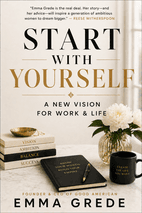
5 Main Takeaways from Start With Yourself
Rightsize your emotions; they're signals, not stop signs.
Emma Grede argues that emotions like anger, fear, guilt, and sadness are essential guides—but only when modulated, not suppressed or unchecked. She shows how to ask 'Is this guilt mine or someone else's?' and how to reframe fear as challenge stress, turning emotional literacy into a superpower for growth.
Take full ownership of your life—stop blaming and seeking permission.
Blame is a trap, and inventing bosses to subordinate yourself to keeps you stuck. Grede insists you must take personal responsibility for your experience, let go of the need for revenge or approval, and walk through the doorway of growth without waiting for anyone's permission.
Negotiate for yourself as fiercely as you would for a client.
Financial security requires you to assume you're undervalued, research your market worth, and state your ask as a fact—no cushioning language. Grede's rules—never accept the first offer, don't overexplain, and always create leverage—directly counter the scarcity mindset and guilt women often feel about earning more.
Set clear habits and boundaries, and forgive yourself for imperfection.
Defining no more than three habits and three boundaries creates momentum even when you fall short. Grede emphasizes that clearing emotional blocks comes first, and that joy isn't a steady state—it's about clearing obstacles, owning your success, and stopping the comparison to curated perfection.
Build real support systems—at home, at work, and among friends.
Deep friendships outside your partner keep you grounded, and partnerships thrive on distinct roles and mutual trust. Grede normalizes fertility struggles and working motherhood, insisting that ambition and parenting coexist only when women have agency, honest conversations, and real support—not just platitudes.
Executive Analysis
These five takeaways form a cohesive thesis: true success begins with internal work—mastering your emotions, owning your choices, and rejecting the guilt and scarcity that hold you back. Grede dismantles the cultural traps (parentified guilt, invented bosses, manufactured scarcity) that keep people, especially women, from stepping into their power. By learning to rightsize feelings, negotiate fiercely, set boundaries, and build authentic support, you stop self-betrayal and start living aligned with your values.
This book matters because it offers actionable, no-fluff strategies for anyone tired of generic self-help platitudes. Grede draws on her own journey as a founder, wife, and mother to address real-world dilemmas—from negotiating a raise to handling mum guilt. It sits in the intersection of emotional intelligence, personal finance, and leadership, giving ambitious women (and anyone facing self-doubt) a practical roadmap to reclaim agency and build a life that feels whole, not divided.
Chapter-by-Chapter Key Takeaways
Introduction (Introduction)
Define no more than three habits and three boundaries; writing them down creates momentum even if you don't achieve all.
Unpaid internships can provide experience and connections more valuable than immediate payment.
Emotional literacy is an advantage, not a weakness—but emotions need modulation, not suppression or unchecked expression.
Rightsizing feelings (including guilt, fear, and enthusiasm) is essential; ignoring your body's "no" leads to self-betrayal.
Clearing emotional blocks comes before deeper mindset work; this can be learned through community programs if therapy isn't accessible.
Try this: Write down no more than three habits and three boundaries to create momentum, and rightsize your emotions by acknowledging them without suppression or unchecked expression.
Anger (Chapter 1)
Anger is an essential emotion that can show you what matters—but you must become skillful in expressing it without destruction.
The goal is not to avoid anger, but to learn how to choose a different response when it arises.
Blame is a trap. Taking personal responsibility for your experience shifts everything.
Revenge is a maze with no exit. Letting go of the need to be right or get even frees you to move forward.
Forgiveness is a process, and boundaries are a valid form of love. Not everyone deserves re-entry into your life.
Try this: When anger arises, pause and choose a response rather than reacting; take responsibility for your own experience instead of blaming others, and forgive without automatically letting people back in.
Fear (Chapter 2)
Fear is a signal, not a stop sign. If you're not a little scared, you're not pushing your edge.
Reframe fear as challenge stress—your body rising to meet opportunity, not danger.
Speed matters. Move forward through discomfort quickly; don't let overthinking freeze you.
Stop inventing bosses to subordinate yourself to. You don't need permission from anyone to take your next step.
The women-may-get-fired reflex is real, but it's a cultural trap. Recognize it and refuse to live there.
The doorway is always there. Walk through it. Growth is waiting on the other side.
Try this: Reframe fear as challenge stress and move quickly through discomfort—stop inventing bosses to give you permission and recognize when the 'women-may-get-fired' reflex is a cultural trap you can refuse.
Guilt (Chapter 3)
Parentified children grow up with a skewed sense of responsibility. Grede’s experience of being the “little mother” taught her that she could never do enough, a pattern that later fed her own mum guilt. Recognizing that pattern is the first step to breaking it.
Guilt has a purpose, but only when it’s your own. It’s a useful signal when you’re out of alignment with your values. But too often, guilt reflects other people’s expectations, not your own. Always ask: Is this guilt mine, or someone else’s?
Don’t make your kids responsible for your choices. When we blame our families for not pursuing our ambitions, we shift the burden onto them. Michelle Obama’s advice rings through: “If you are choosing to drive in your career, don’t parent from guilt.” Kids watch us; let them see you own your decisions.
We need to normalize working mothers. Grede calls out the double standard where fathers are rarely questioned about their presence, while mothers are constantly judged. Fighting back—even at the school gate—matters. Modeling ambition for your children, especially your daughters, gives them permission to do the same without the same guilt.
Try this: Ask yourself if the guilt you feel is truly yours or inherited from others; own your choices without making your family responsible, and model ambition for your children instead of parenting from guilt.
Next chapter: “Sadness” is locked
Keep learning from Start With Yourself — and unlock all 500+ book summaries with audio, mindmaps and AI Q&A.
$0.00 due today · 7 days free, then $89.99/year ($7.49/mo) · Cancel anytime before day 7