Six Months to Six Figures Quotes
by Josh Coats
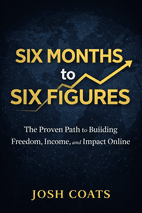
This page collects some of the most memorable lines from Josh Coats' book. They are the kind of sayings that stop you mid sentence and make you reconsider what you thought you knew. Each quote feels earned, like a truth tested in real experience rather than dreamed up in a classroom.
What makes the book so quotable is how it weaves practical business wisdom with deep personal insight. The lines hit on identity, courage, and the quiet discipline behind meaningful success. They are short enough to post and remember, yet layered enough to return to again and again.
Top Quotes from Six Months to Six Figures
“Entrepreneurship is a multi-skill sport being marketed like a single-skill trick.”
The author explains why simple 'one thing' solutions fail.
It encapsulates the core fallacy that holds entrepreneurs back, highlighting the need for integration rather than a single fix.
“Your identity always wins, even when your goals disagree.”
The author discusses subconscious programming in Pillar One.
This line resonates because it speaks to the universal struggle between intention and habitual behavior, making it a powerful reminder of inner dynamics.
“Speed creates momentum, and momentum creates confidence.”
Author Tori Armstrong explains the core mechanism of speed.
This line succinctly captures the central thesis of the chapter—action breeds belief—and makes it easy to remember and repeat.
“It's not about motivation,” she said. “It's about what you believe about yourself when no one's watching.”
The author's coach responds to her frustration about inconsistency during a coaching call.
This line reframes the root of inconsistency from a lack of motivation to deep-seated self-belief, making it a powerful and relatable insight for anyone struggling with follow-through.
“Transformation doesn’t begin with confidence. It begins with courage—the quiet kind that chooses to believe before there's proof.”
The author reflects on the essential starting point of personal change near the end of the chapter.
This sentence beautifully distinguishes between courage and confidence, validating the fearful but brave first step that many readers need permission to take.
“You do not rise by doing more—you rise by becoming the version of yourself capable of holding more.”
After overcoming a decade of stagnation, the author reflects on the lesson from crossing the million-dollar mark.
This line reframes success as identity evolution rather than hustle, making it a powerful mantra for entrepreneurs who feel trapped in overwork.
“Grit is not loud. Grit is not glamorous. Grit is built in the quiet decisions no one applauds.”
She explains the nature of resilience after describing her early struggles as a young mother and wife.
It redefines grit as unglamorous persistence, validating the small, unseen efforts that lead to long-term success.
Themes Behind the Quotes
A central theme is that external success is a mirror of internal growth. The quotes repeatedly challenge readers to look at their own identity and beliefs as the real engine behind achievement. They argue that no amount of effort or strategy can outrun who you are at your core.
Another strong thread is the power of small, consistent choices over dramatic leaps. The book emphasizes courage over confidence, showing that belief often needs to come before proof. It also explores the tension between belonging and expansion, urging readers not to shrink themselves to fit in. Grit and resilience are framed as quiet, unglamorous habits built in the messy middle of progress.
Quotes by Chapter
Chapter One - The Three Pillars of Entrepreneurial Success
“You don’t fail from lack of effort. You fail due to a lack of integration.”
The author reframes failure in the section on the Dangerous Myth of the 'One Thing'.
It's a liberating insight that shifts blame from personal deficiency to systemic incompleteness, offering hope and a clear direction for growth.
“If your identity is strong but your messaging is weak, you'll feel confident... but invisible.”
The author describes the consequences of missing pillars in 'Why You Need All Three'.
It's a vivid, memorable warning that reveals the practical impact of imbalance, easily relatable for entrepreneurs feeling unseen despite their efforts.
Chapter Two - The Power of Speed: Confidence in Action
“Confidence is a byproduct of commitment.”
Tori Armstrong defines how confidence is built through action.
It reframes confidence as something earned through follow-through, not a prerequisite, which empowers readers to start before they feel ready.
“Success doesn’t wait for you to be ready. It rewards the ones who move first.”
The closing challenge to the reader, urging immediate action.
This forceful, memorable pair of sentences creates urgency and directly challenges procrastination, leaving a lasting call to action.
Chapter 3 - Stacking Priorities, Not Sacrifices
“My life wasn't the problem. My architecture was.”
The author realizes that her life's struggles came from having her priorities stacked in the wrong order.
This line encapsulates the chapter's core insight — that burnout isn't a personal failure but a structural issue, empowering readers to rebuild rather than blame themselves.
“If you don’t close them intentionally, they bleed into the next one.”
She warns that seasons of sacrifice don't end on their own unless you deliberately choose to stop them.
This quote is a sharp, memorable reminder that temporary sacrifices can become permanent habits without conscious boundaries, resonating with anyone prone to overextending.
“I didn’t want to be the woman who hit high ranks but felt hollow.”
After achieving a major milestone, the author felt grief instead of pride, leading to this realization.
It captures the painful disconnect between external success and internal fulfillment, making it deeply relatable for ambitious readers who fear losing themselves in their goals.
“You don't have to shrink yourself to grow your income.”
This appears near the end, as she summarizes the message of building on a solid foundation.
This short, defiant statement challenges the common belief that success requires self-sacrifice, offering hope that you can expand without diminishing who you are.
Chapter Four - The Woman Who Chose to Believe
“Success isn't one big moment. It’s hundreds of small, unseen decisions—choosing belief again and again until it becomes your new normal.”
The author's coach teaches her about the nature of success during their sessions.
It demystifies success as an accumulation of quiet, deliberate choices rather than a single dramatic event, offering a practical and encouraging mindset shift.
“I believed before I could see it. Someone believed in me when I couldn't. And now, I choose to hold that belief forward.”
The author summarizes her journey from doubt to becoming a mentor herself.
It captures the cyclical power of belief—first received, then embodied, then given—creating a resonant and inspiring call to pay it forward.
Chapter Five - The Effortlessly Productive Method
“Elimination is a practice. A rhythm. A return.”
In the section on releasing what drains you, the author describes elimination as an ongoing process.
The concise, rhythmic structure makes this memorable and emphasizes that letting go is not a one-time event but a continuous discipline.
“The business can only grow to the extent that you do.”
During the discussion of reclaiming ownership, the author connects personal development to business capacity.
It captures the core truth that scaling requires inner expansion, resonating with anyone who has felt limited by their own mindset or identity.
“You cannot keep carrying what was never yours to hold alone.”
The author describes her burnout and the realization that delegation is necessary for leadership.
This line validates the exhaustion of over-functioning and offers permission to let go, striking a chord with perfectionists and solo operators.
Chapter Six - The Token Leadership for Black Women
“Belonging isn’t earned by shrinking. It’s earned by daring to expand.”
Tiffany shares Lesson One: belonging comes from expanding, not shrinking.
This line flips the common narrative that to fit in you must make yourself smaller, inspiring readers to embrace their full presence.
“Imposter syndrome is not insecurity—it’s misdiagnosed brilliance.”
In Lesson Two, Tiffany redefines imposter syndrome as a sign of trailblazing.
It offers a powerful reframe that turns self-doubt into evidence of greatness, giving readers permission to own their achievements.
“Your transformation will threaten the people who benefited from your silence.”
Lesson Four warns that growth often unsettles those comfortable with your past silence.
This validates the pushback many experience when they start speaking up, normalizing the discomfort of change.
“Legacy isn't something you leave behind—it’s something you live in real time.”
Tiffany explains in Lesson Five that legacy is an active, present choice.
It shifts the focus from future accolades to current impact, encouraging readers to live purposefully today.
Chapter Seven - The Armor I Was Given
“I was not born into stability. I was born into survival.”
Haley Ebersole contrasts her upbringing with those who had stability.
This line is instantly relatable to anyone who has faced hardship, framing survival as a distinct, formative experience rather than a temporary setback.
“You do not wake up thinking something is wrong. You simply adapt. You normalize things that should never feel normal. You build your nervous system around unpredictability and call it strength.”
She describes how chaotic environments shape a child's perception of reality.
It captures the insidious way trauma rewires normalcy, and the false strength that comes from forced adaptation—resonant for survivors who later unlearn those patterns.
“The hardest parts of your life are not always the parts that ruin you. Sometimes they are the parts that build you.”
Haley reflects on her childhood trauma and her father's incarceration.
This reframes pain as a potential foundation for growth, offering hope without dismissing the difficulty of the experience.
Chapter Eight - Building My Dream in The Middle of Chaos
“I did not become who I am despite my past. I became who I am because of it.”
The author reflects on how her chaotic upbringing shaped her identity.
This line powerfully reframes adversity as integral to personal growth, inspiring readers to embrace their past rather than overcome it.
“Dreams aren't built in ease — they're built in the messy middle.”
The author states the chapter’s core message about pursuing dreams amid life’s chaos.
It offers a memorable mantra that validates the struggle of pursuing goals when conditions are far from perfect.
“Your beginning is not your ending. Your grit is your greatest asset. And the life you imagine is already waiting on the other side of the beliefs you outgrow.”
The author concludes her introduction with an empowering call to action.
This trio of statements encapsulates the chapter’s theme of resilience and the necessity of shedding limiting beliefs.