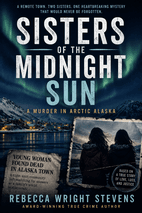
Sisters of the Midnight Sun Quotes
by Rebecca Wright Stevens
These quotes come from a novel that moves between sharp dialogue, vivid narration, and the narrator's private thoughts. You will find moments of grief, humor, frustration, and tenderness, often in the same scene. The voice is direct and alive, with observations that feel true in the moment and linger afterward.
The Arctic setting shapes everything, but the concerns are universal: identity, justice, belonging, and survival. What makes the book quotable is how often a single line captures a character's whole situation or a hard truth without spelling it out. The best quotes work like small stories you can carry with you.
Top Quotes from Sisters of the Midnight Sun
“The legal system was Anglo, and the location was Native. The two didn’t fit.”
Rebecca reflects on the conflict between Anglo due process and Inupiaq community justice.
It condenses the novel's central cultural conflict into two blunt sentences.
“We are all prey, I thought. Many things had changed in my lifetime, with the advent of television, jet air travel, and the internet, but this one fact remained the same.”
Rebecca looks around the courtroom at women after hearing about Amos's mother.
It strikes the chapter's darkest chord: modernity has not ended the predation of women.
“There are other women missing on the tundra.”
Marten explains to Rebecca why Public Safety must chase rumors about Amos Lane, noting that other women have disappeared.
A single quiet sentence points to the sprawling crisis of missing Indigenous women, deepening the novel’s grief beyond the two murdered sisters.
“Any woman could end up a victim like this. I said a prayer for the peace of her soul and for her sister's, and I added one for Amos's mother, who had died as they had, as though she also were a sister. I thought that all of us who are prey are sisters.”
Inside the murdered sisters' home, the narrator prays for the victims and Amos's mother.
It transforms the crime-scene detail into a profound statement about shared vulnerability and solidarity among women.
“You white eyes come up here with all your degrees and think you're going to fix everything, and then it takes the whole village to get you trained to the job.”
Liz warns Rebecca in the bathroom about how the village teases outsiders who think they know everything.
It is a sharp, affectionate reality check that frames the novel's larger tensions between outside expertise and Native knowledge.
“But Inupiaq law has been around for thousands of years before you guys came. Some people shouldn't be represented. They should be cast out.”
Liz argues that Rebecca should not represent Amos Lane, invoking traditional Inupiaq justice.
The lines confront Rebecca—and the reader—with a legal and moral worldview that challenges the assumptions of due process.
“The caribou feeds the wolf, but it is the wolf who makes the caribou strong.”
Opening epigraph to the chapter.
It captures the paradox that hardship and danger can create strength, framing the novel's themes of survival and interdependence.
Themes Behind the Quotes
One central theme is the clash between outside systems and Native lives. The legal framework imported from elsewhere does not fit the place or its people, and that gap creates suspicion, unfairness, and pain. Another thread is the vulnerability of women, who are treated as prey even as they hold communities together. The novel connects their suffering across time and place, making sisterhood a form of resistance.
There is also a deep concern with identity, especially for Inupiat people caught between two cultures and for outsiders who can never fully belong. Yet the book insists on strength found in tradition, interdependence, and values that survive any place. Grief is not hidden here. It is accepted, and survival is not a clean triumph but a shared, messy process. These themes work together to question what justice means and who gets to decide.
Quotes by Chapter
Chapter 1
“The second answer was that the midnight sun and the polar night and the white owls and white bears and white foxes of the Arctic fascinated me. Especially the white owls.”
Rebecca recalls the private reason she moved to Arctic Alaska.
It captures the strange, luminous beauty that drew her north.
“When Amos was fourteen, his mother was dragged into a house by three men. They raped and tortured her until she died.”
Petersen tells Rebecca about Amos Lane's traumatic past during the arraignment.
This revelation shocks Rebecca and gives a human face to a man the courtroom already condemns.
Chapter 2
“Men were the ‘keepers of the tradition,’ and therefore they were thought to be the most important. The women let them think this, but the women knew that if it weren't for them, doing all the hard work putting up supplies to feed the family and planning for the future, the people wouldn't survive.”
Opening epigraph of the chapter, attributed to Emma Sikkikoq Mills via Loretta Outwater Cox.
It reframes a patriarchal hierarchy with dry irony, making clear that survival depends on women’s invisible labor.
“If he's innocent, he’s got nothing to worry about.”
Rebecca refuses to give Ellingsworth names from her client’s case, and he responds with this pressure tactic.
The line seems reasonable but is a chilling coercion tactic, exposing how law enforcement can weaponize innocence.
“I had never known Public Safety to push this hard for evidence. If they couldn't find any evidence, might they make some? Sometimes hair was found where it had been “overlooked” before. Often jailhouse snitches coincidentally overheard just what Public Safety needed them to overhear.”
Rebecca walks back to her office after discovering Public Safety’s illegal recording and thinks about how pressure can corrupt an investigation.
It is a chilling inner monologue about the fear that justice systems may fabricate what they cannot find, and it puts the reader inside a defense attorney’s dread.
Chapter 3
“No wonder the ancients had called the area “place where the snowy owls gather.” I always think of it that way.”
The narrator watches snowy owls gliding above the tundra outside her house.
It links the narrator's personal awe to an ancient sense of place, making the Arctic landscape feel timeless and sacred.
“I had no duty to point the button out to Joe, but at the same time, I had a duty not to secretly confiscate it, though my fingers itched to grab it and carry it off to submit to our own forensic experts before the State saw it.”
The narrator spots a torn plaid button near the stove and wrestles with what she should do with it.
It captures the sharp ethical tension of a defense attorney caught between legal duty and the instinct to protect her client.
“The faces were swollen out of proportion by the gases of decomposition, produced during what was Utqiagvik's warmest season, the early weeks of August. They looked not only dead but as though they had never been alive and human. They looked like balloons with lips and eyes smeared on in paint.”
Joe shows the narrator photographs of the two murdered sisters' bodies.
The stark, grotesque imagery makes the horror of violent death visceral and impossible to look away from.
Chapter 4
“But the damned endless summer sunlight got on my nerves. There were no peaceful twilights, no star- dazzled midnights, just sun so bright it made your eyes wince until you could get behind blackout curtains and hide.”
Rebecca arrives at her surprise birthday party while the midnight sun is still glaring overhead.
It captures the strange oppressiveness of endless daylight, a specific Arctic experience that outsiders rarely imagine.
“I got the impression people in Utqiagvik were not surprised by grief and that tears were okay, even at a party.”
After crying while dancing with Michael, Rebecca notices no one stares or judges her.
It shows a community's quiet, compassionate acceptance of pain, making the moment more moving than simple comfort.
Chapter 5
“Right away, I couldn't hardly see her very well because it was so dark with the blackout curtains. Now I can't stop seeing her.”
Officer Tidwell is describing to the narrator what he saw when he entered the Ipalooks’ house and found the first victim.
The contrast between textbook images of death and the actual, fading sight—followed by the intrusive memory—captures how trauma imprints itself.
“I grabbed the knife, and the kid lunged for it, and I shoved it in his guts.”
Liz tells the narrator how, at age twelve, she killed a boy who was attacking her cousin.
The blunt, unadorned confession is shocking and unforgettable, revealing the violent childhood that drives Liz’s empathy for kids like Randy.
“Some young Inupiat, caught between two cultures, couldn't envision a future that would work for them.”
The narrator reflects on the high rate of Native teen suicides while worrying about Randy.
It distills a whole cultural tragedy into one clear, heartbreaking sentence, making Randy’s danger feel immediate and systemic.
“The kid wanted a shell for his dying mom. He would have a shell. I had no idea where to get a suitable shell but would figure something out. If it was up to Liz and me, Randy was going to be all right.”
After Liz tells the narrator that Randy asked for a seashell for his dying mother, the narrator silently vows to make it happen.
The small, homely detail of the seashell becomes a powerful symbol of care, and the quiet resolve here is both moving and hopeful.
Chapter 6
“I was a tanik. Bull knew things about Utqiagvik—about Michael, and about the vast North Slope and its customs—that I would never know. No matter how long I lived here, I would always be an outsider.”
The narrator rides through Utqiagvik with Bull and Michael and feels like an outsider.
It lays bare the narrator's self-consciousness and the unbridgeable gap between living in a place and truly belonging to it.
“My heart always ached for the beautiful slaughtered whales, though I sternly reminded myself that the whales taken were few, especially compared with the legions of butchered cattle and pigs in the Lower 48. The process of obtaining bacon did not differ except in the details.”
The narrator watches whaling crews bring in a whale and reflects on subsistence hunting.
It complicates easy judgments about animal suffering by comparing Arctic whaling to industrialized meat production.
“That guy is stronger than four bears. I fell to the ground. The next thing I knew he had grabbed Kiana by the hand and was dragging her off. I got up and jumped on his back. Everybody in the dugout—there were ten or fifteen of us—we all piled on him. He shook us off like we was puppies.”
Nate describes Amos's violent outburst at the dugout when Amos tried to force Nate to swap clothes.
It is a visceral, colloquial account of Amos's frightening power—and how easily he threw off a pile of men.
Chapter 7
“To me, the beauty of what became known as Inupiat Ilitqusiat—Inupiat Values —was the fact that they were not material. They were deeply entrenched in the mind and heart and spirit, and entirely transportable.”
This chapter opens with an epigraph from an Inupiaq state legislator about Inupiat Values.
It frames the novel's central idea that cultural identity lives in the mind and spirit, not in possessions. The phrase 'entirely transportable' vibrates with the narrator's experience of entering a new community.
“For just a moment I wished we had the house to ourselves, but when I looked up at him, I could see that he was pleased with the occasion, and with me, and so I returned to my cooking, warmed in spite of the wind.”
The narrator watches Michael enjoy the chaotic family barbecue after he kisses her at the back door.
It captures the tension between wanting privacy and feeling joy in being accepted by his family. The final phrase, 'warmed in spite of the wind,' beautifully conveys emotional warmth against the cold setting.
“The clan had absorbed me, perhaps not permanently, but at least, for Michael's sake, for the occasion.”
During the poker game, the narrator realizes she feels included in Michael's family gathering.
It expresses the fragile, conditional sense of belonging she has found. The honest qualifiers make the moment more poignant than simple acceptance.
“Did I look older than this lady, whose son’s kiss I could still feel on my mouth?”
The narrator meets Michael's mother, Mamie, for the first time and worries about how she appears.
It catches a moment of vulnerable self-comparison just after Michael has kissed her. The mingling of insecurity and desire makes it deeply relatable.
Chapter 8
“I wasn't afraid of him, exactly, though I knew that a client could do considerable damage to your eye with a pencil before a guard could stop him.”
Rebecca stands in the jail before meeting her client Amos.
It captures the low-level menace of a public defender's work and the wary self-awareness that comes with it.
“What an awful human condition, to be alone and pursued by armed strangers, and then, in spite of your own strength and your best skill and greatest courage, to be overwhelmed by the cold and never to reach home. No wonder he was surly at times.”
After seeing Amos's mutilated feet, Rebecca imagines what he must have survived.
The passage turns judgment into compassion, grounding Amos's hostility in a history of loss and suffering.
Read Sisters of the Midnight Sun: A Murder in Arctic Alaska in context on the summary page.