Right Thing, Right Now Quotes
by Ryan Holiday
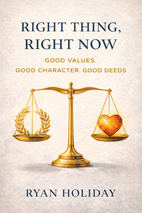
The quotes you'll find here come from Ryan Holiday's book Right Thing, Right Now. They are sharp, direct, and meant to be used. Each one captures a moment of clarity about justice, honesty, and courage. These lines are not just for reflection. They are for action.
This book is so quotable because it blends ancient wisdom with modern examples. Holiday pulls from Stoic philosophers, presidents, and ordinary people who made hard choices. The result is a collection of sayings that cut through confusion and remind you what matters. They stick with you because they are true and urgent.
Top Quotes from Right Thing, Right Now
“Virtue—arete—translates to something very simple and very timeless: Excellence.”
The author explains the ancient Greek meaning of virtue.
This line distills a complex concept into an actionable ideal, reminding readers that virtue is about striving for quality in all aspects of life.
“Until we stop debating, we can't start doing. We keep debating so we don't have to start doing.”
The author criticizes our tendency to prefer abstract debates about justice over practical action.
The paradox and self-awareness in these sentences resonate because they expose a common human evasion, urging readers to move from discussion to commitment.
“Do what is right. Do it right now. For yourself. For others. For the world.”
The author closes the introduction by echoing Admiral Rickover's command to act with justice.
This rhythmic, imperatives-driven line serves as a powerful call to action, encapsulating the book's practical mission in a single, urgent directive.
“Justice is not this thing we demand of other people, but something we demand of ourselves. It's not a thing we talk about, it’s a way of life.”
The author redefines justice in personal terms, contrasting it with common external expectations.
These sentences reframe justice as an internal, active practice rather than a passive complaint, making the concept accessible and deeply personal for readers.
“Each time we keep our word, we make a deposit, we add a strand to the rope that binds the world together.”
The author discusses the social and communal impact of keeping promises.
The metaphor of a rope binding the world together powerfully conveys how individual acts of trustworthiness strengthen the fabric of society.
“He was good for so long that he became great.”
The closing reflection on Marcus Aurelius, who focused on internal virtue and achieved lasting external fame.
This succinct line captures the paradox that greatness is a byproduct of sustained goodness. It resonates because it redefines success as the cumulative result of consistent ethical behavior.
“Whenever you are to do a thing tho’ it can never be known but to yourself, ask yourself how you would act were all the world looking at you, & act accordingly.”
Thomas Jefferson's advice to his friend Peter Carr in a 1785 letter.
It is a timeless ethical guideline, though its irony—given Jefferson's own failures—makes it a sobering lesson about the gap between principles and practice.
Themes Behind the Quotes
One central theme is that justice begins with the individual. It is not about demanding fairness from others but about holding yourself to a high standard. Many quotes emphasize the importance of keeping your word and being honest even when no one is watching. This idea shows up as a call to live with integrity in every small action.
Another theme is the urgency of doing the right thing now. Procrastination and debate are seen as excuses. The book pushes readers to stop talking and start acting. Responsibility is a recurring thread, with an insistence that we must accept duties rather than avoid them. Character is built through consistent choices, not grand gestures. These ideas together form a practical philosophy for everyday life.
Quotes by Chapter
The Four Virtues
“They're called “cardinal,” C. S. Lewis pointed out, not because they come down from church authorities, but because they originate from the Latin cardo, or hinge.”
The author discusses why the four virtues are named cardinal.
The metaphor of a hinge makes the virtues feel foundational and practical—they are what the door to a good life swings on.
“He takes no notice of delicate ground, he just plants his foot down firmly on it.”
Winston Churchill describing Harry Truman's decisive leadership style.
The vivid imagery captures the essence of courageous, unwavering action—a memorable way to describe a leader who does what is right regardless of political sensitivity.
Introduction
“Nothing is right if we're not doing what is right.”
The author summarizes the ancient view that justice is the whole point of every virtue and action.
This short, declarative line cuts to the heart of the book's moral thesis, making it instantly memorable and quotable as a personal maxim.
To Stand Before Kings…
“If it’s not right, do not do it,” Truman underlined in his well-worn copy of Meditations, “if it is not true, do not say it.... First do nothing thoughtlessly or without a purpose. Secondly, see that your acts are directed to a social end.”
President Harry Truman underlined this passage in his copy of Marcus Aurelius's Meditations.
It captures Truman's personal Stoic code of conduct, emphasizing integrity and purposeful action, which guided his decisions as president.
“Since childhood at my mother’s knee,” Truman would recount, “I have believed in honor, ethics, and right living as its own reward.”
Truman reflected on the foundation of his moral beliefs.
This line reveals the deep-rooted personal conviction that drove Truman's life, showing that virtue was its own reward for him.
“I don’t know if you fellas ever had a load of hay fall on you,” Roosevelt's successor would tell the press, “but when they told me what happened yesterday, I felt like the moon, the stars, and all the planets had fallen on me.”
Harry Truman described the overwhelming feeling of suddenly becoming president after Franklin Roosevelt's death.
The vivid agricultural metaphor conveys the immense weight of responsibility he felt, making his subsequent steady leadership all the more remarkable.
“I was taught that the expenditure of public money is a public trust,” he explained, “and I have never changed my opinion on that subject. No one has ever received any public money for which I was responsible unless he gave honest service for it.”
Harry Truman explaining his integrity as a county judge, refusing kickbacks from contractors.
This line captures the essence of public service as a sacred duty, and Truman’s personal commitment to honesty even when surrounded by corruption makes it powerfully inspiring.
Keep Your Word
“I have sworn to them to return,” Regulus explained of the honor system he had been paroled on. “I will not transgress my oaths, not even when they have been given to enemies.”
The Roman general Regulus explains why he must return to Carthage as a prisoner after being sent to Rome to negotiate peace.
This story illustrates the supreme value of keeping one's word, even to enemies and at great personal cost, inspiring readers to uphold their commitments regardless of circumstances.
“But we'll never regret being the kind of person who keeps their word. Who swears truthfully with their actions the promises they made with their mouth.”
The author concludes the chapter by reflecting on the long-term value of integrity.
This line reassures readers that while breaking promises may seem easier in the moment, a life of consistent honesty and reliability is always worth the effort.
“Your word should be enough. Because where are we if it’s not?”
The author argues for the fundamental importance of verbal commitments over formal contracts.
This rhetorical question cuts to the heart of trust and integrity, reminding readers that without reliable words, human relationships and society itself would unravel.
Tell the Truth
“I didn’t really think I could live with a man I didn’t respect and if he went over there and lied, I’d have no respect for him.”
Nell Fitzgerald said this to her husband Ernie the night before he was to testify before Congress, with his bosses pressuring him to lie.
It captures the personal stakes of integrity, showing how truth-telling is tied to self-respect and the respect of loved ones.
“An honest person should be like a smelly goat in the room, Marcus would say—you know when they're there.”
Marcus Aurelius used this analogy to describe how an honest person's presence is unmistakable.
This vivid metaphor makes the ideal of honesty tangible and memorable, emphasizing that truth-tellers cannot be ignored or confused.
“His rule: Let that come into the world, let it even reign supreme—only not through me.”
Aleksandr Solzhenitsyn defined the rule of an ordinary brave man who refuses to participate in lies.
It distills the essence of moral resistance into a simple, powerful principle that anyone can apply to their own life.
“In matters big or small, public or private, convenient or inconvenient, whether it will be rewarded or punished, tell the truth.”
The author's concluding exhortation to readers after recounting the examples of whistleblowers and ancient wisdom.
This concise, universal call to honesty leaves no loopholes, challenging readers to make truth-telling an uncompromising habit.
Take Responsibility
“I then made the only resolution that I ever kept,” he would later tell a friend. “And it was, never to refuse a responsibility.”
Maxwell Perkins, after saving a drowning friend as a teenager, later recalled his resolution.
This quote encapsulates the chapter's core message—choosing to accept responsibility as a defining life decision that leads to a just and meaningful life.
“We make an agreement with children that they can sit in the audience without helping to make the play,” the doctor tells her as they sit on her couch, “but if they still sit in the audience after they're grown, somebody's got to work double time for them, so that they can enjoy the light and glitter of the world.”
A doctor in F. Scott Fitzgerald's short story "The Adjuster" lectures a spoiled young wife about adulthood and responsibility.
This metaphor powerfully contrasts childhood privilege with adult duty, compelling readers to recognize when it is their turn to contribute rather than just consume.
“Which is why we must swear never to refuse it.”
The concluding sentence of the chapter, summarizing the call to embrace responsibility.
It delivers a simple, memorable mandate that ties the chapter's arguments together, urging readers to adopt Perkins' resolution as their own.
Good, Not Great
“He wasn't going to wait for someone to say something. He didn’t care that they'd won. He didn’t care if they'd let him get away with it. He did the crime, he was going to do the time—or in this case, pay the fine.”
Frank Robinson, after failing to hustle on a hit, walks into the manager's office and fines himself $200.
This passage exemplifies radical personal accountability—holding yourself to a higher standard even when no one else does. It resonates because it shows that true integrity means enforcing your own rules regardless of external consequences.
“My whole theory about life,” Will wrote back, despite the fact that he himself had effortlessly graduated from Harvard, “is that glory and accomplishment are of far less importance than the creation of character and the individual good life.”
Walker Percy's uncle William Alexander Percy writes to the struggling medical student in 1940.
This line challenges the relentless pursuit of external success by prioritizing character over achievement. It resonates because it offers a countercultural yet deeply humane definition of a life well lived.
“Remind yourself that your task is to be a good human being,” he writes, “remind yourself what nature demands of people. Then do it, without hesitation.”
Marcus Aurelius in his Meditations, reminding himself of his fundamental purpose.
This sentence distills Stoic philosophy into a simple, actionable command. It resonates because it cuts through ambition and complexity, focusing on the universal duty of being good.
Be an Open Book
“Double your fee,” Drusus replied, “and make my whole house visible, so that every citizen may see how I live my life.”
Drusus responds to an architect offering to give his house more privacy.
This line perfectly captures the essence of radical transparency, showing that true integrity welcomes public scrutiny rather than shying away from it.
“There is not a crime, there is not a dodge, there is not a trick, there is not a vice,” Joseph Pulitzer famously said, “which does not live by secrecy.”
Joseph Pulitzer's famous observation about the link between secrecy and wrongdoing.
It is a concise and powerful reminder that hiding things is the lifeblood of misconduct, making transparency a moral imperative.
“Son, you ought to keep the company of the sort of people who won't cause you to change color when observed.”
A Spartan king's reply to a youth and his lover who tried to hide their blushing after being seen together.
This offers a practical, everyday test for integrity: live so that you never feel shame when seen by others.