Public Speaking How To Speak Effectively Without Fear Quotes
by Derek Borthwick
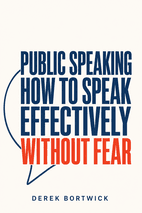
On this page you will find a handpicked collection of lines from Derek Borthwick's practical book on public speaking. They cover nerves, mindset, preparation, delivery, and the small mental shifts that can change how you communicate in front of a room or in everyday conversations.
The book is quotable because it turns familiar speaking fears into clear, practical observations. Many lines are short enough to remember and direct enough to use before a talk, a meeting, or any moment when confidence matters.
Top Quotes from Public Speaking How To Speak Effectively Without Fear
“It's not the act of speaking in public or presenting in front of people that makes you nervous. You make yourself nervous by choosing how you react to the situation.”
The chapter challenges the common belief that public speaking itself is what causes nervousness.
It shifts responsibility to the speaker's reaction and suggests that nervousness can be changed.
“People who get nervous and enter a runaway state have a talent for using their imagination. They have just learned to use this talent in the wrong way!”
The chapter describes what happens when nervousness escalates into a runaway state.
It reframes anxious imagination as a talent that has simply been used in the wrong direction.
“Remember, for something to be interpreted as true, it does not have to be true, just plausible. This is very important.”
This appears after the discussion of the confused mind and the suspicious mind.
It reminds readers that persuasion depends on plausibility as much as truth. This makes perception and framing central to effective speaking.
“There is an adage that people will not remember what you said, but they will remember how you made them feel.”
The chapter discusses how speakers can influence an audience emotionally.
It distills the lasting impact of a presentation into how the audience felt.
“The brain cannot tell the difference between something vividly imagined and something real.”
The author uses this principle to justify imagination-based state control.
It explains why mental rehearsal and imagined experiences can shape real emotional states.
“A speech or talk that has great content and is delivered very poorly will resonate with very few in the audience. On the other hand, a speech where the content is not perfect, but is delivered well, will remain in the minds of the audience.”
While comparing content and delivery, the author explains why delivery has a major effect on audience memory.
It reminds speakers that connection and delivery can matter more than perfect content. It also relieves pressure to make every detail flawless.
“Knowledge is power, and proper preparation prevents a poor performance.”
The author introduces the section on preparing for question time.
It condenses preparation into a memorable maxim. It frames rehearsal as a practical way to reduce risk and stress.
Themes Behind the Quotes
The quotes keep returning to the idea that fear is learned and can be unlearned. Nerves are treated less as a fixed personality trait and more as a reaction shaped by imagination, belief, and focus. Several lines explore how perception, posture, memory, and vivid mental rehearsal influence the state you bring to the room.
Another major theme is practical delivery. Good speaking is not just about content; it is about preparation, clarity, timing, and making the audience feel something. The book also stresses that attention is limited and that presenters should respect the audience's time. Overall, the quotes combine mindset work with simple communication habits, showing confidence as something you build rather than something you simply have.
Quotes by Chapter
CHAPTER 1
“When I delivered my first presentation, I felt very uncomfortable doing it. During my career, I have delivered over three thousand presentations and talks. I have made many mistakes during this time. The good news is I've made the mistakes, so you don't have to.”
The author introduces his own early discomfort and extensive speaking experience.
It builds credibility while making the reader feel that mistakes are a normal part of growth. It promises a shortcut by turning the author's hard-won lessons into guidance.
“Many feel trapped and are a prisoner of their mind.”
The author describes the inner experience of people who dread having to speak in public.
It vividly captures how anxiety can make the mind feel like a prison. The line resonates because it names a feeling many speakers recognize but rarely articulate.
“Ironically, we are experiencing all these emotions and we haven't done anything yet!”
The author points out that fear and stress arise before any actual presentation has begun.
It exposes the ironic power of anticipation, showing that much of the fear is self-generated. That insight makes the anxiety feel more understandable and manageable.
“One of the worst things to experience in business is “death by presentation” delivered by a gifted “PowerPoint hypnotist”!”
The author criticizes poorly prepared business presenters who rely on slides and charm.
The phrase is darkly funny and instantly recognizable to anyone who has endured a lifeless presentation. It sticks in the memory because it turns a common frustration into a vivid image.
CHAPTER 2
“The good news is that as someone has created and learned this fear, then they can unlearn it too.”
The chapter explains that the fear of public speaking is learned and therefore changeable.
It offers hope by framing the fear as a learned response rather than a fixed trait.
“Saying to somebody who suffers from a fear of public speaking that there is nothing to worry about is about as effective as telling someone who struggles with their weight to eat less and move more.”
The chapter compares empty reassurance to unhelpful weight-loss advice.
It vividly shows why telling someone not to worry does not address the underlying fear.
CHAPTER 3
“The confused mind always says: “no” and the suspicious mind always says: “no”. In this story, the confused mind said: “No”, and “let's get out of here!””
This follows the story of the author leaving a currency-trading presentation early.
It captures how confusion and suspicion close the mind before logic can engage. It is a memorable warning for anyone who needs to communicate clearly.
“We never actually experience full reality, just our version of it. This is our map of the world.”
This is stated while explaining how the brain filters sensory data into a personal reality.
It offers a compact explanation of why people interpret the same message differently. It encourages speakers to respect each audience's map of the world.
“If we put this in the context of a presentation or speech, if you are going to confuse your customers and not treat them with respect, then you are likely to experience a shutdown in their thinking.”
The author applies his currency-trading story to presentations and speeches.
It links emotional shutdown to poor communication and disrespect. The line gives speakers a practical reason to prioritize clarity and respect.
CHAPTER 4
“For something to be perceived as true, it does not have to be true, just plausible.”
The author explains how humans seek meaning and why false ideas can seem true.
It is a compact warning about belief and plausibility that applies to inherited myths about speaking ability.
“My view is that being a great presenter or public speaker is not solely of genetic origin, but there is a combination of factors.”
The author states their position in the nature-versus-nurture debate about public speaking.
It frames speaking skill as learnable rather than fixed at birth, which is the chapter’s central reassurance.
“The motto of the story is that a negative belief can restrict what is possible.”
The author draws a lesson from Roger Bannister breaking the four-minute mile.
It turns a famous sports story into a memorable claim about mindset and self-imposed limits.
“Our destiny is not predetermined but is very much in our own hands, except for less than five per cent of genetically inherited diseases.”
The author concludes the chapter after discussing genetics, epigenetics, and belief.
It gives readers an empowering takeaway while acknowledging rare genetic exceptions.
CHAPTER 5
“This means that by adopting a different body posture, it is possible to generate a corresponding emotional response.”
After discussing Amy Cuddy and power poses, it explains the mind-body link.
It gives speakers a physical lever for changing emotional state before presenting.
“The easiest way to get into a particular state is to revivify a previous experience associated with that state as strongly and as realistically as possible.”
It introduces state-control exercises based on vivid recall.
It makes state control practical by tying confidence to vivid memory and imagination.
CHAPTER 6
“Please remember that a situation does not make you nervous. You do it to yourself by the way you choose to react to the stimulus.”
The author explains how to manage nervousness by recognizing that the reaction comes from within.
It reframes nervousness as a controllable response rather than something imposed by the situation, empowering the speaker.
“A big part of presenting, speaking, and communicating effectively is being able to do this with confidence and having control over our state.”
The author summarizes the importance of confidence and state control for effective presenting.
It makes clear that strong communication depends on managing internal state, not just memorizing content.
“People have surprisingly poor recall of events. This is important and is something to consider when we are preparing and delivering our speech or presentation.”
After the party-embarrassment example, the author discusses why speakers overestimate how much others notice.
It offers comfort by showing that audiences are unlikely to remember minor mistakes, reducing post-speech rumination.
“The good news is that as you created the memories based on your perception of reality, then you can change how you choose to recall these memories.”
In the section on subjective memory, the author explains that remembered experiences can be reframed.
It gives readers agency over past memories that may fuel public-speaking anxiety.
CHAPTER 7
“The purpose of a presentation or a talk is to inform, entertain, or educate people. If you can do that in ten minutes, then do so.”
In discussing how much material to include, the author challenges the impulse to overstuff a talk.
It reframes speaking around audience value rather than duration. It gives a crisp standard for knowing when to stop.
“I believe the purpose of a presentation is to generate interest so that people think that sounds interesting; I need to learn more.”
After rejecting a product-dump approach, the author states his own view of a presentation’s purpose.
It shifts the goal from dumping information to sparking curiosity. It is a memorable standard for audience engagement.
CHAPTER 8
“People have very short attention spans, and their concentration tends to waver after ten minutes or sooner.”
The chapter opens by explaining why speakers must capture attention quickly.
It highlights the limited window a speaker has before concentration fades, making early engagement essential.
“If the mind is confused, suspicious or angry, it will always say “no” and will shut down to the information.”
The author describes what happens when an audience feels confused or skeptical during a talk.
It captures how resistance shuts down communication and reminds speakers to reduce confusion and suspicion.