As an Amazon Associate, we earn from qualifying purchases.
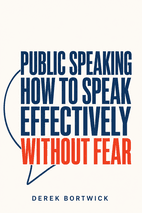
Derek Borthwick's Public Speaking How To Speak Effectively Without Fear treats public speaking as a learnable skill rather than an inborn gift, drawing on clinical hypnotherapy, NLP and thousands of presentations to explain the fight-or-flight response behind glossophobia and how to interrupt it. It covers state control, memory techniques, structuring a talk, hooking attention and rehearsal, aimed at professionals, sales communicators and anyone whose career stalls because they avoid presenting.
On Insta.page you also get an Apply This Book tool that lets you combine insights from up to 3 books to solve your specific situation.
Chapter mindmaps
Free preview: chapters 1–4 are fully interactive. Click any node to expand or collapse. Subscribe to unlock the rest.
CHAPTER 1
Key concepts: CHAPTER 1
CHAPTER 1
Anticipatory Fear and Its Impact
Fear arrives before speaking, causing dread, nausea, or insomnia.
Imagined failure drains energy and worsens anxiety.
Notice and govern thoughts to prevent spiraling.
Career Consequences of Avoiding Speaking
80% experience anxiety; 40% rank it among top fears.
Confused or suspicious minds tend to refuse; plausibility, not truth, makes ideas seem real.
Each person's reality is a map built by generalizing, distorting, and deleting sensory data.
Neuroplasticity and Learning
Brain has ~100 billion neurons and ~0.2 quadrillion connections; remolds throughout life.
Reversed bicycle experiment: practice and feedback rewire steering, but old path remains.
Four stages: unconscious incompetence, conscious incompetence, conscious competence, unconscious competence.
Conscious and Unconscious Minds
Conscious mind: critical, limited capacity (7±2); overload crashes it.
Unconscious mind: controls breathing, heart rate, digestion; takes things literally.
Conscious is bus driver, unconscious is bus; to change autopilot, distract guard or make subtle changes.
Stress Regulation Before Communication
Slow breathing and widen attention to calm your own stress response first.
Let rest restore prefrontal functions that stress shuts down.
Regulate yourself before attempting to regulate your words.
CHAPTER 4
Key concepts: CHAPTER 4
CHAPTER 4
Genes as Potential, Not Destiny
No single gene identified for public speaking anxiety or complex traits
Single-gene disorders affect under 2% of people
Most traits involve many genes interacting with environment
Genes are potential awaiting activation, not fixed outcomes
Correlation vs. Causation in Genetics
Media conflates correlation with causation
A link to disease is not a cause
Gene control of biology treated as truth, not hypothesis
Nijhout argued gene control is a metaphor, not fact
Cell Membrane and Epigenetics
Cell membrane is command centre; nucleus handles reproduction
Receptor and channel proteins receive signals
Epigenetics: environment modifies gene expression without changing DNA
Stress, nutrition, emotion can alter gene expression across generations
The Four-Minute Mile: Breaking Limiting Beliefs
Doctors once called sub-four-minute mile impossible
Bannister broke record in 1954; many have since
Limiting beliefs constrain what seems possible
Inherited capacity sets a range, not a destiny
Implications for Public Speaking Anxiety
Anxiety is not genetically fixed; effort and awareness can improve it
No ceiling exists from inheritance alone
Beliefs about innate ability can be overcome
Destiny remains in our hands apart from rare inherited diseases
You've reached the end of the free mindmaps
Next chapter: “CHAPTER 5” is locked
See every chapter of Public Speaking How To Speak Effectively Without Fear as an interactive mindmap — and unlock all 700+ book summaries with audio and AI Q&A.
$0.00 due today · 7 days free, then $89.99/year ($7.49/mo) · Cancel anytime before day 7
plus sales tax where applicable
Continue exploring Public Speaking How To Speak Effectively Without Fear