Poisoned Ivies Quotes
by Elise Stefanik
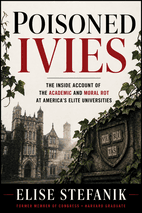
Inside this page you will find the most memorable lines from Poisoned Ivies. The quotes range from searing indictments of university leadership to personal reflections on courage and fear. Some lines are brief and punchy, others build to a powerful conclusion. Each one captures a moment of clarity in a fraught debate.
The book earns its quotable status through blunt honesty. Stefanik does not hide behind euphemisms. She calls out what she sees, whether it is the refusal to condemn genocide or the inversion of campus values. These are not throwaway lines. They are arguments in miniature, designed to stick with you and spark conversation.
Top Quotes from Poisoned Ivies
“The carnage that followed on October 7th constituted the bloodiest day for the Jewish people since the Holocaust.”
The author describes the scale of the Hamas terrorist attack on Israel on October 7, 2023.
This stark, factual statement anchors the chapter in the gravity of the atrocity, making readers confront the unprecedented horror of that day.
“At UCLA, pro-Hamas rioters encamped between the iconic Royce Hall and the Powell Library, the main undergraduate library, and established a “Jew Exclusion Zone.””
The author recounts antisemitic incidents on American college campuses after October 7.
The phrase 'Jew Exclusion Zone' chillingly evokes segregation and persecution, showing how open antisemitism became institutionalized on elite campuses.
“It struck me that the only time Harvard had so vociferously and passionately defended freedom of speech was when it was calling for the genocide of Jews.”
Stefanik's reflection on Harvard's stance during the hearing, contrasting its defense of antisemitic speech with its suppression of conservative voices.
This powerful indictment exposes the shocking irony of a university championing free expression for hateful calls while silencing dissenting views, making it a memorable and damning observation.
“I refuse to let hatred drown out my love for freedom.”
Jewish student Eyal Yakoby testifying before the House Judiciary Subcommittee about antisemitism at Penn.
This defiant declaration captures the resilience of Jewish students facing hatred, and serves as an inspiring counterpoint to the pervasive bigotry described in the chapter.
“It should not be hard to condemn genocide.”
Pennsylvania Governor Josh Shapiro criticizing President Magill's testimony.
This simple, direct statement underscores the moral clarity that university leaders lacked, and resonated widely as a call for accountability.
“The moral judgment of these university leaders is utterly upside down. This is not 1930s Germany. This is the 2020s in New York City at one of the most prestigious universities in the United States of America.”
The author concludes a passage about the inverted moral code at Columbia.
By invoking 1930s Germany, it shocks readers into recognizing the gravity of the situation at a modern American university.
“President Trump isn’t wrecking the Ivy League; the Ivy League wrecked itself.”
The author argues that the federal government's pressure on elite universities is a response to their own failures.
This line is sharp and memorable, placing blame squarely on the institutions rather than on external critics, and it captures the book's central thesis about self-inflicted decline.
Themes Behind the Quotes
A central theme is the betrayal of academic ideals. These quotes repeatedly show how elite universities have abandoned their stated commitments to truth, free speech, and the protection of all students. Instead, they enable a climate of antisemitism and violence, applying rules selectively and prioritizing political narratives over basic safety. The contrast between lofty mission statements and ugly campus realities is stark.
Another thread is the personal cost of speaking out. The quotes capture the courage required to challenge powerful institutions and the loneliness of standing against the tide. They also highlight a broader cultural rot, where hatred is excused under the guise of activism. The book insists that silence is complicity and that reform will only come when people refuse to look away.
Quotes by Chapter
Chapter 1: The Hearing Heard Around the World
“But I had never participated in a hearing quite like this one, where complete moral bankruptcy was on full, obvious display.”
The author reflects on the December 5, 2023 congressional hearing with the university presidents.
This line captures the author's shock at the leaders' failure and sums up the chapter's central critique of elite higher education's moral collapse.
“Israel is a murderous, genocidal settler state and Palestinians have every right to resist through armed struggle.”
Yale anthropologist Zareena Grewal posted this in response to a condemnation of Hamas's attack on Israeli civilians.
This quote reveals the radical ideology openly embraced by faculty at elite universities, justifying terrorism and fueling the antisemitic campus climate.
Chapter 2: Harvard
“Determined to remove me from my current school's bullying environment, my mother informed Albany Academy for Girls that even if I was behind academically, I was a hard worker, a quick learner, and that I would be in the proper uniform and starting in the classroom on Monday.”
The author describes how her mother forced her enrollment at a private school despite the administration's concerns.
This passage captures a mother's fierce advocacy and refusal to let institutional hesitation stand in the way of her child's well-being, making it deeply resonant for anyone who has seen parental love overcome barriers.
“One of the lessons here is to guard the precious memories and stories of your own life, my dear reader!”
The author reflects on a journalist who falsely claimed to know details of her early life and college admissions.
It serves as a powerful reminder to protect and own one's personal narrative, especially in an age of misinformation and unsolicited biography.
“Their goal was to stop the panel discussion from happening.”
The author describes far-left activists disrupting a National Security career panel at Harvard.
This simple sentence starkly exposes the anti-intellectual tactic of silencing speech rather than engaging in debate, a theme that resonates with ongoing campus free speech controversies.
“I agree with many in the Harvard alumni community who believe now that the seemingly forced resignation of Larry Summers in 2006 was a real turning point for Harvard that led directly to the rot exposed at our congressional hearing nearly two decades later.”
The author offers her assessment of former Harvard President Larry Summers's ouster and its long-term consequences.
This line links a historical administrative decision to a contemporary scandal, suggesting a direct causal chain that frames institutional decline and stirs debate about academic leadership.
Chapter 3: Harvard Exposed
“Her unforgettable final answer was: “It depends on the context.””
Representative Elise Stefanik describing Harvard President Claudine Gay's response to the question of whether calling for genocide of Jews violates Harvard's code of conduct.
This line became the defining moment of the hearing, encapsulating the moral relativism and failure of leadership that sparked outrage and calls for Gay's resignation.
“Harvard's motto of Veritas had certainly fallen a long way to “my truth.””
Stefanik's commentary after Claudine Gay's apology in The Harvard Crimson, where Gay used the phrase 'my truth.'
It sharply criticizes the abandonment of objective truth for subjective relativism, encapsulating the erosion of academic integrity in a single, biting sentence.
“Nly a hate-filled, anti- Semitic SNL could do a sketch about the anti-Semitic college presidents testifying in front of Congress and make the questioner Congresswoman Stefanik the target of the sketch.”
Radio host Mark Simone tweeted this about SNL's cold open sketch.
This line encapsulates the media's perceived double standard and deflection, making it a sharp critique of how antisemitism is mishandled in public discourse.
Chapter 4: University of Pennsylvania
“When it comes to the protection of Penn's Jewish students, the rules do not apply.”
From a civil complaint filed by students Eyal Yakoby and Jordan Davis against Penn.
This line starkly exposes the institutional double standard that allows antisemitism to flourish while other forms of hate are condemned, making it a damning indictment of campus leadership.
Chapter 5: Columbia
“Columbia is now bankrupt, if not yet financially, then certainly morally and intellectually.”
David Friedman, former U.S. Ambassador to Israel, in a public statement on April 18, 2024.
This line uses a powerful metaphor of bankruptcy to condemn the university's moral failure, making it instantly memorable.
“An institution that helped educate the men who put their lives at stake for liberty and equality is now a breeding ground of race hatred and violence.”
The author describes the transformation of Columbia from its founding legacy to its current state.
It starkly contrasts Columbia's noble origins with its current deplorable state, creating a sense of tragic irony.
“Jewish students, faculty, and staff being harassed, assaulted, and engulfed in antisemitic threats on a daily basis on campus? Not a priority. Climate change? That deserved a seven-thousand-mile trip by Columbia's president, with a university entourage in tow.”
The author contrasts President Shafik's response to antisemitism versus her trip to Dubai for a climate conference.
This sardonic juxtaposition exposes the administration's twisted priorities, resonating with anyone who values accountability.
Chapter 6: The Other Ivies and Beyond
“She testified to receiving death threats for her pro-Israel activism and to “the hundreds upon hundreds of individual stories of Jewish students who are living in constant fear and intimidation, who have begun calculating their every move since October 7 through a lens of fear.””
Sahar Tartak, a Yale student stabbed in the eye with a Palestinian flag, testified before Congress.
Her words convey the deep fear and constant intimidation faced by Jewish students. The phrase 'calculating their every move' powerfully illustrates the hostile environment.
“I had to fight for months to remove an unjustly imposed university order, yet I have witnessed errant anti-Israel protesters who seem to violate university policy and the law being privileged with an expedited disciplinary process, often resulting in no discipline at all.”
Princeton student journalist Alexandra Orbuch described her experience with a no-contact order imposed after she reported on antisemitic protests.
It reveals a blatant double standard where victims of harassment are punished while perpetrators face no discipline. This quote underscores the systemic suppression of pro-Israel and conservative voices.
“The whole world is a very narrow bridge, and the main thing is not to be afraid at all.”
Rabbi Eitan Webb began singing this line during a fire alarm at a Princeton event, and students joined in.
It captures a moment of defiant courage and solidarity in the face of intimidation, transforming fear into communal resilience.
“In the 1930s, that’s what they used to say about Jews here at Princeton: ‘We couldn't hire them because they're Jewish.”
An anonymous Princeton professor recounts a colleague’s comparison of current DEI hiring restrictions to historic antisemitism.
This stark parallel indicts modern campus ideology by echoing the very prejudices that elite institutions once claimed to have overcome.
Chapter 7: What Went Wrong?
“DEI is racism under the guise of opposing racism, sexism under the guise of opposing sexism, and antisemitism under the guise of opposing hatred.”
The author summarizes the true nature of Diversity, Equity, and Inclusion programs.
It encapsulates the hypocrisy of DEI in a sharp, parallel structure that sticks with the reader, exposing the movement's contradictions.
“At Harvard, it's a staggering 88-to-1 ratio.”
This is a statistic from a study of faculty political affiliation at elite universities.
The extreme number vividly illustrates the profound political imbalance at one of America's most prestigious institutions, making the abstract problem concrete and shocking.
“We want to abolish the university as it is.”
Princeton "Latinx" Studies Professor Lorgia Garcia Pena told a conference in July 2025.
This line starkly reveals the radical ambition behind DEI programs to dismantle traditional academic structures, making it a memorable rallying cry for critics.
“Eliminating racial discrimination means eliminating all of it.”
Chief Justice John Roberts stated this bluntly in the 2023 Supreme Court decision Students for Fair Admissions v. Harvard.
This concise, forceful statement encapsulates the principle of colorblind equality, resonating with those who oppose race-based admissions.
Chapter 8: How We Fix It
“Antisemitism is a sickness, and it can’t go untreated.”
The author summarizes the moral urgency of addressing campus antisemitism.
The metaphor of sickness makes the problem visceral and urgent, while the short, declarative structure makes it easily repeatable and powerful.
“Far too long, university leaders, administrators, faculty, and donors have turned a blind eye to the moral and academic failures of their institutions.”
The author condemns the collective negligence of higher education stakeholders.
It names every group complicit in the crisis, creating a sweeping indictment that resonates with readers who feel betrayed by elite institutions.