Pen Pal Themes
by J.T. Geissinger
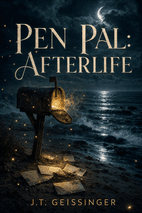
Underneath its plot, Pen Pal is wrestling with love as destiny and tether, the unstable reality of a mind-shaped limbo, and guilt that keeps the past alive. It’s also about trauma and secrecy, sacrifice and surrender, and a paradise that decays as old violence intrudes.
On this page, you’ll find those themes tied to concrete moments, like Aidan locking Kayla away, the decaying afterlife house, and the returning hangman game and white envelope. The symbols section covers the Hanged Man card, crows and ravens, and water as a boundary between death and the supernatural.
Major Themes in Pen Pal
Love as destiny, tether, and repeated loss
The novel frames Kayla and Aidan's love as a force that survives death and binds them across many lives, but also as something that can trap them in limbo and repeat their losses. Past-life revelations show their love leading to tragedy, while the ending insists on recognition and reunion beyond forgetting.
- Fiona realizes Kayla did not ascend because her love for Aidan kept her from crossing and led her to live in his limbo.
- Aidan tells Kayla, 'You're my destiny, baby, and I'm yours,' and insists nothing can keep them apart.
- Alaric swears an oath to find Caterina through all ages: 'I will find you... I will never let you go.'
- Aidan says that in every possible future he loved Kayla and failed to save her from dying violently.
Illusion, reality, and mind-shaped limbo
The afterlife is presented as unstable and shaped by belief, memory, and subconscious will. Kayla and Aidan's paradise is not a fixed heaven but a limbo where environment, weather, and even threats can be projections or mind-created realities.
- Kayla dreams she stands at a road splitting toward Heaven and Hell, where an owl and a raven tell her she is on neither list.
- Fiona explains that weather and environment can change because spirits subconsciously make them change, and that Aidan's father may be a projection or memory.
- Kayla tears down the faded curtains and argues that if their minds create reality they can choose not to decay.
- During sex, a crack spreads on the wall while Aidan tells himself reality is what he makes it and that Fiona was wrong.
Guilt, atonement, and self-judgment
Aidan's killing of his father and the older blood vow with Michael drive the book's questions of guilt and repentance. The story repeatedly returns to whether atonement is required, who judges a soul, and whether refusing culpability keeps the cycle going.
- The raven's poem says Kayla must atone for blood to find her rightful place.
- Fiona says Aidan must repent and seek forgiveness for killing his father, but Aidan refuses.
- Miss Eleanor tells Mr. Leighrite that his refusal to accept culpability is the problem.
- Elizabeth Bennet says there is no trial, judge, jury, or afterlife sentencing: 'Souls judge themselves.'
Trauma, protection, and secrecy in love
Kayla's past abuse leaves her hypervigilant, while Aidan's protective instincts lead him to lock her away and withhold painful truths. The novel presents protection as both loving and isolating, and Kayla repeatedly insists on autonomy and shared danger.
- Aidan recognizes Kayla's scanning for threats as a learned stress response like his mother's when his father was around.
- Kayla admits she was afraid of Aidan's breath, and Aidan interprets it as fear that he could hurt her.
- Kayla tells Aidan, 'I. Am not. You,' insisting he does not get to decide what will happen to her even in his limbo.
- Kayla tells Aidan he is 'isolating me inside your fear' of the truth.
Sacrifice and surrender
Love in the novel is repeatedly expressed through sacrifice, whether Aidan gives his life to save Kayla or Kayla gives up their cycle so Aidan can be free. Surrender is also defined as trust rather than defeat, especially in Kayla's final choice.
- Aidan shoots himself to create a diversion, and his final note says true love pays any price and makes any sacrifice without question.
- Kayla chooses to break the cycle even though it means she and Aidan will never meet again, so Aidan can have a chance at happiness.
- Fiona begs not to go alone, Jim pleads to stay by her side, and the Ferryman grants Jim a special dispensation so they enter the light together.
- Kayla draws The Hanged Man from Finn's tarot deck and refuses his kiss despite wanting answers.
Entropy, decay, and the past intruding on paradise
The idyllic afterlife home steadily decays, and the violence of Aidan's past returns in physical forms. Blood-stained apparitions, the remade envelope, and the undead army all show that paradise cannot stay sealed off from guilt and history.
- Kayla sees Aidan's father outside the window wearing the blood-stained clothes he died in.
- Kayla notices faded curtains, a dirty kitchen window, water stains on the ceiling, cracked plaster, and her faded watercolor.
- The burned white envelope remakes itself from ashes and appears in the mirror frame.
- An army of identical undead figures stretches from the rocky beach across the meadow, and Aidan's father has returned as an army.
Symbols and Motifs
Hangman game and white envelope
The hangman game represents unfinished business, hidden truth, and the inescapable repetition of the past. Its white envelope keeps returning even after being burned, making it a sign that the cycle cannot be ignored.
- Kayla finds an envelope marked KAYLA containing a hangman drawing and guesses the letter I, then later guesses A on a mirror note.
- The hanged man in the game gains a stick arm after Kayla's wrong guess, and later grows an arm and a leg.
- The burned white envelope remakes itself from ashes and appears in the mirror frame.
- Atlas reveals his lifelong hangman game with letters that come to him.
The Hanged Man tarot card
The Hanged Man is linked in the notes to surrender, sacrifice, guilt, and martyrdom. It appears around Kayla's refusals of Finn and around the revelation of the blood vow that binds the lovers' cycle.
- Kayla draws The Hanged Man from Finn's tarot deck and refuses his kiss despite wanting information.
- Finn interprets The Hanged Man and links it to surrender and sacrifice.
- Finn shows Kayla the Hanged Man card when revealing that Aidan, as Alaric, killed Michael before making the blood vow, tying the card to sacrifice, guilt, and martyrdom.
Crows and ravens
Crows and ravens mark supernatural guidance, trickster presence, and thresholds between lives. They appear in Kayla's dreams, as Finn's alternate form, and as omens around Aidan's past-life oath and the forest's instability.
- In Kayla's dream, a raven tells her she is not on Hell's list and recites a poem about atoning for blood.
- Finn appears as a crow that becomes a man in a black suit, and later vanishes in smoke and black feathers.
- Crows burst overhead when Aidan chases the wounded figure into the forest.
- After Alaric's oath to find Caterina, a crow caws three times.
Water
Water is tied to death, danger, and the boundary of the supernatural in this limbo. It appears in warnings, in Kayla's avoidance of the shore and bathtub, in the haints' fear of water, and in Caterina's drowning.
- Aidan takes Kayla on a pontoon boat ride around the cove, where she notices there are no other people on the island.
- Big Jim explains that haints fear water and blue, and Aidan says his porch ceiling is blue-green because it is the color of Kayla's eyes.
- Aidan tells Kayla she is never going near water again, and Kayla avoids the shore and bathtub because of his ominous comment.
- Alaric finds Caterina drowned and beaten on a riverbank after her wedding to Michael.