Passive Income, Aggressive Retirement Key Takeaways
by Rachel Richards
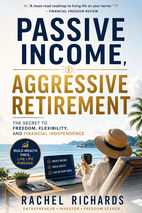
5 Main Takeaways from Passive Income, Aggressive Retirement
Retirement means passive income covers your expenses, not a nest egg number.
Richards says the nest egg model is a bad trade: decades of accumulation can be wiped out by a crash, divorce, or medical crisis. Instead, define retirement as financial independence and grow income streams you control until they cover your real spending.
Time is your most valuable resource; calculate your real hourly wage.
Every hour you spend on DIY has a cost, so use your combined real hourly wage as the exchange rate. If cleaning service costs $65 for four hours and your time is worth more, outsource it; if a project costs four hours, don't ignore the $74.40 of life it consumes.
Passive income starts with active stage-one work; use the SCRIMP filters.
No stream is truly passive at first—you must build a book, course, product, or property. SCRIMP forces you to check control, risk, effort, money, and scalability before you start, and it exposes recruiting schemes as active income in disguise.
Choose income streams that match your time or capital available.
Royalties, courses, and e-commerce reward time; real estate and coin-ops require capital; portfolio income is a later addition. Matching your dominant resource prevents you from starting something you can't sustain.
Use house hacking, BRRRR, and cash-flow rules to build rental wealth.
Direct residential real estate is the middle-class path because sweat equity can force appreciation. Richards advises buying one rental a year on 15-year fixed mortgages, vetting tenants hard, and hiring a property manager once the fee becomes affordable.
Executive Analysis
Together these takeaways form one argument: retirement is not a number you save to; it is a cash-flow threshold you build toward. Richards replaces the nest egg's two levers with a three-part method—treat time as currency, score ideas with SCRIMP, and choose streams that match your available time or capital. The book then drills into creation (royalties, courses, apps), coin-ops, rentals, and portfolio income, always returning to controllable assets and stage-one work. The common thread is that anyone can begin.
This book matters because it makes passive income practical rather than a lottery ticket. It is squarely in the FIRE/self-employment genre, but its contribution is the anti-nest-egg reframe and the decision framework. Readers get exact checklists, pricing data, and real costs, from a $2,000 washer-dryer yielding $3,000 a year to a $100 online course. It normalizes starting small and iterating, and it closes with a friendly kick to discard limiting beliefs. For someone stuck between saving more or quitting the rat race, it offers a third door.
Chapter-by-Chapter Key Takeaways
Nest Egg Theory , Debunked (Chapter 1)
Retirement means financial independence: you work because you choose to, not because a permanent exit from work is required.
The nest egg model is a poor trade, since it forces decades of accumulation for a target that a market crash, divorce, disability, lawsuit, or medical crisis can wipe out first.
With only two levers available, spending cuts quickly hit a fixed-cost floor; income growth is the lever that offers real room to move.
The three generational responses reduce to accepting the faulty trade, giving up on it, or rejecting it; only the refusal points toward passive income from a controllable asset rather than reliance on the market.
Try this: Redefine retirement as enough passive income to cover your spending, then stop relying on a market nest egg and start building a controllable asset that pays you.
Your # 1 Most Valuable Resource (Chapter 2)
Treat time as the irreplaceable resource: any purchase that spends your hours for money is a bad trade unless survival is at stake, because no wage can buy back a spent hour.
Calculate your real hourly wage from every job and side hustle combined, then treat it as the exchange rate for every do-it-yourself decision; at $18.60 an hour, a four-hour invitation project costs $74.40 of your life before a single supply is bought.
Outsource any task whose replacement cost undercuts the hours it consumes: a $65 weekly cleaning service that reclaims four hours is a bargain whenever those hours hold over $200 of value to you.
Build passive income until it covers your expenses, because that is the moment retirement actually arrives; the greater difficulty is planning what to do with days no longer assigned by an employer, and the question of what you would do with a lottery windfall reveals the answer.
Try this: Calculate your real hourly wage from all income sources and use it as the cutoff for every outsourcing and DIY decision, so you buy back time whenever the cost per hour is lower.
Passive Income : Such Beauty , Such Grace (Chapter 3)
Divide every potential income stream into active or passive before looking at IRS labels; active trades time for money, passive trades assets for money.
Treat the construction phase of any passive stream as a real job; the passivity lies entirely in how small and outsourceable stage two is.
Run every idea through the five SCRIMP filters, and notice which failures hurt most: a weak controllability score exposes you to platform rules, while a weak scalability score caps your upside.
Pick your category based on the resources you can lock up in stage one, since royalties and e-commerce favor time, while machines and real estate favor capital.
Reject any scheme that promises income without stage one work; if it is marketed as passive but runs on recruiting, it is active income.
Try this: Run every income idea through the five SCRIMP filters and schedule stage-one build time as a real job before you call anything passive.
Royalties : The What , the Why , and the How (Chapter 4)
Sort any potential royalty stream by asking whether you can create it once and sell it repeatedly, which separates creative works and patents from mineral-rights leases.
Run every royalty idea through the five SCRIMP factors, and treat controllability and regulation as the weakest link because marketplace platforms dictate the rules.
Match your royalty idea to one of the nine categories, then test demand with neutral tools like Facebook groups and free surveys instead of biased friends and family.
Let Amazon's search rankings and review gaps guide your product decisions, treating a sales rank under 100,000 as a reason to pursue the niche.
Try this: Pick a royalty niche by checking Amazon sales ranks and review gaps, then verify demand with neutral surveys before you create anything.
Introducing Books and eBooks (Chapter 5)
Treat a book as a scalable income stream: even a small royalty per sale becomes meaningful at volume, but the most reliable path is to write for readers' benefit rather than for a dollar target.
Plan to fully outsource marketing only after you accept that some appearances and interviews will always require you; that's the difference between 90% and 100% passive.
For a nonfiction title, start with research, then outline as bullet points or a mind map, and defend your writing time in small daily blocks to get past writer's block.
After the first draft, step away for one to two weeks, then edit on paper and bring in two or three well-read friends to catch what you cannot.
Expect a book's income to come in two phases: the concentrated launch period and a lifelong marketing tail you must keep feeding, because the audience's connection to you is the part no outside marketer can replace.
Try this: Outline your nonfiction book first and defend small daily writing blocks, then plan a launch spurt plus a permanent marketing tail.
The Great Debate on Publishing (Chapter 6)
Decide between the two paths by weighing who absorbs production costs and who keeps revenue: a publisher funds the book but takes most of the return, while self-publishing puts all costs on you in exchange for a larger royalty share.
If you go traditional, find an agent first and tailor the submission package to the format, then plan to keep promoting because the advance is simply early payment against royalties and is set by your platform, not by manuscript quality.
Make self-publishing a product launch: invest in editing, cover, and formatting before going live, source those services from marketplaces, and distribute through KDP, IngramSpark, Lulu, Apple Books, or Kobo rather than treating the manuscript as done once it is written.
Expect the money to lag the work; Hal Elrod built The Miracle Morning for eighteen months before reaching 2,000 monthly US sales, and that base later produced about $4 million, preserved his US rights, and generated nine publisher offers.
Try this: Choose self-publishing only if you can invest in editing, cover, and formatting as a product launch; otherwise pitch agents with a platform-focused submission.
Do - Re - Mi - Fa - So - La - Ti - Do (Chapter 7)
Music royalties are three distinct streams, mechanical, public performance, and synchronization, each triggered by a different way a song is used.
Master rights and publishing rights can be separated, so owning the composition does not guarantee control of the recording, as Taylor Swift's masters dispute demonstrates.
Multitrack recording lets a musician compose, edit, mix, and master alone, making the traditional publisher an option rather than a necessity.
Per-play payouts are so small that income accumulates only across a large catalog and constant new releases, which is why Landon Sears put out 21 songs in a year.
A viable career in music depends on genuine love for the craft, since royalties alone rarely reward the talent and luck involved; without that passion, another income stream makes more sense.
Try this: Decide which of the three music royalty streams you can realistically generate, then treat per-play pennies as a catalog game, not an overnight hit.
Photos , Downloads , and PODs (Chapter 8)
License each photo on non-exclusive stock sites so a single image can earn royalties repeatedly instead of forcing you to keep uploading new inventory.
In digital products, avoid crowded categories like wedding invitations and instead sell templates aimed at specific audiences where competition is thin.
For POD, treat each design as a volume bet: spread it across every product a platform offers and upload many designs, since one sale per twenty uploads is normal.
Before uploading a POD design, search the USPTO database for trademark conflicts, because even innocuous phrases can be legally protected.
When hiring freelancers for design work, write a detailed job spec, inspect their portfolio, and calculate how many sales it takes to break even before paying.
Try this: Before uploading any digital or POD product, search USPTO for trademark conflicts, then upload many designs and spread them across every platform.
Dropping Your Knowledge with Online Courses (Chapter 9)
Choose a marketplace like Udemy or Skillshare only if you have no audience to tap; otherwise pick a platform that lets you own student email lists and follow up.
Cap the course at ninety minutes of five-minute modules and charge at least $100; a Podia study put the average course at $182.59, so three-figure pricing is the norm, not the ceiling.
Write the course around a single-sentence aim and a narrow topic like finding a first rental property, not a broad subject like passive income.
Budget for the first launch to demand real work, then automate emails and ads so the course sells on its own; treat that foundation as the base for stacking more income streams.
Try this: Charge at least $100, cap your course at ninety minutes, and choose a platform that lets you own email addresses so you can automate follow-up sales.
Software , Franchising , Minerals , Oh My ! (Chapter 10)
Favor subscription pricing for any app you build, since recurring fees outlast one-time downloads or ad revenue.
If you want to franchise, design your business to run without you, then sell the rights to others; the income comes from their upfront fees and ongoing royalties.
Check your deed and local county records to see whether your property's mineral rights are yours, because those rights can be leased for an upfront bonus plus extraction royalties.
You do not need to be a programmer to ship an app: buy courses or hire a freelancer, and plan for the post-launch period when maintenance becomes minimal and the income turns passive.
Try this: Choose subscription pricing for your app and buy courses or freelancers to build it; then plan for maintenance to shrink so income becomes passive.
The Must - Know on Marketing & Launching (Chapter 11)
Let marketing, not quality, decide your sales: a well-promoted decent product will outsell a better one nobody hears.
Before launch, build your audience: grow a social following, join relevant Facebook groups, and collect emails with a landing page and teasers.
Beta test by offering part of the product free or discounted, and use the feedback to collect testimonials.
Launch at a low or zero price to create momentum, then raise the price toward the profit sweet spot; recruit a launch group for early access, reviews, and sharing.
Keep marketing running after launch, whether in-house or via a social media marketer; the upfront cost is time, not money.
Try this: Build an email list and launch group before you launch, open at a low price for momentum, and keep marketing after the launch.
Portfolio Income : The Basics (Chapter 12)
Score portfolio income as the most passive stream under SCRIMP, but accept that you are trading a large upfront investment and nearly all control for that passivity.
Treat dividend yield as a risk signal: an unusually high yield usually means a higher chance the payout gets cut or the stock fails, so spread the risk with dividend ETFs.
Run your required capital calculation with a 4% yield assumption, then remember the Nest Egg Theory fails; portfolio income is a supplement or a later replacement for rental equity, not a standalone retirement plan.
Time your bond buying to the interest-rate cycle: yields fixed at issue mean high-rate eras can pay $7,500 a year on $50,000, while low-rate eras push you toward stocks and ETFs.
Try this: Treat portfolio income as the most passive but least controlled stream: assume 4% yield for capital needs and use dividend ETFs to avoid yield-trap risk.
Portfolio Income : The Advanced (Chapter 13)
Treat peer-to-peer lending as a speculative loan book: you can beat savings-account yields, but only by underwriting borrowers yourself and accepting that defaults will happen.
If a master limited partnership appeals to you, bring in a professional: the tax advantages and steady payouts come wrapped in a complexity that even experienced investors hesitate to handle.
Use REITs when you want rental income without property management, but remember their dividends land at ordinary tax rates, so weigh the tax hit against the liquidity and diversification.
For crowdfunded real estate like Fundrise’s eREITs, put in only money you can spare for at least a month, since redemption is sluggish; Kristy Shen’s $5,000 stake projected 7.7 percent at 0.15 percent advisory fees, a decent premium for that illiquidity.
Portfolio income is the only truly hands-off stream, but it demands either large capital or long holding periods; since most of us start short of that, build active or semi-passive streams first and let portfolio income wait.
Try this: Treat portfolio-adjacent options like P2P, MLPs, and eREITs as speculative allocations and size each one to the risk it carries.
Small Coin - Ops (Chapter 14)
Let the SCRIMP verdict guide you: single coin-op machines are a solid passive play, but their scalability is capped by physical location.
For vending, invest in the real estate: negotiate a good host split, locate where customers lack alternatives, and stock familiar brands.
Do the weekly restocking and cash collection yourself rather than buying into a turnkey vending route; otherwise the income stops being passive.
Expect ATM and arcade setups to behave like vending with a different coin box: ATMs demand patience because locations are already taken, and arcade games work best inside a host venue.
Try this: Negotiate a strong host split for your first vending machine, place it where customers have no alternatives, and do the weekly restocking yourself.
Big Coin - Ops (Chapter 15)
Treat a car wash as a capital investment, not a side novelty: upfront location research, licensing, insurance, and marketing are the price of admission before a single successful bay can fund retirement.
According to the author, a dorm washer-dryer costs around $2,000 and can return about $3,000 a year, making it a low-risk test before you commit $200,000 to $500,000 to a full laundromat.
Only pursue slot machines in states where you can accept years-long licensing, mandatory legal counsel, and revenue sharing with both the state and the venue.
Classify any app-based rental, such as Bird scooters, as a coin-op, then use conservative projections, worst-case analysis, and compliance checks to decide whether the passive income justifies the setup time.
Position coin-ops as the middle asset: they need more capital than royalties and more time than portfolio income, so only take them on when you have enough of both.
Try this: Test coin-op scale with a single washer-dryer before buying a laundromat, and run conservative worst-case projections on any car wash or slot machine deal.
“ A ” is for Ads & Affiliates (Chapter 16)
Choose affiliate marketing when your audience is small or nonexistent, and treat display advertising as a scale game that only pays once traffic is very high.
Add a clear disclosure to every affiliate link, since that requirement applies to all paid relationships and is not optional for solo bloggers.
Make affiliate income passive by scheduling posts in advance and outsourcing writing, so your earnings do not depend on your daily effort.
For ad revenue, look beyond AdSense at networks like Media.net and BuySellAds, and judge them by your actual click-through expectations, not their pitch.
Launch immediately rather than polishing for months; a focused weekend routine and a single course can shorten the way up, as demonstrated by bloggers who reached thousands in monthly income within a year.
Try this: Create an affiliate-focused blog or social page and publish a batch of scheduled posts, then add honest disclosures and set up ad networks only after traffic is meaningful.
Do’s & Don’ts of Dropshipping (Chapter 17)
Start by choosing one of the two dropshipping models: reselling stock from wholesalers or inventing a product for a Made to Order manufacturer.
Treat reselling as an active, research-heavy business: cheap entry invites price wars, so you must constantly track trends and protect margins.
If you move to product creation, expect to invest in licensing and prototyping before you can sell, and line up a manufacturer who produces on demand.
Never mistake dropshipping for passive income; you are the merchant who arranges the sale and then buys from a third party, so fulfillment and marketing remain on you.
Try this: Start a dropshipping store only with a clear model: pick wholesale reselling or made-to-order creation, and know fulfillment and marketing stay on you.
Rental Income — It’s for Everyone (Chapter 18)
Before you buy a rental, compute cash-on-cash return from rent minus all expenses against your actual cash invested; that number, not monthly rent, tells you if the deal works.
If you lack a big down payment, use house hacking or the BRRRR method to cut the upfront cash needed for your first property.
Borrow to grow, but only while every property still delivers positive cash flow, and never give tenants breaks; those two mistakes can wipe out rental profits.
Hire a property manager even at a meaningful share of rent, because the fee trades a hands-on job for an hour-a-month passive income.
Treat direct residential real estate as the middle class's route to wealth, since sweat equity lets you force appreciation that a stock portfolio can never match.
Try this: Buy only rentals that pass cash-on-cash return and expense checks, then hire a licensed property manager once you can budget the fee.
First , Funding … (Chapter 19)
Use leverage rather than cash, with a substantial down payment and a long hold, so a market drop doesn't leave you underwater.
House hack to get the best financing and cash flow: buy a two-to-four-unit property and live in one unit, or do a live-in flip and stay for the residency period to capture the capital gains exclusion.
Rehab a distressed property, rent it out, refinance to pull your capital back, then repeat with the same money to build multiple rentals.
In high-cost metros, buy long-distance where you have trusted family or contacts to handle the property.
Scale without a large down payment by drawing on home equity, refinancing after appreciation, and tapping REITs, fractional platforms, partnerships, community bank lines, or seller financing.
Try this: House hack your first rental or use BRRRR to recycle capital, and scale with refinancing or seller financing only while every property stays cash-flow positive.
… Followed by Finding (Chapter 20)
Set your acquisition criteria (location, building size, price, and condition) and assemble your realtor, lender, and insurance agent before you start searching, so every lead is filtered through that team.
Look beyond the MLS for expired listings, bandit signs, probate records, bank-owned REOs, short sales, and direct owner deals, and you will meet sellers the crowd never sees.
Run the 1% rule and the full expense list on a property before you visit it, including the 8% vacancy allowance and management costs, so an emotional tour never overrides the numbers.
Judge a deal by positive monthly cash flow and by cash-on-cash return, and weigh that return against what a passive stock investment would earn over the long run.
Submit an offer only with a preapproval letter and proof of funds, and treat every non-price term as a negotiable lever; the fewer demands, the more competitive your bid.
Try this: Write your acquisition criteria and assemble your realtor/lender/insurance team first, then look off-MLS and run the 1% rule before visiting any property.
Avoiding Tenant Nightmares (Chapter 21)
Vet every tenant as if your cash flow depends on it, because a lease survives a property sale and an inherited tenant is your problem until it expires.
Treat property management as a job you must learn before you can outsource it; manage your own duplex first, then budget a manager's fee before you buy anything larger.
Never hire an individual property manager from a classifieds site; pay for a licensed, insured professional and verify every applicant with credit and background checks rather than personal trust.
Buy one rental house a year on 15-year fixed mortgages and reinvest the cash flow; the early returns look small, but the compounding over two decades turns rent into a replacement for your paycheck.
Try this: Vet every tenant with credit and background checks, manage a duplex first to learn the job, and then outsource to a licensed property manager.
The Fun Part (Chapter 22)
Put your money basics in order before chasing passive income: a clear budget, manageable debt, savings, taxes, and insurance are the floor the whole plan stands on, and the plan assumes you can supply either time or upfront capital.
Write your real monthly spending, debts, and savings down first, because the passive income figure you need is anchored to what you actually spend, not to a guess.
Imagine having nothing, a single year left to live, or a $20 million windfall, in turn, then write down your reason so the version of you that fails still knows why to continue.
When your ideal life costs more than today's, build a separate proposed budget, give housing, health coverage, and childcare some extra room, add the monthly savings you want, and use that total as your target.
Try this: Write down your actual spending, debts, and savings to set your real passive income target, and sketch the life you want as a separate budget goal.
Drumroll . . . Your first passive income stream (Chapter 23)
Track how you actually spend your day in fifteen-minute segments to find the hours you can redirect toward building income, the same way you would find waste in a budget.
Decide in advance whether this stream will be funded by time or by money, because each path has a different cost you need to be willing to pay.
Cut the full list of ideas down to three or four by eliminating anything you cannot afford or cannot realistically bring to life.
Rank the SCRIMP factors by your own priorities, then score each finalist against them so your choice reflects what matters most to you.
When the scores leave you torn, set up a weighted decision matrix to turn a subjective favorite into an objective winner.
Try this: Track your day in fifteen-minute blocks, rank your three or four stream ideas using weighted SCRIMP scores, and choose the winner by your own priorities.
Limiting Beliefs Are for the Birds (Chapter 24)
Name the limiting belief under your fear, then test it against what you would tell a friend who said the same thing; the belief becomes true only if you act as if it is.
Cross off the common excuses first: no time, no money, no ideas, and no skills are objections you can outflank, because one small income stream is enough to move you forward.
Ask yourself both what you lose by never trying and what you gain if you succeed, then start with a risk you can tolerate rather than waiting for certainty.
The traditional path is the risky one: Richards’s statistics on Social Security, 401(k)s, and college costs show the old guarantees are gone, so your own income stream is the surer bet.
Build a time-based side income rather than a money-hungry one; it is easier to test, better for your happiness, and can start with a course, vending machine, or drop-shipping store while you keep your paycheck.
Try this: Cross off no-time/no-money/no-skill excuses by starting with a time-based side income you can test while keeping your paycheck.