Own or Be Owned Quotes
by Codie Sanchez
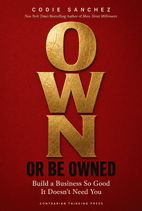
This page gathers lines from Codie Sanchez's book about business, money, and ownership. Some are blunt. Some are uncomfortable. All of them push you to think differently about pricing, customers, focus, and the stories you tell yourself. The quotes here are less about feel-good motivation and more about seeing the tradeoffs clearly.
What makes the book quotable is its mix of plain language and sharp edges. It takes ideas you may have heard before and says them in a way that sticks. You will find lines about fear, value, saying no, building proof, hiring well, and choosing who you serve. Read one, sit with it, then decide what needs to change.
Top Quotes from Own or Be Owned
“Fear is the most expensive line item on your P&L, and it never shows up on the books.”
The chapter introduces the Fear Tax as the hidden cost of underpricing.
It makes an invisible psychological habit feel like a concrete recurring expense, which is hard to ignore.
“Your price is almost never too high. Your perceived value is too low.”
Codie diagnoses why owners mistakenly think their price is the problem.
It reframes the issue from being overpriced to being undervalued, a more empowering diagnosis.
“The moment you stop chasing everyone is the moment the right ones can’t stop chasing you.”
After Jack's landscaping turnaround, Codie summarizes the power of focus.
It captures the paradoxical payoff of focus: less chasing leads to more demand.
“Saying no is your most underutilized asset. And if you're making everyone happy, you're not doing anything interesting anyway.”
From 'STEP 3: Reject the Repellents,' after providing scripts for turning away bad-fit clients.
It reframes rejection as a strategic asset rather than a loss.
“Your real product is the promise: “Give me money, and your pain dies or your pleasure spikes.” That's it.”
The chapter defines what a product actually is beyond the widget, course, or coaching offer.
It reframes product as an outcome-based promise, making offers easier to design and sell. It cuts through the usual branding and feature distractions.
“People don’t follow logos; they follow scars.”
In the origin-story section, the author explains why beginnings and scars connect better than credentials.
It shifts storytelling from polished brand image to human proof and struggle.
“The world doesn’t find you because you figured out the algorithm; the world finds you because you said something nobody else had the guts to say, in a way they couldn't ignore.”
Codie Sanchez reflects on the vending-machine video that unexpectedly went viral.
It reframes discovery as a byproduct of courage and originality, not algorithmic cleverness. It reminds readers that real attention comes from saying what others won’t.
Themes Behind the Quotes
The book keeps returning to ownership as a mindset and a set of choices. It argues that fear, low prices, and vague offers quietly drain profit. The fix is not more hustle but clearer value, stronger positioning, and the discipline to stop serving people who were never a good fit.
Another thread is proof and standards. Codie treats testimonials as weak compared with evidence that makes doubt feel silly. She also connects hiring, trust, and execution, suggesting that a business scales only when the founder stops being the bottleneck. The quotes ask you to simplify, subtract, say no, and build systems that keep working without you.
Quotes by Chapter
1. Stop Paying the Fear Tax | Pricing
“Pricing is the single highest-leverage number in your business. A 1 percent price increase with no change in volume produces an average 11 percent jump in operating profit.2 One percent in. Eleven percent out.”
The chapter cites McKinsey data to show how pricing leverage drives profit.
The contrast between 1 percent and 11 percent makes pricing feel like the highest-ROI move available.
“Lowering your prices is not a strategy; it’s a panic response.”
Codie opens the section explaining why discounts are destructive.
It strips discounts of strategic glamour and exposes them as fear-driven reactions.
2. Target the 10 Buyer | Persona
“You don't need to be rich to get very rich. You just need to stop throwing washers at a hole in the ground and start aiming at the people who can change your life.”
Codie tells the washer story and distills the chapter's core advice about choosing the right target.
It reframes success as a targeting problem, not a capital problem, which makes wealth feel accessible.
“You decide who you serve. You don't owe anyone access to you. Not the prospect who walked through your door. Not the lead who filled out your form. Not the customer your cousin referred. Nobody.”
From the 'YOU GET TO CHOOSE' section on deciding who gets access to your business.
It gives business owners permission to set boundaries and stop serving everyone by default.
3. Find the Pain That Pays | Problem
“But they didn't need me. They just needed clean clothes. There's a difference. And that difference is money.”
The narrator reflects on his laundromat's regular neighborhood customers.
It shows the difference between a routine need and a problem someone will pay you to solve.
“What actually moves money is finding someone with enough pain, at the moment they step on the nail, that they'll pay just about anything to make it stop.”
After the nail salon owner agrees to daily laundry service, the narrator draws the lesson.
It defines pain-point marketing as finding urgent, immediate suffering that customers will pay to end.
“The hardest sale in the world is to someone who's never spent money on your problem. You're not closing a deal; you're starting a religion.”
The narrator explains why buyers with receipts are easier to sell to than newcomers.
It makes the cost of educating a new category vivid and memorable.
“You don’t have to stop being The Artist; you just have to start painting what people are already paying to look at.”
The chapter closes by advising the Artist archetype to align creativity with market demand.
It reconciles creative identity with commercial reality in one vivid image.
4. Cut the Menu | Product
“Complexity impresses your peers. Simplicity impresses your buyers.”
The chapter states this after showing how an advisor tripled his price by stripping his offer down.
It captures the central product lesson: buyers value clarity over feature volume. It is short, memorable, and immediately actionable.
“The most powerful thing you can do to your product is subtract. The emptier the room, the louder the one thing left in it. The best product is the one that does exactly what it promises and nothing else.”
The chapter argues that subtraction is the strongest product-design move.
It makes simplicity feel disciplined and memorable, reminding readers that clarity beats clutter. It gives a vivid standard for deciding what belongs in a product.
“Killing something that's not working isn't giving up; it's focusing. Stopping isn't losing; it's changing the game you play. Sunsetting a product isn’t failure; it's portfolio management.”
The chapter explains why killing declining products is portfolio management, not failure.
It reframes hard cuts as strategic focus rather than defeat. It gives founders language to make emotionally difficult decisions.
5. Pay Yourself First | Profit
“You're not protecting them by keeping your word. You're dragging them to your funeral.”
The narrator says this to Michael after he refuses to renegotiate vendor terms.
It reframes misplaced loyalty as a way to drag others down with you, not protect them.
“First, the problem whispers, then it clears its throat, then it screams. You'll be a lot richer if you catch it at the whisper.”
The narrator describes how cash problems escalate before they become visible.
It gives readers a vivid early-warning signal and a reason to act before a crisis.
“If the numbers only work because you're free, they don’t work.”
The narrator explains why founders should model a real CEO salary in their P&L.
It cuts through the martyr narrative by showing that unpaid founder labor can hide a broken model.
“Revenue didn't betray Michael. The market didn't betray him. His team didn’t betray him. Timing did. Timing, and the quiet, deadly combination of pride and avoidance.”
The narrator reflects on Michael’s failed glass shower company.
It pins the collapse on timing and psychological avoidance rather than external betrayal.
6. Make the Sale Before the Call | Pitch
“When the offer becomes the salesperson, and the sales team becomes independent, you finally get to just sit there watching the scoreboard.”
After the author watches Stripe notifications arrive without a launch or email, he realizes the business is finally working without him in every transaction.
It captures the chapter's core promise: a sales system that runs without the founder. It turns watching sales happen into the ultimate proof of independence.
“Your close rate isn't your superpower; it’s your cap.”
From the section arguing that the founder being the best salesperson can limit company growth.
It reframes a founder's greatest sales strength as their ceiling. The line is short, counterintuitive, and memorable.
“Marcus didn’t get his team to close like him. He got the proof to close for them.”
After the Marcus commercial-cleaning example, the author summarizes why documenting proof scaled sales beyond the founder.
It crystallizes the difference between being a closer and building a sales system. Proof, not personal brilliance, lets a team sell without you.
“Testimonials aren't proof; they're compliments. Proof is what makes a reasonable person feel stupid for still doubting you.”
From Asset 1: Your Proof Vault, explaining what separates real sales proof from vague praise.
It sharply distinguishes feel-good testimonials from undeniable evidence. The second sentence gives a vivid standard for what proof should do.
7. Hire to Replace Yourself | People
“You don’t have a team problem; you have a hiring problem and a trust problem stacked on top of each other.”
The author diagnoses leaders who complain about their team but have actually hired for escalation and mistrust.
It reframes a perceived team issue as two solvable leadership failures: hiring and trust.
“That's when I realized the real job of a CEO wasn't to “be available.” It was to hire people I was actually a little afraid of and build standards so clear they didn't need my permission.”
The author reflects on what she learned after stepping back from constant availability.
It defines leadership not as being needed but as building capable people and clear standards.
“In a company, there is no neutral hire. Every person is either compounding your standards or corroding them.”
The author warns about the cultural impact of every hiring decision after a painful culture breakdown.
It makes hiring feel consequential because each person either strengthens or weakens the company's standards.
8. Make Them Come to You | Promote
“This is what I call “the Ad Trap.” It always starts by rewarding you. And it always ends by punishing you for becoming too reliant.”
Sanchez defines the pattern after describing a business that became dangerously dependent on paid ads.
It names the slow, seductive way paid growth becomes a dependency and then a punishment. The line sticks because it captures a common but rarely articulated business trap.