INFLUENCING THE MASSES Quotes
by Klaus Brenner
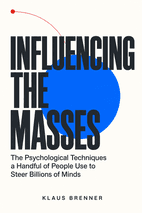
This page gathers lines from a book about crowds, media, and the quiet ways opinion gets shaped. Some quotes are sharp definitions, some are uncomfortable reminders, and some are plain useful if you want to notice when persuasion is happening to you.
What makes the book quotable is how often it turns a big idea into an image you can carry around. You will find lines on advertising, propaganda, algorithms, and the strange gap between what we think and what we are shown.
Top Quotes from INFLUENCING THE MASSES
“The crowd is the water and the individuals are the gases, so studying individuals in order to understand the crowd is like studying hydrogen in order to learn how to swim.”
Le Bon’s chemistry analogy for how a crowd differs from its members.
It vividly explains why individual psychology cannot account for crowd behavior. The analogy is simple, funny, and hard to forget.
“Anyone who wants to move a crowd has three instruments, and only three: assertion, repetition and contagion.”
Le Bon’s three-part formula for moving a crowd.
It reduces the mechanics of mass influence to a chillingly simple toolkit. The line feels like a manual for propaganda and marketing at once.
“If you can invent the color of an autumn, you can also invent a political enemy, a moral crisis or an epidemic of fear.”
It follows Bernays’s campaign to make green fashionable so that Lucky Strike’s green packaging would sell.
It shows how a commercial trick can scale into manufacturing political fear and enemies. The line is memorable because it makes the danger of “engineering consent” concrete.
“That is perhaps the most frightening lesson of all: knowing how manipulation works is no guarantee of being immune to it.”
The author reflects on Jung's own ambiguous conduct toward the Nazi regime.
It turns a historical critique into a warning for every reader. The unsettling idea is that insight alone cannot protect us from the mechanisms we understand.
“A decision that would set off a revolution if taken all at once does not even make the news when it is taken in small steps spread over years.”
This introduces the third strategy, gradualism.
It condenses how sweeping change can pass unnoticed when broken into small, patient steps.
“The algorithm has no idea what is true or false, or what is healthy or unhealthy for you; it knows only what keeps you glued there.”
Haugen’s Senate testimony explains the engagement metric behind Facebook’s feed.
It strips away any pretense of truth or well-being and reduces the algorithm’s purpose to capture.
“Applied to billions of users, the systemic result is a platform that amplifies anger and disinformation exponentially, out of optimization rather than malice.”
The chapter summarizes the systemic effect of engagement-driven recommendation at platform scale.
It frames algorithmic harm as an emergent outcome of incentives, not a conspiracy.
Themes Behind the Quotes
The book keeps circling the idea that crowds do not think like individuals, and that leaders and advertisers work on feeling, repetition, and belonging more than on argument. It looks at how images and stereotypes become the map people trust, so controlling those images can shape politics and daily choices without anyone needing to give orders.
Another theme is that manipulation often hides inside ordinary systems. News routines, brands, and algorithms can push attention in certain directions while looking neutral, and the result is a slow drift rather than a single plot. The book also warns that understanding these mechanisms does not make you immune, though it can make you quicker to notice them.
Quotes by Chapter
CHAPTER ONE
“The answer he will give himself, years later, is the most uncomfortable one available, and it will change the history of the twentieth century: nothing in particular happened. A great many people simply found themselves in the same place at the same moment, and a crowd is a different chemical substance from an individual.”
Le Bon’s answer to what happened in Paris during the Commune.
It states the book’s core thesis: ordinary people become something else when merged into a crowd. The chemical metaphor makes the idea memorable and unsettling.
“Le Bon writes a sentence worth carving in stone: a thing asserted and repeated long enough ends up lodging in those deep places of the mind where the motives of our actions are formed, until we forget who said it first and simply believe it.”
The author highlights Le Bon’s central claim about repetition.
It captures how repeated claims stop feeling like opinion and start feeling like reality. That mechanism explains much of modern propaganda and media.
CHAPTER TWO
“The techniques perfected to sell a war can be used to sell soap, buttons, cigarettes, cars, refrigerators and anything else somebody is willing to pay to promote.”
After World War I, Bernays realizes that the propaganda techniques used to sell the war could be repurposed for commerce.
It captures the book’s core claim that mass persuasion is a transferable technology, not confined to politics. It is chilling because it makes propaganda sound like ordinary commerce.
“Bernays was selling an identity, not a product. It worked so well that it changed history.”
It follows the staged “torches of freedom” campaign on Easter morning in 1929.
It reduces the “torches of freedom” stunt to its essence: Bernays sold a feeling of emancipation, not cigarettes. The line resonates because identity marketing now feels ubiquitous.
“Instead of selling the product, you sell the frame in which the product looks obvious.”
It comes after Bernays uses doctors’ authority to make eggs and bacon seem like the natural American breakfast.
It distills how influence works by changing the context so that the desired choice seems natural. The insight applies as much to politics and media as to bacon.
CHAPTER THREE
“We never live in the world. We live in the accounts of the world that reach us. And the two places are not the same.”
The narrator distills Lippmann’s lesson from the Pacific island story.
It states the book’s central insight in three plain sentences, making the gap between reality and our mental picture unforgettable.
“That map, says Lippmann, is what you call “the world.” It is on that map, not on the real world, that you make every one of your decisions, political and moral: how to vote, what to buy, what to be outraged by.”
The narrator explains how Lippmann’s phantom environment shapes everyday choices.
It turns an abstract media theory into a concrete claim about voting, buying, and outrage, showing that our decisions are made on a mental map rather than direct experience.
“And that means, Lippmann concludes in a flash of radical pessimism, that whoever controls the stereotypes of a society controls, in practice, its deepest opinions.”
Lippmann’s account of stereotypes as necessary mental shortcuts.
It reveals the hidden political stakes of perception: controlling standard images can shape opinions without direct persuasion.
“Democracy is a task, something that has to be built every day, from below.”
Dewey’s reply to Lippmann’s elitist solution, as summarized by the narrator.
It compresses the democratic alternative into a memorable principle: democracy is ongoing work from below, not a machine run by experts.
CHAPTER FOUR
“The difference, Jung says, is one of scale. A psychotic individual gets taken to a clinic. A psychotic nation gets taken to war.”
Jung describes how an entire nation in a psychotic state differs only in scale from an individual patient.
The parallel is chillingly simple, turning clinical language into a warning about collective madness. It sticks because it makes national catastrophe feel like a diagnosable condition.
“The leader is not communicating rational content. He is pressing archetypal buttons, and those buttons work in every human being and every culture, and have worked that way for tens of thousands of years, because they are wired into the structure of the psyche.”
Jung describes how propaganda activates archetypes rather than addressing reason.
It explains why the same manipulative appeals can work across languages and cultures. The phrase 'pressing archetypal buttons' makes an abstract psychological idea immediately tangible.
“It becomes inhuman, and once it is inhuman, everything is permitted against it.”
Jung explains what happens when a group collectively projects its Shadow onto another group.
The line names the moral threshold that enables atrocity. Its force comes from showing how dehumanization converts ordinary people into permission-givers for cruelty.
CHAPTER FIVE
“It is a perfect lesson in how contemporary propaganda works: a list describing the techniques of manipulation is itself spread by a technique of manipulation (false attribution to a prestigious authority) and goes viral for that very reason.”
The narrator explains that the viral “Chomsky” list was falsely attributed.
It captures the chapter’s central irony: a warning about manipulation is itself a case study in manipulation.
“The difference between an aware citizen and an unaware one is that the first, though no more immune, every so often recognizes them while they are being used on him.”
After listing the techniques, the narrator says they affect everyone, including writer and reader.
It defines awareness as recognizing manipulation without pretending to be immune, which is both humbler and more useful.
“Time and attention have become the scarcest resources of the twenty-first century, and the mechanism depends on that scarcity in order to work.”
This appears in the section on distraction and the continuous online stream.
It names attention as the scarce resource that manipulation exploits, making the attention economy feel like a political battleground.
CHAPTER SIX
“It is not the product of a conspiracy. It is the product of a series of structural pressures, each of which, taken on its own, looks reasonable, but whose sum produces a system that converges of its own accord on certain stories and systematically ignores others.”
Chomsky and Herman's propaganda model explains how news is filtered before reaching the public.
It crystallizes the model's core claim that media bias can be systemic without being conspiratorial, making the idea vivid and portable.
“No orders from above are needed. The widespread awareness that certain things “are not to be touched” is quite enough.”
The advertising filter is explained by the indirect pressure of advertisers on newsroom choices.
It shows how structural pressure can silence coverage through shared assumptions rather than direct commands.
“It is no longer an accurate map of the present territory, but as a compass it still points, well enough, to where north lies.”
The author concludes that Chomsky and Herman's aged media model still has practical value.
The map-and-compass metaphor is memorable because it honors both the model's dated limits and its ongoing usefulness.
CHAPTER SEVEN
“Behind that worldwide success (tens of billions of dollars in accumulated revenue, thousands of campaigns in hundreds of languages, all built on the same cowboy) there lay a single insight from 1954: don't sell the product, sell the identity of the person who uses it.”
The narrator explains the single insight behind Marlboro's worldwide success.
It distills the chapter's core lesson: marketing sells identity rather than product features.
“Advertising stopped describing products and started evoking worlds.”
The chapter describes the mid-century shift on Madison Avenue from descriptive ads to symbolic advertising.
It captures the pivot from rational product claims to evoking desire and identity.
“Through the brands you wear, you tell the world who you are and which tribe you belong to.”
The chapter explains how brands became social identities rather than mere labels.
It makes visible the everyday semiotics of consumption and belonging.
“It came from a deliberate industrial and political choice, made at a specific historical moment and carried out with specific techniques for manipulating desire, techniques that work very well and that today are in front of your eyes in practically every waking minute of your day.”
The narrator concludes that consumer society was deliberately engineered rather than naturally demanded.
It compresses the chapter's argument about manufactured desire into a single indictment.
CHAPTER EIGHT
“This shift, which happened so fast that we never had time to think it through, is perhaps the greatest transfer of informational power in human history.”
The chapter describes the rapid move from traditional media to algorithm-driven platforms.
It captures the scale and speed of the transformation in a single memorable claim.