In Search of Now Quotes
by Jo Marchant
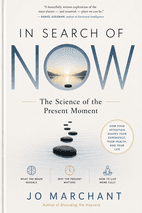
This collection gathers standout passages from Jo Marchant's 'In Search of Now'. You'll find lines that challenge your ideas about time, memory, and the present moment. Marchant mixes neuroscience, philosophy, and personal insight to create memorable observations. The quotes range from mind bending paradoxes to simple truths about perception. What makes the book so quotable is how it makes complex ideas feel immediate and personal.
The lines you'll browse capture the tension between what we feel is real and what science reveals. Some are poetic, some blunt. They work as conversation starters or quiet reminders. If you've ever wondered why the present feels so fleeting yet solid, these quotes get at the heart of that mystery.
Top Quotes from In Search of Now
“Now is an illusion constructed by our brains, merely a potent hallucination in a non-negotiable universe.”
The author explains the physicist's view that the present moment has no fundamental reality in the laws of physics.
Its stark, almost jarring contrast between our felt experience and scientific truth makes it a memorable, thought-provoking statement that challenges our everyday assumptions about time.
“Now, it seems, is the ultimate paradox: everything and nothing, all at once.”
The author summarizes the central paradox introduced in the chapter after contrasting lived experience with physical models.
This succinct phrasing captures the book's core tension in a powerful, quotable way, making it ideal for readers seeking a pithy takeaway that frames the entire exploration.
“The separation between the past, present and future holds nothing more than the value of an illusion, however strong it may be.”
Einstein wrote this to a grieving family after the death of a close friend.
It powerfully states that the distinction between past, present, and future is an illusion, challenging our deepest intuitions about time and offering a radical perspective on existence.
“Time doesn't really flow; past and future coexist.”
The author summarizes the conclusion from Einstein's theory of relativity.
It succinctly captures the radical idea that time is not flowing, directly contradicting our everyday experience and forcing a rethinking of reality.
“Our past may not be gone. Our future may already exist.”
Physicist Brian Greene summarizes the block universe view.
These two simple sentences powerfully express the timelessness of reality, provoking reflection on the nature of existence.
“Advocates of predictive coding argue that what we perceive — the vibrant, changing, three-dimensional reality all around us — isn’t the external world at all, but a guided prediction, or as some have described it, a ‘controlled hallucination’.”
The author explains the radical claim of predictive coding theory.
The phrase 'controlled hallucination' is provocative and unforgettable, forcing readers to question the trustworthiness of their own senses and the nature of reality itself.
“Every three seconds, the brain asks: “What is new?””
Ernst Péppel's conclusion about the brain's rhythm of awareness.
It succinctly captures the idea of periodic updating that underlies our sense of now.
Themes Behind the Quotes
A central theme is the illusion of a fixed present moment. The quotes repeatedly suggest that what we experience as 'now' is not a sharp boundary but a construction of the mind, shaped by memory and anticipation. This challenges our everyday sense of time flowing from past to future. Instead, the book explores the idea that all moments might coexist in a static block universe, with change being a trick of perception.
Another major thread is the active role of the brain in creating reality. Perception is portrayed not as a passive reception of sensory data but as a prediction or controlled hallucination. The brain constantly asks what is new and weaves together past and future to generate a seamless experience. This leads to a view of consciousness as dynamic and never at rest, always in motion.
Quotes by Chapter
Introduction: The Ultimate Paradox
“The very thing that makes the present moment special to us is our awareness of it, and I think that makes it a fascinating doorway through which to explore ourselves and our relationship to the universe in which we live.”
The author reflects on the nature of Now after describing his early experience with moving meditation.
This line encapsulates the book's central premise—that the present moment is both deeply personal and a gateway to profound questions about existence, inviting readers on a journey of self-discovery.
“Our very awareness of flowing time - the breaking wave of Now itself — is merely a deceptive shadow cast by the frozen, barren land that lies beyond.”
The author expands on the illusion of temporal flow using Plato's cave analogy.
The poetic imagery of a 'breaking wave' versus a 'frozen, barren land' vividly conveys the dissonance between our vivid inner sense of time and the static reality of physics, leaving a lasting impression.
Chapter 1. Whispers of Reality
“Now might appear at first like a sharply defined instant, or point, but the more we interrogate it, the bigger and deeper it seems to get.”
The author reflects on the initial perception of the present moment.
It captures the central mystery of the chapter: that the seemingly simple 'now' becomes increasingly complex upon examination.
“Now is a constant, always with us, defining every coordinate of our lives. And yet it is never the same.”
The author summarizes the paradox of the present moment.
This succinctly expresses the duality of now as both ever-present and ever-changing, a profound observation about time and experience.
“If the present, in order to be time, must go into the past, how can we say that a thing js, which can only be on the condition of no longer being?”
St. Augustine questions the existence of the present moment.
This rhetorical question powerfully illustrates the logical contradiction at the heart of time, making it a timeless philosophical puzzle.
“It didn't really start, and it didn’t really end. No earlier or later. No past or future. It was beautiful. I was so bored I thought I had died.”
The writer Joel Achenbach describes his experience of Philip Glass's 'Music in Twelve Parts'.
This vivid description of a musical experience that seems to suspend time perfectly conveys the disorienting yet beautiful feeling of losing temporal bearings.
Chapter 2. The Death of Now
“If there is no separation between life and oblivion, if all moments simply are, then all our choices have already been made, our actions played out, our mountains climbed, our passions yet to be and yet long gone.”
The author reflects on the implications for human life in a timeless universe as described by Einstein's relativity.
This evokes a profound sense of existential determinism, making readers ponder free will, purpose, and the meaning of life in a cosmos where everything coexists.
“That this experience cannot be grasped by science seemed to him a matter for painful but inevitable resignation.”
Rudolf Carnap reported a conversation with the aging Einstein about the present moment.
Reveals Einstein's personal struggle with the implications of his own theory, humanizing the genius and showing that even he found the loss of a shared Now deeply unsettling.
Chapter 3. A Timeless Universe
“The block universe implies that change, or happening, is an illusion, explains the cosmologist Max Tegmark.”
The author introduces cosmologist Max Tegmark's explanation of the block universe.
This line captures the central, counterintuitive implication of the block universe model, challenging our everyday experience of time.
“Your birth, death, and every breath of your life in between, all have their place.”
Describing the block universe's inclusion of all personal events.
It makes the abstract concept deeply personal, reminding readers that every moment of their life is fixed in spacetime.
Chapter 4. The Greatest Illusion
“Everyone lets the present moment slip by, then looks for it as though he thought it were somewhere else.”
The chapter opens with this epigraph from Yamamoto Tsunetomo.
It succinctly captures the human tendency to lose awareness of the present and then seek it externally, a timeless observation that resonates with the chapter's exploration of Now as an illusion.
“Our experience of happening — ‘Nowness' - may be the greatest illusion of all.”
This line concludes the discussion of Herzog's discrete theory of perception.
It directly states the chapter's core thesis in a memorable, provocative way, making it a powerful and quotable summary of the argument.
“Now remains an illusion: a construction of not just the present but the past.”
It appears after the continuous-Now interpretation and postdiction effects are discussed.
This elegantly encapsulates how our brains edit and revise perception, suggesting that the present moment is built from both past and present inputs.
“In a very real way, our experience of Now isn’t about recreating reality from the sensory clues that reach us; it's about predicting it before it has even occurred.”
This is stated near the end of the chapter, as the author synthesizes the predictive nature of perception.
It offers a profound and counterintuitive insight that challenges the naive view of experiencing the present, making it a standout line that invites reflection.
Chapter 5. Predicting the Present
“We perceive not what just happened, nor even what sensory signals indicate about what just happened, but what the brain concludes is most likely to be happening right now.”
The author summarizes the central insight of predictive coding.
This line crystallizes the book's radical thesis that our moment-to-moment experience is not a direct readout of reality but a probabilistic inference, challenging readers to rethink the nature of perception.
“Perception, says Seth, is ‘a writing as much as a reading’.”
British neuroscientist Anil Seth is quoted on the active, creative nature of perception.
The elegant metaphor captures how the brain constructs reality rather than passively recording it, making a complex scientific idea instantly memorable.
“Each sensation that passes through our awareness is woven from the twin forces of past and future: it is a prediction built from our history, both recent impressions and a lifetime of experience.”
The author reflects on the temporal structure of conscious experience.
This poetic statement ties together time, memory, and expectation, offering a profound and beautiful insight into how the present moment is never pure but always a blend of memory and anticipation.
Chapter 6. Riding the Saddleback
“The present isn't a ‘knife-edge’, he insisted, but ‘a saddleback, with a certain breadth of its own on which we sit perched’.”
William James describing the nature of the present moment.
This metaphor powerfully conveys that the present is not a point but a span, reshaping how we think about time.
“We never find any isolated Now; there is no ‘pure’ present sensation that occurs independently of events either side.”
The author summarizing the nested structure of temporal experience.
It encapsulates the chapter's central thesis that every moment is intrinsically connected to past and future.
Chapter 7. Unstoppable Flow
“Our inner narrative is always moving forwards.”
The author describes the constant forward motion of our experience, referencing philosopher Martin Heidegger.
This line succinctly captures the relentless forward momentum of human consciousness, making it both relatable and profound.
“It’s as if our brains just can’t help asking ‘What's new?”
The author discusses why our perception inevitably shifts even when our surroundings stay the same.
The phrasing is playful yet insightful, distilling a complex neuroscientific idea into a universally understandable question.
“Ultimately - apart from in some exceptional brain states that we'll hear about later - change is inevitable.”
After describing bistable image experiments where participants could not stop perceptual switches.
This line delivers a stark, memorable truth about the fundamental nature of perception and the unstoppable flow of Now.
“Our perception never comes to rest, pointed out Varela, but ‘approaches, touches and slips away in perpetual, self-propelled motion’.”
The author describes Francisco Varela's view of consciousness as a complex dynamical system.
The quote combines scientific observation with poetic language, vividly evoking the elusive, ever-moving quality of present-moment experience.