In Search of Now Key Takeaways

by Jo Marchant
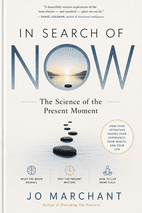
In Search of Now by Jo Marchant Book Cover

5 Main Takeaways from In Search of Now

The present moment is a brain-built illusion

Your conscious 'now' is not a direct window onto reality but a delayed, edited construction. The brain stitches together out-of-sync sensory signals and even rewrites the past to create a seamless narrative, as shown by illusions like the colour phi effect.

Physics says all moments are equally real

Einstein's relativity demolishes a universal 'now': simultaneity is relative, and spacetime is a static block where past, present, and future coexist. Our sense of time flowing is a subjective illusion arising from a limited perspective.

Your brain predicts the present to overcome lag

Neural processing delays mean you never perceive raw 'now'; instead, the brain uses past experience and Bayesian inference to generate a controlled hallucination. This predictive coding blurs the line between past and future.

Time perception is nested across multiple scales

The 'now' is not a single point but a hierarchy of windows — from milliseconds to seconds (a ~3-second cognitive chunk), minutes, and lifetimes. Neural oscillations bind these timescales, creating the fluid stream of consciousness.

We are active co-creators of reality, not passive observers

Enactivism and quantum interpretations show that perception is an embodied, participatory process. Organism and environment shape each other; every choice and action contributes to weaving the world, making the present moment a creative precondition for experience.

Executive Analysis

These five takeaways form a cohesive arc: the book begins by exposing the paradox between our vivid experience of 'now' and physics' claim that it has no special status. It then dissects the neuroscience behind how the brain constructs this illusion, revealing that our perception is a predictive, hierarchical, and embodied process. Finally, it bridges to quantum mechanics and enactivism, arguing that reality is co-created through participation, dissolving the gap between objective universe and subjective experience.

This book matters because it offers a scientifically grounded yet deeply human perspective on the present moment. It challenges readers to rethink time, self, and reality — with practical implications for mindfulness, mental health (e.g., depression, schizophrenia), and everyday choices. Sitting at the intersection of physics, neuroscience, and philosophy, 'In Search of Now' provides a rare synthesis that empowers readers to see 'now' not as a fleeting point but as the very fabric of creative existence.

Chapter-by-Chapter Key Takeaways

The Ultimate Paradox (Introduction)

  • The present moment feels vital and real, yet physics suggests it has no special status—all moments are equally real.

  • Mindfulness and popular culture champion Now as a source of well-being, creating a tension with the scientific view.

  • This paradox isn't just philosophical; it challenges our understanding of time, self, and reality itself.

  • The book will explore the gap between the objective universe and our subjective experience, searching for a synthesis.

Try this: Notice the tension between your felt sense of 'now' and the scientific view that all moments are equally real — use this paradox to stay curious rather than dismissive.

Chapter 1. Whispers of Reality (Chapter 1)

  • The present moment feels simple but is actually a complex blend of sensory input, memory, anticipation, and bodily awareness.

  • Philosophers and artists have long grappled with the paradox of a constant yet ever‑changing now.

  • Scientific discoveries show that our perception of now is highly subjective, varying between species and even between individuals with different neurobiology.

  • Our experience lags behind real‑world events due to neural processing delays, and the brain actively stitches together out‑of‑sync signals to create a coherent present.

  • Illusions like the Hoerl collision and the colour phi effect prove that what we see can be systematically wrong, with the brain rewriting the past to fit a continuous narrative.

  • Understanding now requires us to look beyond our intuitive sense of reality and into the machinery of the mind.

Try this: When you feel you're perceiving reality instantly, remind yourself that your brain is actually stitching together delayed sensory data — pause before reacting to give your construction time to settle.

Chapter 2. The Death of Now (Chapter 2)

  • Gravitational wave detection confirmed Einstein's final prediction, but the deeper implication is that there is no objective "now" moment.

  • Newton's absolute time—a universal clock advancing for everyone—was dethroned by Einstein's relativity.

  • Special relativity shows simultaneity is relative: events that appear simultaneous to one observer may not be for another, demolishing the concept of a shared present.

  • General relativity reveals spacetime as a dynamic fabric warped by mass; the 1919 eclipse and countless experiments validate it.

  • Our subjective experience of time flowing, of a privileged present moment, is an illusion according to physics—a sensation arising from our limited perspective.

  • Accepting a timeless reality forces us to reconsider human existence: if all moments are equally real, our choices and actions are already inscribed in the fabric of the universe.

Try this: Question your assumption that others experience the same 'now' as you; relativity shows simultaneity is relative, so practice patience when timing conflicts arise.

Chapter 3. A Timeless Universe (Chapter 3)

  • The block universe model, derived from Einstein's relativity, treats all of time as a static four-dimensional structure where past, present, and future coexist; change is an illusion.

  • The arrow of time is not fundamental but statistical: entropy increases from a highly ordered initial state (Big Bang), and we perceive this trend as the flow from past to future.

  • Alternative views (Barbour's static Nows, Rovelli's event-based relational universe) also eliminate fundamental time, but in different ways—suggesting time is a perspective, not a feature of reality.

  • The specialness of the present moment is not in the cosmos; it's constructed by our minds, leading the book to next explore how human consciousness creates the experience of time.

Try this: Reflect on the idea that past, present, and future coexist in the block universe — this can reduce regret about the past and anxiety about the future by framing them as equally real.

Chapter 4. The Greatest Illusion (Chapter 4)

  • The conscious present moment is not a direct experience of real-time events but a construction built from sensory data processed over hundreds of milliseconds.

  • The shortest perceivable interval between distinct events is roughly 20–60 milliseconds; anything shorter is bound into a single "functional moment."

  • Two main theories—discrete updating and continuous evolution—both agree that the brain significantly delays and edits our perception before we become aware.

  • Postdictive effects (where a later event alters perception of an earlier one) don't require time travel; they simply show that the brain's final version overwrites any earlier drafts.

  • Our sense of a smooth, ongoing Now is an illusion, maintained by a brain that constantly rewrites the past and predicts the future.

Try this: When processing a rapid sequence of events, remember your brain binds anything under 20–60 milliseconds into one moment — use this to design clearer communication by slowing down.

Chapter 5. Predicting the Present (Chapter 5)

  • Neural lag means sensory input is always out of date—we never perceive the raw "now" directly.

  • The brain solves this by predicting the present, using past experience and Bayesian inference.

  • What we perceive is not the external world but a "controlled hallucination"—the brain's best guess.

  • Predictive coding reverses traditional bottom-up perception: top-down predictions drive the show, and errors fine-tune them.

  • This understanding blurs the line between past and future—each moment is woven from both, and the pure present is entirely inaccessible.

Try this: Train yourself to recognize that what you perceive is your brain's best guess, not raw reality — especially in ambiguous situations, ask 'what might my predictions be missing?'

Chapter 6. Riding the Saddleback (Chapter 6)

  • The "three-second rule" reflects a real cognitive window: events within ~3 seconds feel bound together as a single moment.

  • Husserl’s three-part structure (retention, primal impression, protention) explains how we experience melodies, stories, and other extended meanings.

  • Pöppel’s research supports a three-second "parcel of experience," though critics argue for a more flexible, sliding window.

  • Our sense of now is hierarchical: from millisecond instants to seconds, minutes, hours, and lifetimes—all nested to create a seamless flow.

  • William James’ "stream of consciousness" accurately describes the continuous, saddleback-like nature of temporal awareness.

Try this: Leverage the ~3-second cognitive window when listening to others or creating content — chunk your messages into three-second bursts to feel more cohesive and memorable.

Chapter 7. Unstoppable Flow (Chapter 7)

  • Bistable images show we cannot stop our perception from shifting, even with constant visual input

  • Predictive coding suggests the brain's fundamental belief in a changing world ensures continuous forward motion

  • Synchronized neuronal oscillations lasting several seconds may correspond to our experienced moments

  • Brain activity shows musical structure with repeating motifs, rhythms, and harmonies at different timescales

  • The brain operates like a masterful orchestra, with different neural sections playing their own rhythms and melodies while harmonizing into a unified experience. This metaphor captures Lloyd’s central insight: that our perception of the present moment isn’t a single point in time, but a rich temporal landscape where past, present, and future interweave. Our consciousness flows because the brain can bind together multiple timescales within each Now—holding onto stable threads of identity and direction while simultaneously navigating fast-changing events.

  • This layered temporal composition isn’t just a feature of perception; it may be the very structure through which we experience reality—and who we are. Studies of binocular rivalry reinforce this idea: subsets of neurons fire in synchrony only when they correspond to whatever interpretation we currently perceive, showing that our brain actively selects and organizes its own temporal coherence.

  • And here’s a fascinating twist: Lloyd suggests music isn’t merely a cultural artifact or “auditory cheesecake,” as some scientists have claimed. If our brain activity is fundamentally rhythmic and harmonic, then music might be something far deeper—a model of the mind in sound, developed because it resonates with how our minds actually work. That ancient flutes made from bone and mammoth ivory speak to a universal human impulse to externalize the inner rhythm of consciousness.

  • The brain binds multiple timescales together within each moment, creating a fluid yet stable sense of Now.

  • Neural synchrony actively shapes what we perceive, as seen in binocular rivalry studies.

  • Music may be a natural expression of the brain’s own rhythmic structure, not just a cultural invention.

  • Our experience of time is not merely perceived but is the foundational frame for reality and selfhood.

Try this: Pay attention to the nested timescales of your experience: from milliseconds to hours — deliberately zoom in and out to gain perspective on a situation.

Chapter 8. When Now Goes Wrong (Chapter 8)

  • Fractal brain activity—the nested relationship between different frequencies—is linked to a robust sense of self. Disrupting these patterns weakens our experience of being a coherent “I.”

  • Depression involves a loss of conation (forward drive), making time feel slow and the future unreachable. A mismatch between inner and outer time may be central.

  • Mania accelerates inner time relative to the world, creating impatience and a sense that everything drags.

  • Schizophrenia disrupts synthesis—the integration of moments—leading to fragmented, frozen time. Patients lose predictive timing, feel disconnected from their bodies, and experience thoughts as alien.

  • Predictive coding suggests that hope and confidence in the future are essential for normal flow; hopelessness stalls the engine of time perception.

Try this: If you feel time slowing or speeding up (e.g., in depression or mania), understand that your inner time may be mismatched with outer time — seek activities that realign your rhythm.

Chapter 10. Imagining the Past (Chapter 9)

  • Language makes us vulnerable to confusing direct experience with secondhand information.

  • Source monitoring becomes essential in larger social groups, where not all information is trustworthy.

  • The ease of processing (fluency) can trick us into false memories—we remember something because it was easy to complete, not because we actually encountered it.

Try this: When recalling an event, separate direct experience from secondhand information — ask yourself 'did I actually see this, or was it described to me?' to avoid false memories.

Chapter 12. Weaving the World (Chapter 11)

  • Perception is not a purely intellectual process confined to the brain but an embodied interaction between brain, body, and world

  • Emotions aren't reactions to perception but integral to how we construct perceptual experience in the first place

  • The insula may serve as a neural hub where bodily signals and contextual information integrate into unified "emotional moments"

  • Our history of bodily responses shapes present perception—we never see the "raw" world, but one filtered through embodied experience

Try this: Notice how your emotions and bodily state shape what you perceive — before judging a situation, check your physical sensations and emotional context.

Chapter 13. Be the Change (Chapter 12)

  • Reality, unlike digital representations, is never finished—it’s indeterminate and open to exploration.

  • Presence comes from perceiving the world as incomplete and probing for new possibilities.

  • The present moment is less about a static snapshot and more about active weaving—the process of prediction and interaction.

  • Perception is a skill of mastery, not mere reconstruction; we are co-creators of what feels real.

Try this: Approach reality as unfinished and open to probing — instead of seeking a final snapshot, engage with the world as a process you co-create through interaction.

Chapter 14. Staying Alive (Chapter 13)

  • The self is a guess, not a fixed entity—it can fragment, distort, or dissolve, confirming its constructed nature.

  • Time is a personal model built to predict and control our physiological state, not an objective readout.

Try this: When your sense of self feels shaky, remember that the self is a guess built for prediction — use this to loosen rigid self-narratives and experiment with new identities.

Chapter 16. I Am the Fire (Chapter 15)

  • Enactivism starts with life itself, not brains: even a bacterium has a perspective shaped by survival.

  • Organism and environment shape each other; there is no separate, objective world apart from experience.

  • Sensation is not an inner representation but the ongoing interaction between action and prediction.

  • The "hard problem" of consciousness dissolves when experience is seen as the process itself, not a byproduct.

  • Mainstream physics may need to be rethought to make room for a living, present-centered reality.

Try this: Think of perception as an active, survival-driven interaction with your environment — ask not just 'what is out there?' but 'what does this situation require me to do?'

Chapter 17. Quantum Maze (Chapter 16)

  • Quantum mechanics introduces fundamental uncertainty: particles exist as probability waves until measured, at which point the wave function “collapses.”

  • The Copenhagen interpretation accepts this uncertainty as fundamental, while many-worlds avoids collapse by splitting reality into parallel branches.

  • George Ellis sees collapse as an irreversible physical event that creates a flowing, objective present moment—the boundary where possibility becomes actuality.

  • Lee Smolin, inspired by entanglement, proposes a universe of events with absolute time and no transcendent laws; the present is a “thick” window of activity.

  • Wigner’s friend experiments suggest that different observers can hold mutually exclusive but valid realities, challenging the notion of a single objective world.

Try this: When faced with uncertainty, accept that quantum mechanics treats 'now' as the boundary where possibility becomes actual — act decisively to collapse potential into reality.

Chapter 18. Bursts of Creation (Chapter 17)

  • Quantum mechanics is personal: The equations describe an agent's beliefs about their own future experiences, not an objective external world.

  • Paradoxes are illusions: Superposition, collapse, entanglement, and Wigner's Friend all become straightforward statements about how individuals update their beliefs.

  • Reality has structure, not stuff: There are rules (like the Born rule) that constrain our predictive models, creating a consistent shared framework for all observers.

  • We are participants, not spectators: Each action we take contributes to creating reality. The universe isn't a pre-existing block but a dynamic, evolving "pluriverse" that we help shape.

  • Physics and cognitive science converge: Both fields point to a world where perception and reality are co-created through an ongoing process of prediction and action.

Try this: Realize that your choices and attention are not trivial — they are acts of co-creation in a pluriverse; treat each moment as a chance to shape reality.

Chapter 20. Time to Choose (Chapter 19)

  • Everyday choices and attention are not trivial; they actively shape reality and ourselves in a Now-focused universe.

  • Some physicists argue for a causative role of consciousness in physical events, but the independent existence of the universe makes this difficult to explain.

  • Integrated Information Theory (IIT) quantifies consciousness via "Phi," linking it to the integration and information content of a system's states.

  • Brain studies support IIT's prediction that posterior cortex, not frontal regions, is most critical for conscious experience.

Try this: Consider that consciousness may have a causative role in physical events — experiment with focused attention as a force that influences outcomes.

Being-Time (Epilogue)

  • Western thought inherited a view of time as a passive backdrop from Plato, Aristotle, and monotheistic religion

  • Dogen's "Being-Time" offers an alternative: reality as a constant flow of arising, with no external framework

  • Katagiri emphasized that all existence comes together in each moment

  • This resonates with the scientific view that organisms enact their worlds moment by moment

  • Now may not be a thing or a time, but the creative precondition for all experience

  • Time and being are inseparable. You do not have a moment; you are that moment, fully and with everything it entails.

  • The present is not a vanishing point. “Now” is the only arena where causality, meaning, and ethical weight reside.

  • Participation is not optional. Reality is co-created in each instant.

  • Life gains significance through this lens. If each moment contains the entire universe, then the way we inhabit time becomes a matter of profound consequence.

Try this: Live each moment as if time and being are inseparable — you don't have a moment, you are that moment; let this insight infuse your daily actions with significance.

Continue Exploring