I Hate Job Interviews Quotes
by Sam Owens
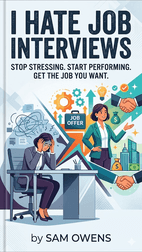
Welcome to a collection of standout quotes from Sam Owens' book I Hate Job Interviews. Inside you will find lines that cut through the usual fluff and get straight to what matters in landing a job. These quotes cover everything from self belief to company research to the art of telling stories.
What makes this book so quotable is its frankness. Owens does not sugarcoat the interview process. He delivers hard hitting truths that are easy to remember and even easier to share. The quotes here are not just clever, they are practical. They challenge common assumptions and give you a fresh perspective on how to prepare, present yourself, and connect with interviewers. Each one is a mini lesson worth revisiting.
Top Quotes from I Hate Job Interviews
“The most qualified candidate doesn't necessarily get the job; the best interviewer does.”
The author reframes the hiring process after addressing the BIT that candidates blame lack of qualifications.
This provocative statement challenges a common excuse and refocuses readers on the controllable factor—interview performance.
“Data are forgettable, stories are memorable.”
The author contrasts data with stories in a job interview context.
This line is a sharp, memorable contrast that encapsulates the core argument for storytelling over dry facts.
“Our hiring policy is simple: no A-holes.”
A general manager the author worked for states their hiring policy.
It's blunt, memorable, and instantly conveys the priority of avoiding toxic personalities.
“Show me a shy person who can do that well, and I'll show you someone who will get the job. Show me an outgoing, personable person who can't, and I'll show you someone who will be shown the door after an interview.”
Part of the author's debunking of the myth that introverts are at a disadvantage in interviews.
It uses a memorable parallel structure to emphasize that preparation outweighs personality type, empowering shy candidates.
“If these people want to behave like everyone else, they must be satisfied with getting the results everyone else gets.”
The author explains why few job seekers conduct informational interviews.
This line is a sharp motivational kick, urging readers to break from the crowd. It resonates because it ties mediocrity to inaction and offers a clear path to differentiation.
“If people can’t work well with one another, it's game over.”
The author discusses the importance of cultural fit in hiring.
This line succinctly captures the high stakes of teamwork and why cultural fit is prioritized over competence.
“Interview momentum is an invisible but powerful force. You can feel it when it's there. It sets a positive tone for the rest of the interview, like riding a bike with the wind at your back.”
The author explains the concept of momentum created by a strong response to the first interview question.
The vivid metaphor of riding a bike with the wind at your back makes the abstract idea of momentum tangible and memorable, and it captures the relief and confidence a great start provides.
Themes Behind the Quotes
One major theme is preparation. Owens stresses that confidence comes from being truly prepared, not just believing in yourself. He advocates practicing deliberately and gathering unique information. Another theme is the importance of storytelling. Data is forgettable, but specific stories that show your skills make you memorable.
The second theme is cultural fit. Many quotes emphasize that being competent is not enough; you must also be someone people enjoy working with. Badmouthing past employers or being difficult to work with can ruin your chances. Finally, the best interviewer gets the job, not the best candidate. Success comes from preparation, storytelling, and likability.
Quotes by Chapter
Chapter One: Convince Your Harshest Critic: Believing in Yourself Changes Everything
“If you want your interviewer to believe in you, you must first believe in yourself.”
From the author's argument that lacking confidence makes you appear as a risky hire to interviewers.
It distills the core message of the chapter into a single, actionable truth—self-belief is the prerequisite for convincing others.
“The way to feel confident that you are an excellent candidate is to be an excellent candidate, and the way to be an excellent candidate is to prepare more than anyone else.”
The author explains that genuine interview confidence comes from preparation, not quick fixes.
This line flips the usual notion of confidence as a feeling into a result of deliberate action, motivating readers to invest in preparation.
Chapter Two: Get Inside Information: Gaining an Easy Advantage
“It was the information he had that no one else did.”
The author reflects on why Ivan Boesky succeeded in insider trading.
This line crystallizes the core argument of the chapter: exclusive knowledge is a game-changer. It's memorable because it frames inside information as a simple, powerful advantage.
“When it comes to company research, talking to people is almost always better than reading.”
The author contrasts human interaction with online research during interview preparation.
This directly actionable advice challenges a common lazy habit and stresses the value of personal connection. It's both practical and counterintuitive.
“Never leave the conversation without asking, “Is there anyone else you can think of whom I should speak with?””
The author gives closing advice for an informational interview.
This specific, memorable question unlocks exponential networking opportunities. Its directness makes it a quotable takeaway that readers can immediately apply.
Chapter Three: Craft Power Examples: Positioning Yourself for the Job
“Not at all... and! want you to know that also, I will not make age an issue in this campaign. I am not going to exploit, for political purposes, my opponent's youth and inexperience.”
Ronald Reagan responds to a moderator's question about his age during the 1984 presidential debate.
This masterful repositioning turns a potential weakness into a strength with humor and confidence, making it a classic example of reframing a narrative.
“Job descriptions are like instruction manuals except they aren’t the worst. In fact, a job description is a gold mine—a document that tells you exactly how to prepare for the interview by listing the skills required for the job.”
The author explains the value of job descriptions for interview preparation.
It vividly contrasts the typical disdain for instruction manuals with the underutilized treasure of a job description, motivating readers to treat it as a critical tool.
“Doing so is the equivalent of taking an open-book test without opening the book.”
The author warns against ignoring the job description during interview preparation.
This simple, relatable analogy drives home the absurdity of neglecting such an obvious resource, making the advice memorable and actionable.
“The more your power examples spoon- feed them exactly why you are the best option, the better.”
This is from the chapter's advice on crafting power examples to make hiring decisions easy for interviewers.
The vivid 'spoon-feed' metaphor humorously underscores the importance of removing any ambiguity, making the candidate's value unmistakably clear.
Chapter Four: Practice with Humans: Accelerating Your Performance
“If you want to learn the language fast, speak it.”
The author's older brother gave this advice on how to learn Portuguese quickly.
It's a simple, counterintuitive piece of wisdom that directly translates to the importance of practicing job interviews rather than just preparing mentally.
“The discomfort and frustration wrought by practicing job interviews is exactly what you need to rapidly improve.”
The author reflects on his language-learning experience and applies it to interview preparation.
This line reframes the pain of practice as a necessary catalyst for growth, motivating readers to embrace awkwardness rather than avoid it.
“To be precise, being good in the interview will give you a good chance of getting the job; being great in the interview will give you a great chance of getting the job; but being the best interviewee will give you the best chance of getting the job.”
The author explains why 'good' isn't enough in a competitive job market.
It's a memorable, escalating structure that drives home the competitive reality of interviews and the need to aim for being the best, not just adequate.
“The mastery gained through practice is what will give you the ability to go off script and improvise a little because you are so familiar with the material.”
The author counters the fear that practice makes you sound robotic.
This insight reassures readers that true spontaneity comes from deep preparation, not from avoiding practice.
Chapter Five: Start with Momentum: Owning the First Question
“You should be persuasive but not pushy. This is a critical skill not only for your response to the introductory question but also for your whole interview and throughout your whole career.”
The author contrasts his approach with interview coaches who advise being mild in the opening answer.
This line distills a nuanced principle into a simple, actionable contrast, and it elevates the advice beyond just interviews to long-term professional success.
“A good opening statement highlights three things to the interviewer: First, that you have the right skills for the job. Second, that you are a top performer. Third, that you are very interested in the position.”
The author introduces a framework for crafting an effective response to introductory questions.
This clear, three-part checklist gives candidates a concrete structure to follow, making a daunting task feel manageable and purposeful.
“Resist the urge to tell them everything on your mind or all experiences you've had. Just because you've worked hard at something doesn’t mean the interviewer cares about it.”
The author advises against mentioning irrelevant skills or experiences in the opening statement.
This blunt reminder cuts through a common pitfall—over-sharing—and forces candidates to adopt a disciplined, audience-focused mindset.
Chapter Six: Tell Compelling Stories: Mastering Behavioral Questions
“Showing, not telling, is the first rule in telling great stories in job interviews, and you do it by being specific.”
After describing Aron Ralston's speech, the author explains the key principle for interview stories.
It distills the most important advice of the chapter into a clear, actionable rule that readers can immediately apply.
“If you can't find anything in your story to take credit for, find another story.”
The author is advising readers on the action portion of the SPAR model.
This blunt, no-nonsense line forces readers to take ownership of their achievements and avoid vague, self-effacing answers.
“A story that inspires emotion solidifies the information in our minds and makes it memorable.”
The author explains why stories are more effective than data for making an impact.
It connects the psychological power of emotion to practical interview success, making the advice feel both scientific and actionable.
Chapter Eight: Know Thyself: Answering Questions about You
“On Paper, Janet was a powerhouse. But she was also mean.”
The author introduces Janet's contradictory image—impressive credentials versus harmful personality.
It succinctly highlights the gap between résumé and reality, a cautionary reminder that skills don't excuse bad behavior.
“Calling someone a bad cultural fit is the nicest possible way of saying that either people don't like working with that person or the person doesn't like working with everyone else.”
The author explains the corporate euphemism for a toxic employee.
This demystifies a common HR term and underscores the human cost of poor cultural fit, making the abstract concept feel concrete and honest.
Chapter Nine: Avoid Land Mines: Handling Illegal, Negative, or Just Plain Wacky Questions
“Bad-mouthing your past organization says more about you than it does the organization.”
The author advises against negativity when answering the trap question 'Why are you leaving your current job?'
This line is a powerful reminder that how you speak about former employers reflects your own character. It encourages candidates to stay positive and professional, a lesson that extends beyond interviews.
“Even if your boss was a raging psychopath and the only reason you are applying for a new job is to get away from them, you must find a way to show that you can work with others.”
The author explains how to handle the trap question about what you didn't like about your last boss.
The humorous hyperbole makes the advice unforgettable while driving home the point that negativity is a career-limiting move. It empowers readers to reframe even the worst workplace experiences into stories of adaptability.