I Hate Job Interviews Key Takeaways
by Sam Owens
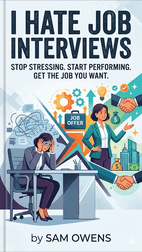
5 Main Takeaways from I Hate Job Interviews
Earn self-belief through disciplined preparation and practice
Confidence isn't a personality trait—it's the result of systematic preparation. Use the book's checklist to break the vague process into small tasks, focus on your weakest area for the biggest gains, and practice with mock interviews to accelerate performance. The discomfort you feel during practice is a signal of improvement, not a reason to stop.
Gain an insider edge with ethical informational interviews
Most candidates skip live research, but talking to people inside the company gives you a decisive advantage. Use the REAL method (Research, Express appreciation, Ask relevant questions, Listen actively) and always close by asking for referrals to multiply your network. Warm introductions beat cold outreach every time.
Craft power examples that prove your fit
Vague promises lose to concrete evidence. Prepare at least three examples per target skill, use bridging to connect any experience, and always spoon-feed the link to the interviewer. Power examples are your primary interview currency—without them, you're just making claims.
Tell compelling stories with the SPAR model
Every behavioral question is a story prompt. Master 5–7 versatile stories using the SPAR structure (Situation, Problem, Action, Result), with the Action step broken into three clear actions you personally took. Practice each story aloud until the arc feels natural and you can adapt it to different skills.
Close with enthusiasm and negotiate with logic
Always express clear interest at the end of an interview and lock in a timeline for next steps. When negotiating, lead with market data and a collaborative tone, know your walk-away number, and look for alternative levers like signing bonuses if one element can't move. The best negotiators acknowledge the company's constraints while advocating for themselves.
Executive Analysis
These five takeaways form a complete system that shifts the reader from a passive, anxious candidate to an active, prepared performer. The book's core argument is that interviews are not about being a 'good enough' candidate but about becoming the best-prepared person in the room through disciplined research, targeted practice, and strategic storytelling. Each takeaway builds on the previous one: self-belief from preparation enables you to gather inside information, which feeds power examples, which become compelling stories, and all of it culminates in a confident close and negotiation.
This book matters because it addresses the most common pain point among job seekers—the feeling of being at the mercy of an unpredictable process—and replaces it with a repeatable, actionable framework. Sam Owens demystifies the interview by treating it as a performance skill rather than a personality test. In a crowded field of career advice, 'I Hate Job Interviews' stands out for its practical, system-oriented approach, offering tools like the SPAR model, the REAL method, and the SEE model that readers can apply immediately. It's a no-nonsense guide that turns anxiety into action.
Chapter-by-Chapter Key Takeaways
Convince Your Harshest Critic: Believing in Yourself Changes Everything (Chapter 1)
An interview that feels “adequate” (B-plus) will lose to a well-prepared candidate every time.
Use the preparation checklist to turn a vague process into a series of small, doable tasks.
Self-belief is earned through disciplined preparation, not wishful thinking.
Focus your practice on your weakest area—that’s where the biggest gains hide.
Try this: Use the preparation checklist to break your interview prep into small, doable tasks, then focus your practice time on the single area where you feel weakest—that's where the biggest gains hide.
Get Inside Information: Gaining an Easy Advantage (Chapter 2)
Inside information (ethically gathered) is your biggest advantage—most candidates skip this step entirely.
Spend the bulk of your research time talking to people, not reading websites.
Warm introductions always beat cold outreach; leverage your network creatively.
Make every informational interview REAL: Research, Express appreciation, Ask relevant questions, Listen actively.
Always close by asking for referrals to other contacts. One good conversation can lead to many more.
Try this: Start your research by scheduling at least three informational interviews with people in your target role or company, using the REAL method, and always end by asking for referrals to more contacts.
Craft Power Examples: Positioning Yourself for the Job (Chapter 3)
Power examples are your primary interview currency. Without them, you’re making a vague promise; with them, you deliver evidence.
Bridging isn’t a last resort—it’s a strategic move. Any experience can become relevant when you frame the transferable skill explicitly.
Prepare at least three examples per target skill. Volume gives you flexibility, confidence, and depth.
Always spoon‑feed the connection. Don’t assume the interviewer will connect the dots; do it for them with clear, specific language.
Try this: For each required skill on the job description, brainstorm three distinct power examples from your experience, then practice bridging unrelated roles by explicitly stating the transferable skill and spoon-feeding the connection to the interviewer.
Practice with Humans: Accelerating Your Performance (Chapter 4)
Being a “good” candidate often isn’t enough; the person with the best interview gets the offer.
Most competitors won’t put in the uncomfortable work of live practice—that’s your advantage.
Practice has three stages: read out loud, memorize off book, then simulate with a mock interviewer.
For mock interviews: take them seriously, don’t break character, hold feedback to the end, seek honest critique, and aim for two sessions.
The discomfort you feel during practice is a signal that you’re improving—lean into it.
Try this: Schedule two formal mock interviews with a trusted friend or coach, treat them as real (don't break character), hold all feedback until the end, and lean into the discomfort as a sign of growth.
Next chapter: “Start with Momentum: Owning the First Question” is locked
Keep learning from I Hate Job Interviews — and unlock all 500+ book summaries with audio, mindmaps and AI Q&A.
$0.00 due today · 7 days free, then $89.99/year ($7.49/mo) · Cancel anytime before day 7