How to Make People Like You in 90 Seconds or Less — Interactive Mindmaps

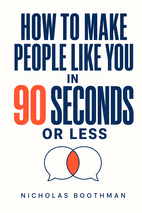
How to Make People Like You in 90 Seconds or Less by Nicholas Boothman Book Cover

by Nicholas Boothman

Buy on Amazon

As an Amazon Associate, we earn from qualifying purchases.

Nicholas Boothman's How to Make People Like You in 90 Seconds or Less breaks connection into three stages—meeting, rapport, and communicating—with tools like the five-part greeting, a Really Useful Attitude, and sensory-preference profiling. Written for professionals, job seekers, salespeople, and socially hesitant readers who want to build trust quickly through practice.

On Insta.page you also get an Apply This Book tool that lets you combine insights from up to 3 books to solve your specific situation.

Chapter mindmaps

Free preview: chapters 1–4 are fully interactive. Click any node to expand or collapse. Subscribe to unlock the rest.

Chapter 1: 1. People Power

Key concepts: 1. People Power

People Power

People as the Greatest Resource

  • Connecting with others is the greatest resource for success.
  • People supply money, work, service, comfort, and care.
  • Even solitary artists hope their work reaches an audience.
  • A connected community frees energy for growth.

Connection and Health

  • Socially active people live longer and keep brains young.
  • Lacking social ties triples risk of death from illness.
  • Isolation harms health regardless of other factors.
  • Emotional well-being depends on feedback from others.

Face-to-Face vs. Online

  • Online groups help but are poor substitutes for in-person contact.
  • Face-to-face reveals nonverbal cues and true openness.
  • In-person interaction builds supportiveness and companionship.
  • Keep face-to-face contact in your routine.

Why Likability Works

  • Likability signals willingness to connect and builds trust.
  • It's more about how you make people feel than looks.
  • A warm, easygoing demeanor attracts others.
  • Likability captures attention; rapport holds it.

The 90-Second Window

  • People judge friend or foe in 90 seconds or less.
  • Presence, attitude, and how you make people feel matter.
  • Make availability visible through posture, expression, warmth.
  • Connecting skills can be switched on when needed.

Chapter 2: 2. First Impressions

Key concepts: 2. First Impressions

First Impressions

The Greeting Sequence

  • Open: positive attitude, open body, heart aimed, arms uncrossed
  • Eye: make eye contact first, practice naming eye colors
  • Beam: smile first as reflection of attitude
  • Hi!: pleasant voice, own name, handshake, use their name

Handshake and Hands-Free Alternative

  • Firm, respectful grip like ringing for room service
  • Avoid bonecrusher or wet noodle; confusion causes withdrawal
  • Hands-free: keep heart, eyes, smile aimed but drop hand
  • Useful for presentations and when handshake doesn't fit

Firing Energy Exercise

  • Circle ~12 feet; one person fires energy to another
  • Six channels: body, heart, eyes, smile, clap, voice/breath
  • Receiver fires to someone else until all struck three times
  • Aim for subtlety; use same flash with cashiers, waiters, etc.

Rapport and Communication Cycle

  • Rapport: shared ground, comfortable zone where minds meet
  • Four capacities: positive attitude, synchronizing, conversation, VAK
  • Communication meaning = response received; sender responsible
  • KFC: Know what you want, Find out what you're getting, Change until you get it

Key Takeaways

  • Make opening four seconds a fixed sequence: attitude, torso, eyes, smile, name, lean
  • Use firm handshake or hands-free; keep chest, eyes, smile aimed
  • Practice circle exercise until coordinated burst becomes automatic
  • Own results: state goal affirmatively, watch responses, redesign approach

Chapter 3: 3. “There’s Something About This Person I Really Like!”

Key concepts: 3. “There’s Something About This Person I Really Like!”

“There’s Something About This Person I Really Like!”

The Critical First Impression

  • You have about 90 seconds to make a good first impression.
  • Rapport makes you believable, leading to mutual trust.
  • Without rapport, people focus on you, not your message.
  • Spend the opening minute making the other person feel understood.

Natural Rapport

  • Humans naturally sync with others, like animals and plants.
  • Shared interests create instant connection and ease.
  • Society often trains us to fear strangers, hindering rapport.
  • Rapport is essential for sanity, growth, and survival.

Rapport by Chance

  • Shared language or hometown quickly creates temporary friendship.
  • Chance encounters happen daily at work, stores, and transit.
  • Friendships may fade when only language or location connects you.
  • Give such friendships more to stand on to make them last.

Rapport by Design

  • Deliberately reduce distance by finding common ground and becoming like the other person.
  • Mirror posture, gestures, facial expressions, and vocal rhythms.
  • Use your native tools: attitude, appearance, body, voice, and curiosity.
  • Treat each encounter as a puzzle to solve and a game to enjoy.

Key Takeaways

  • Credibility and trust come from making the other person feel understood.
  • Create connection on purpose when no natural link exists.
  • Enjoy easy warmth but build deeper foundations for lasting friendship.
  • Work with your existing equipment: observation, curiosity, and adaptability.

Chapter 4: 4. Attitude Is Everything

Key concepts: 4. Attitude Is Everything

Attitude Is Everything

Mind and Body as One System

  • Attitude shapes thoughts, tone, word choice, and body language.
  • Once an attitude takes hold, conscious control over signals is limited.
  • Body plays out the pattern, affecting relationships and outcomes.

Really Useful vs. Really Useless Attitudes

  • Useful attitudes like cheery and interested benefit everyone at no cost.
  • Useless attitudes stem from not knowing what you want (KFC: Know what you want).
  • Useless attitudes leak out as boredom, impatience, or hostility.

Choose Your Attitude with a Goal

  • Ask what you want and which attitude serves it.
  • Rapport works better than indignation when seeking help.
  • Warmth is the favorite first-meeting attitude; it triggers feel-good chemicals.

Imagination Drives Attitude

  • Imagination is stronger than willpower and works through senses.
  • Feed it vivid, concrete material to magnify desired attitudes.
  • It twists reality for better or worse, so choose inputs carefully.

Anchor Attitudes with Physical Triggers

  • Relive a memory of the attitude at full sensory intensity.
  • Clench fist at peak to bind the state to the gesture.
  • Test the trigger until it fires reliably.
You've reached the end of the free mindmaps

Next chapter: “5. Actions Do Speak Louder Than Words” is locked

See every chapter of How to Make People Like You in 90 Seconds or Less as an interactive mindmap — and unlock all 700+ book summaries with audio and AI Q&A.

$0.00 due today · 7 days free, then $89.99/year ($7.49/mo) · Cancel anytime before day 7

plus sales tax where applicable

Continue exploring How to Make People Like You in 90 Seconds or Less