Homo Deus — Interactive Mindmaps

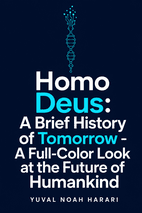
Homo Deus by Yuval Noah Harari Book Cover

by Yuval Noah Harari

Buy on Amazon

As an Amazon Associate, we earn from qualifying purchases.

Yuval Noah Harari's Homo Deus argues that humanity has conquered famine, plague, and war and now faces a new agenda of reshaping life itself, exploring the Anthropocene, the human soul, the Modern Covenant, Humanism, and Dataism. Written for general readers drawn to sweeping, provocative big-picture questions about technology and humanity's future.

On Insta.page you also get an Apply This Book tool that lets you combine insights from up to 3 books to solve your specific situation.

Chapter mindmaps

Free preview: chapters 1–4 are fully interactive. Click any node to expand or collapse. Subscribe to unlock the rest.

Chapter 1: 1   The New Human Agenda

Key concepts: 1   The New Human Agenda

1   The New Human Agenda

The Old Human Agenda: Famine, Plague, and War

  • For thousands of years, these three threats dominated human life.
  • Societies built institutions and tools to combat them.
  • Many believed they were part of a divine plan or human nature.

The Collapse of the Old Agenda

  • By the 21st century, these threats became manageable problems.
  • When they slip, we ask what went wrong and promise to do better.
  • We no longer accept them as inevitable.

The Reversal of Mortality Causes

  • More people die from overeating than from hunger.
  • More die from old age than from infectious diseases.
  • More commit suicide than are killed by soldiers, terrorists, and criminals combined.

Famine: From Natural Disaster to Political Failure

  • Historical famines killed millions due to natural causes.
  • Modern famines are rare and almost always caused by politics.
  • Technology, trade, and aid provide safety nets against starvation.

The New Human Agenda: Power and Purpose

  • The question is no longer survival but what to do with our power.
  • Biotechnology and information technology give humanity huge new powers.
  • The remaining disasters will be shaped by human decisions, not nature.

Chapter 2: 2   The Anthropocene

Key concepts: 2   The Anthropocene

2   The Anthropocene

The Anthropocene Defined

  • Last 70,000 years: Homo sapiens became the dominant global ecological force
  • First single species to reshape planetary ecology alone
  • Impact rivals ice ages and may exceed the dinosaur-killing asteroid
  • Humans unified the planet into one interconnected ecological system

Humanity's Divine Power

  • Humans wield unprecedented power over other animals, rarely acknowledged
  • Wildlife halved since 1970; humans and livestock exceed 90% of large animals
  • Stories still teem with wild animals that are now scarce in reality
  • Germany: under 100 wolves but 5 million dogs

Stone Age Extinctions

  • Pre-farming ancestors wiped out other human species and megafauna
  • 90% of Australia's and 75% of the Americas' large animals lost
  • Slow-breeding large animals were vulnerable to even light hunting
  • Fast breeders like rabbits survived heavy hunting pressure

Feelings as Algorithms

  • Humans and animals alike are algorithms shaped by natural selection
  • Emotions like hunger and fear are calculations, not arithmetic
  • Baboons and peahens solve probability problems through feeling
  • Timid and reckless individuals both leave fewer descendants

The Mammalian Bond

  • Mother-infant attachment is the one emotion all mammals share
  • Harlow's experiments overturned behaviourist advice against affection
  • Infants chose soft comfort over food, thriving only with responsive care
  • Meat and dairy industries repeat Harlow's separation at massive scale

The Agricultural Deal

  • Theism reduced the cosmos to humans and gods, animals as scenery
  • Gods supplied rain and fertility; humans paid with sacrifice
  • Deluge myth read as proof of human supremacy over animals
  • Even non-violent religions licensed human use of animals

The Farm as Prototype

  • Nayaka 'mansan' marks beings with personality; cows and crops excluded
  • Demotion of animals to property extended to enslaving humans
  • Farm model: puffed-up masters, inferior races, beasts to exterminate
  • Science then silenced the gods, leaving humans alone with power and no obligations

Chapter 3: 3   The Human Spark

Key concepts: 3   The Human Spark

3   The Human Spark

The Soul as Justification for Human Superiority

  • Humans claim unique value via an indivisible, eternal soul.
  • Experiments find no soul in animals or humans.
  • Evolution cannot build a partless essence step by step.

Darwin's Threat to Human Identity

  • Many Americans reject evolution because it removes the soul.
  • Education barely shifts biblical views on human origins.
  • Evolution threatens identity unlike physics or relativity.

The Mind-Brain Problem

  • Thoughts are neural activity, not immaterial traces.
  • No algorithm explains subjective experience.
  • Self-modeling machines lack fear or consciousness.

Animal Minds and Shifting Burden of Proof

  • Cambridge Declaration and New Zealand recognize animal sentience.
  • Rats show hope; jays plan; Santino hides stones.
  • Sceptics dismiss animal behavior as non-conscious algorithms.

Clever Hans and the Risk of Humanizing Animals

  • Hans tapped arithmetic by reading human posture.
  • Pfungst exposed the trick in 1907.
  • Humanizing animals can hide their real talents.

Flexible Cooperation as the Human Spark

  • Dominance comes from cooperation, not soul or intelligence.
  • Humans cooperate with strangers; animals only with known individuals.
  • 23,000 communists organized to rule 180 million peasants.

Hijacked Revolutions and the Limits of Intimacy

  • Crowds in Timisoara and Bucharest could not convert numbers to power.
  • Organized groups like the army or Brotherhood fill power vacuums.
  • Social media mobilizes but cannot replace organized cooperation.

Chapter 4: 4   The Storytellers

Key concepts: 4   The Storytellers

4   The Storytellers

Three Layers of Reality

  • Objective things, subjective feelings, and shared stories shape human life.
  • Stories about money, gods, nations, and corporations increasingly dominate.
  • Cognitive Revolution enabled imagination, but stories stayed local for 60,000 years.
  • Farming and cities set the stage for larger cooperation.

Gods as Brands, Pharaoh as Brand

  • Sumerian temple gods acted as legal persons owning property and collecting taxes.
  • Egypt merged priest-king and god into pharaoh, a living story.
  • Writing and money broke memory limits, enabling bureaucracies and vast kingdoms.
  • Documents, not individual memory, tracked pharaoh's lands and taxes.

The Algorithm of Bureaucracy

  • Writing turned society into a step-by-step machine with officials as parts.
  • Pharaohs used networks to mobilize tens of thousands for massive projects.
  • Bureaucracy enabled large-scale coordination without wheels or iron.

When Paper Wins

  • Writing trained elites to experience reality through symbols.
  • Bureaucrats honored visas, saving thousands in the Holocaust.
  • Fake reports under Mao led to famine by forcing reality to match records.
  • Tanzanian collective farms existed mainly on paper, producing little.

Borders Drawn in Berlin

  • European powers divided Africa on paper with little knowledge of interior.
  • New lines split peoples and bundled rivals, ignoring geography and ethnicity.
  • Independent states kept colonial borders to avoid endless war.

The Yardstick of Marks

  • Precise numerical marks are recent, adopted with industrial mass schooling.
  • Schools chase high marks, though exam skill differs from understanding.
  • Marks began as measures but became goals, distorting education.

Scriptures as Guidebooks

  • Holy scriptures claimed authority over all reality, pressing courts to conform.
  • Biblical views spread because they supported wider cooperation.
  • Scriptures ignored ecology and politics, yet shaped societies.
You've reached the end of the free mindmaps

Read less, remember more

See every chapter of Homo Deus as an interactive mindmap — and unlock all 800+ book summaries with audio and AI Q&A.

$0.00 due today · 7 days free, then $89.99/year ($7.49/mo) · Cancel anytime before day 7

plus sales tax where applicable

Continue exploring Homo Deus