Good to Great Quotes
by Jim Collins
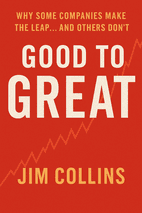
These quotes capture the core ideas behind one of the most influential business books of the last two decades. You will find lines that challenge the way you think about leadership, discipline, and what it really takes to build something lasting. Each quote is a condensed insight from years of research, meant to be remembered and passed on.
The book is so quotable because it doesn't settle for platitudes. Instead, it offers sharp, evidence based truths that cut through the noise. The language is direct, almost spare, which makes each idea stick. Whether you are a CEO or a team lead, these lines will make you stop and reconsider your own assumptions about performance and purpose.
Top Quotes from Good to Great
“Good is the enemy of great. And that is one of the key reasons why we have so little that becomes great.”
Opening statement of Chapter 1, introducing the central theme.
It captures the book's core premise in a simple, provocative phrase that challenges complacency and resonates with anyone striving for excellence.
“Greatness is not a function of circumstance. Greatness, it turns out, is largely a matter of conscious choice.”
One of the key surprises from the research, listed near the end of the chapter.
It empowers readers by shifting the focus from external factors to internal decisions, reinforcing that anyone can choose to pursue greatness.
“It’s not that Level 5 leaders have no ego or self-interest. Indeed, they are incredibly ambitious—but their ambition is first and foremost for the institution, not themselves.”
The author defining the key trait of Level 5 leadership.
This distills the core paradox of Level 5 leaders, making it clear that they are not passive but intensely driven, yet that drive is directed outward toward building a lasting company.
“Look, I don’t really know where we should take this bus. But I know this much: If we get the right people on the bus, the right people in the right seats, and the wrong people off the bus, then we'll figure out how to take it someplace great.”
This is the core principle expressed by the good-to-great executives who transformed their companies.
It encapsulates the counterintuitive 'First Who, Then What' philosophy that challenges conventional wisdom about strategy first. The bus metaphor is memorable and actionable.
“People are not your most important asset. The right people are.”
This conclusion is drawn from the Nucor example in the chapter.
It is a powerful rephrasing of a common cliché, making a subtle but critical distinction. It forces organizations to be rigorous about who they hire.
“Leadership is about vision. But leadership is equally about creating a climate where the truth is heard and the brutal facts confronted.”
Author's synthesis of a key principle from the good-to-great companies.
It reframes leadership as a balance between vision and reality, emphasizing that truth-telling is as essential as inspiration.
“Good to great comes about by a cumulative process—step by step, action by action, decision by decision, turn by turn of the flywheel—that adds up to sustained and spectacular results.”
Continues the explanation of the flywheel concept in the same section.
The rhythmic repetition of 'step by step, action by action' makes the idea memorable and actionable. It reinforces the core lesson that sustained excellence is built through many small, consistent choices.
Themes Behind the Quotes
A central theme is that greatness is a deliberate choice, not a matter of luck or circumstance. The research shows that companies that made the leap from good to great shared a disciplined approach to people, strategy, and culture. They first focused on getting the right individuals on the team, then figured out where to go. This people first mindset appears repeatedly as a foundation for everything else.
Another recurring idea is the importance of confronting brutal facts while maintaining unwavering faith. Great leaders balance humility with fierce resolve, and they create environments where truth is heard without fear. The book also emphasizes a simple, deep understanding of what you can be best at, combined with a relentless flywheel of consistent effort. There are no shortcuts, only patient, cumulative progress driven by disciplined action.
Quotes by Chapter
Chapter 1 - Good is the Enemy of Great
“Can a good company become a great company and, if so, how? Or is the disease of “just being good” incurable?”
Jim Collins recalls Bill Meehan's challenge that sparked the entire research project.
It frames the fundamental question driving the study, making readers reflect on whether mediocrity is a permanent condition or can be overcome.
“We believe that almost any organization can substantially improve its stature and performance, perhaps even become great, if it conscientiously applies the framework of ideas we've uncovered.”
Collins summarizing the central conclusion after five years of research.
It offers a hopeful, evidence-based message that greatness is attainable through disciplined application, countering the notion that only a lucky few can achieve it.
Chapter 2 - Level 5 Leadership
“You can accomplish anything in life, provided that you do not mind who gets the credit. —HARRY S. TRUMAN!”
Opening epigraph of the chapter.
It perfectly captures the paradoxical humility and ambition of Level 5 leaders, emphasizing that true greatness comes from focusing on the outcome rather than personal credit.
“I never stopped trying to become qualified for the job.”
Darwin Smith, CEO of Kimberly-Clark, reflecting on his performance after transforming the company.
It reveals the relentless self-improvement and humility of a Level 5 leader, showing that even extraordinary success is rooted in a mindset of continuous learning rather than ego.
“Level 5 leaders are a study in duality: modest and willful, humble and fearless.”
The author summarizing the dual nature of Level 5 leaders.
It is a concise, memorable phrase that captures the seemingly contradictory traits that define the most effective leaders, challenging conventional notions of heroic leadership.
Chapter 3 - First Who . . . Then What
“Great vision without great people is irrelevant.”
This is a key insight from the author summarizing the third truth of good-to-great leaders.
It distills a profound truth into a single, punchy sentence that is easy to remember and apply. It drives home the importance of people over vision.
“The right people don’t need to be tightly managed or fired up; they will be self-motivated by the inner drive to produce the best results and to be part of creating something great.”
This is the second of three simple truths that good-to-great leaders understood.
It reframes motivation and management, emphasizing that with the right people, external incentives become less important. This resonates with leaders who struggle with employee engagement.
Chapter 4 - Confront The Brutal Facts (Yet Never Lose Faith)
“There is no worse mistake in public leadership than to hold out false hopes soon to be swept away.”
Epigraph from Winston S. Churchill's The Hinge of Fate at the start of the chapter.
It succinctly captures the chapter's central tension between hope and reality, warning leaders against the danger of wishful thinking.
“When you turn over rocks and look at all the squiggly things underneath, you can either put the rock down, or you can say, ‘My job is to turn over rocks and look at the squiggly things,’ even if what you see can scare the hell out of you.”
Pitney Bowes executive Fred Purdue describing the company's culture of confronting uncomfortable truths.
The vivid metaphor of turning over rocks makes the act of facing brutal facts both memorable and emotionally resonant.
“The moment a leader allows himself to become the primary reality people worry about, rather than reality being the primary reality, you have a recipe for mediocrity, or worse.”
Author's observation about the dangers of charismatic leaders who overshadow external facts.
It delivers a sharp warning that a leader's personality can distort organizational attention, undermining long-term success.
Chapter 5 - The Hedgehog Concept - (Simplicity within the Three Circles)
“The fox knows many things, but the hedgehog knows one big thing.”
Opening of the chapter referencing an ancient Greek parable to divide people into hedgehogs and foxes.
This line memorably introduces the central metaphor of simplicity versus complexity that underpins the Hedgehog Concept.
“Look, it just wasn't that complicated! Once we understood the concept, we just moved straight ahead.”
CEO Cork Walgreen explaining Walgreens' remarkable performance during an interview.
It captures the power of simplicity and focused execution, showing that great results come from clarity, not complexity.
“A Hedgehog Concept is not a goal to be the best, a strategy to be the best, an intention to be the best, a plan to be the best. It is an understanding of what you can be the best at.”
The author explains the fundamental distinction between a Hedgehog Concept and typical strategic goals.
This passage sharpens the reader's understanding by emphasizing that greatness comes from deep insight, not mere ambition.
“To go from good to great requires transcending the curse of competence.”
Discussion of why good-to-great companies must move beyond what they are merely good at.
This concise, powerful phrase encapsulates a key lesson: being competent is not enough; you must focus on where you can be the best.
Chapter 6 - A Culture of Discipline
“When you put these two complementary forces together—a culture of discipline with an ethic of entrepreneurship—you get a magical alchemy of superior performance and sustained results.”
George Rathmann's insight on combining discipline with entrepreneurship to create a great company.
It captures the central paradox of the chapter: that freedom and discipline together create superior performance, not one or the other.
“They hired self-disciplined people who didn’t need to be managed, and then managed the system, not the people.”
Describing the good-to-great companies' approach to management and culture.
It succinctly expresses the key principle of a culture of discipline: hire the right people and then give them freedom within a consistent system.
“Indeed, discipline by itself will not produce great results. We find plenty of organizations in history that had tremendous discipline and that marched right into disaster, with precision and in nicely formed lines.”
Warning against misapplying discipline without the right foundation of disciplined people and thought.
It reminds readers that discipline alone is not enough; it must be paired with the right people and thinking to avoid catastrophic outcomes.
“Much of the answer to the question of “good to great” lies in the discipline to do whatever it takes to become the best within carefully selected arenas and then to seek continual improvement from there.”
Explaining the essence of the 'rinsing your cottage cheese' metaphor and the drive for continuous improvement.
It encapsulates the relentless, focused effort that distinguishes great companies from merely good ones, emphasizing discipline and selection.
Chapter 7 - Technology Accelerators
“Let’s quietly go about doing what we need to do, and it'll become clear soon enough that they just pulled the tail of the wrong dog.”
A Walgreens executive responding to an arrogant comment from an Internet leader about Walgreens being left behind.
This line captures the quiet confidence and long-term perspective of great companies, using a vivid metaphor that resonates with anyone who values substance over hype.
“When used right, technology becomes an accelerator of momentum, not a creator of it.”
Jim Collins summarizing the central insight of the chapter after analyzing the good-to-great companies.
This concise statement distills the core lesson: technology is a tool that amplifies existing success, not a shortcut to greatness.
“Technology without a clear Hedgehog Concept, and without the discipline to stay within the three circles, cannot make a company great.”
Jim Collins contrasting the good-to-great companies with comparison companies that failed to sustain success.
It reinforces that technology must serve a deeper strategic purpose, and without discipline and focus, even advanced technology cannot create lasting greatness.
“No technology, no matter how amazing—not computers, not telecommunications, not robotics, not the Internet—can by itself ignite a shift from good to great.”
Author summarizing the central finding of the chapter about technology's limited role in transformation.
This quote powerfully counters the popular obsession with technology as a silver bullet, reminding readers that greatness comes from deeper factors like culture and discipline.
Chapter 8 - The Flywheel and The Doom Loop
“No matter how dramatic the end result, the good-to-great transformations never happened in one fell swoop. There was no single defining action, no grand program, no one killer innovation, no solitary lucky break, no wrenching revolution.”
From the section 'Build Up and Breakthrough' where the author explains the flywheel concept.
This passage dismantles the popular myth of overnight success, emphasizing that greatness emerges from a steady accumulation of effort. It resonates because it reframes transformation as a patient, unglamorous process rather than a single heroic event.