Good to Great Key Takeaways
by Jim Collins
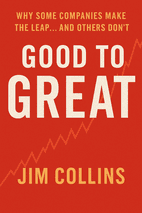
5 Main Takeaways from Good to Great
Sustainable greatness builds from consistent effort, not instant breakthroughs.
The flywheel effect demonstrates that enduring companies achieve transformation through persistent, incremental pushes that accumulate momentum. In contrast, seeking dramatic revolutions leads to the 'doom loop' of failed strategies and poor long-term results.
Hire for character and alignment, not just credentials and experience.
Great companies prioritize getting the right people on board who share core values, which simplifies compensation and management. This 'first who, then what' approach ensures that the team drives success from within, focusing on innate potential over specific skills.
Confront harsh realities head-on while maintaining unwavering faith.
The Stockdale Paradox emphasizes facing the brutal facts of your situation without losing hope. By fostering a culture where truth is heard through questioning and blame-free analysis, leaders make better decisions and keep teams motivated.
Find your simple, core focus where passion, excellence, and economics intersect.
The Hedgehog Concept requires deep self-reflection to identify what you can be the best at, what drives your economic engine, and what you are passionate about. This clarity, developed through iterative dialogue, guides all strategic decisions and avoids distractions.
Foster a culture of disciplined people and thought, not bureaucratic control.
A culture of discipline empowers individuals to act within a structured framework, using tools like 'stop doing' lists to maintain focus. This contrasts with authoritarian control and enables sustained adherence to the Hedgehog Concept for long-term results.
Executive Analysis
Good to Great presents a unified thesis that greatness is not a matter of luck or genius but of disciplined application of fundamental principles. The five takeaways interconnect: starting with the right people creates a foundation for confronting brutal facts, which leads to discovering a simple Hedgehog Concept. This focus is maintained through a culture of discipline, and momentum builds via the flywheel effect, with technology serving only as an accelerator. The central argument is that sustained excellence emerges from this systematic, evidence-based approach rather than from charismatic leadership or disruptive innovation.
The book's practical impact lies in its rigorous, research-driven framework that provides a blueprint for organizational transformation. It matters because it translates complex success factors into actionable steps, emphasizing long-term discipline over short-term trends. In the field of business management, it stands as a seminal work that bridges strategic vision with operational execution, offering timeless insights for leaders seeking to build enduringly great companies.
Chapter-by-Chapter Key Takeaways
Good is the Enemy of Great (Chapter 1)
A culture of discipline, combined with entrepreneurship, is essential for great performance, reducing the need for hierarchy and bureaucracy.
Technology should be used as an accelerator, not a primary driver of change.
Sustainable transformations happen through consistent, incremental efforts (the flywheel effect), not sudden revolutions.
Good to Great serves as a foundation for building enduring organizations, with principles that apply universally across sectors.
Timeless organizational principles remain relevant despite economic changes, focusing on core truths rather than fleeting trends.
Try this: Cultivate a culture of discipline and use technology as an accelerator to build momentum through consistent, incremental efforts, avoiding the pursuit of sudden breakthroughs.
First Who . . . Then What (Chapter 3)
Compensation systems should prioritize securing the right people rather than attempting to incentivize performance in mismatched hires.
The value lies not in having people, but in having the right people who align with the organization's core values and goals.
Hiring and retention strategies must emphasize character and innate potential over specific credentials or experience.
Try this: Focus your hiring and compensation strategies on securing individuals with strong character and alignment to core values, rather than trying to motivate mismatched hires.
Confront The Brutal Facts (Yet Never Lose Faith) (Chapter 4)
Confronting brutal facts is the first step toward breakthrough results, making right decisions self-evident.
Foster a culture where truth is heard through questioning, dialogue, blame-free autopsies, and red flag systems.
The Stockdale Paradox—maintaining faith while facing reality—is crucial for overcoming adversity.
Charisma can deter honesty; leadership starts with truth-confrontation, not vision-setting.
Motivation stems from not demotivating people by ignoring facts, rather than from external incentives.
Try this: Implement processes like blame-free autopsies and open questioning to confront brutal facts, while steadfastly maintaining faith in your organization's ability to prevail.
The Hedgehog Concept - (Simplicity within the Three Circles) (Chapter 5)
Developing a Hedgehog Concept is an iterative process that typically takes years, not days, and cannot be rushed through superficial planning sessions.
The Council serves as a vital mechanism for facilitating the ongoing dialogue and debate needed to refine understanding within the three circles.
True insight emerges from confronting brutal facts with disciplined persistence, leading to a quiet, confident understanding rather than loud bravado.
Accelerating the discovery process involves increasing the frequency of complete cycles of questioning, decision-making, and learning.
The distinction between delusional ambition and grounded understanding is crucial; the Hedgehog Concept is a recognition of fact, not a statement of desire.
Try this: Convene a council to iteratively debate and refine your Hedgehog Concept by rigorously examining what you are passionate about, best at, and what drives your economic engine.
Next chapter: “A Culture of Discipline” is locked
Keep learning from Good to Great — and unlock all 600+ book summaries with audio, mindmaps and AI Q&A.
$0.00 due today · 7 days free, then $89.99/year ($7.49/mo) · Cancel anytime before day 7
plus sales tax where applicable