Get Paid to Teach Quotes
by Jonathan Milligan
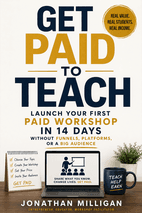
Looking for the best quotes from Get Paid to Teach by Jonathan Milligan? Below are the lines that stand out most across the book.
The quotes are organized by chapter, each with a short note on where it appears and why it stands out.
Top Quotes from Get Paid to Teach
“Lower effort doesn't mean lazy. It means you've got a system.”
The author introduces the concept of a paid workshop as a proof offer that reduces effort through systematic teaching.
It reframes efficiency as strategic, not lazy, empowering teachers to seek smarter methods rather than working harder.
“A small list of buyers beats a big crowd of freebie-seekers.”
The author contrasts paid versus free audiences while listing key takeaways.
It succinctly argues for quality over quantity in audience building, a powerful truth for educators who want engaged, paying students.
“They chase the obvious topic instead of the one people will actually pay to solve.”
The author concludes the chapter by highlighting what most teachers get wrong when choosing what to teach.
It pinpoints the critical error of selecting popular topics over profitable ones, guiding readers toward market fit and genuine demand.
“Name the frustration well and the want comes almost for free.”
The author explains how identifying audience frustrations directly reveals their desires.
This line is both poetic and practical, encapsulating the core insight that clarity on problems naturally uncovers solutions.
“That's why I told you to spend your time in the frustration zone. Do that part honestly and the wants fall out of it like coins from a torn pocket.”
The author emphasizes the value of deeply exploring what frustrates the audience.
The vivid simile of coins spilling from a torn pocket makes the payoff of honest exploration tangible and memorable.
“This flip is the engine of the whole map.”
The author summarizes the transformation of frustrations into wants as the central mechanism of the book's approach.
Short, forceful, and declarative, this sentence positions the 'flip' as the driving force behind the entire strategy.
Quotes by Chapter
2. Digging for the Vein
“Your future copy is being written right now, one flip at a time.”
The author connects the current exercise of flipping frustrations to future sales copy.
This line creates urgency and foresight, motivating readers to see their present work as directly shaping their marketing results.
3. Craft the One Belief
“Because people don't buy information. They buy a new belief about what's possible for them.”
The author explains why the one-belief formula works so effectively.
This flips the conventional marketing wisdom on its head, reminding readers that emotional transformation, not facts, drives decisions.
“One sentence can install that belief.”
The author states a key takeaway immediately after the formula explanation.
It's a punchy, empowering reminder that a single well-crafted line has the power to reshape a potential client's mindset.
“The word "only" matters more than it looks. It tells the reader this result isn't available through the tired methods they've already tried and abandoned.”
The author breaks down why the word 'only' in the formula is crucial.
It highlights the psychological trigger of exclusivity and hope, directly addressing audience skepticism from past failures.
“That sentence is your idea at its sharpest. You believe in it, and you've built the case for it.”
The author summarizes the outcome of the one-belief crafting process near the end of the chapter.
This line validates the reader's effort and gives a clear, satisfying benchmark for when the belief statement is ready.
4. The Hand-Raiser Post
“Your engagement is the fuel that carries your test to the people who haven't seen it yet.”
The author advises not to post and walk away, but to reply to comments.
It reframes engagement as a powerful tool for organic reach, reminding readers that their active participation amplifies their message.
“Here's where the hand-raiser post stops being a test and starts being a salesperson.”
The transition from gauging interest to actively selling the workshop.
This line marks a clear turning point in the strategy, giving readers a memorable framework for understanding the post's dual role.
“That's it. No pressure, no pitch. You're giving an interested person what they asked for.”
Describing the simple DM to follow up with commenters.
It strips away sales anxiety and shows that a respectful, direct follow-up is all that's needed when someone has already raised their hand.
“I've made workshop sales doing nothing more than this, because these people were already leaning in. The DM just closed the loop.”
The author shares personal experience of success with this method.
This provides social proof and reinforces that the strategy works, motivating readers to take action without overcomplicating it.
5. Cold, Warm, or Hot
“You found out in two days for free. That's a win disguised as a letdown.”
The author discusses the benefit of cold testing an idea quickly.
This reframes failure as a positive learning opportunity, encouraging risk-taking and early validation.
“The whole point of testing is permission to be wrong cheaply.”
The author explains the purpose of testing a business idea.
It distills a core entrepreneurial principle into a simple, memorable phrase that liberates creators from perfectionism.
“People are nodding, but no one's reaching for their wallet.”
The author describes the deceptive nature of a 'warm' response.
This vivid metaphor instantly reveals the gap between polite interest and actual purchasing intent, a crucial lesson for any teacher.
“The warmth was real. The urgency was missing, and urgency is what actually fills a room.”
The author concludes the section on warm leads.
It powerfully contrasts genuine but passive interest with the active force needed to drive sales, making the key insight unforgettable.
6. A Title That Sells the Seat
“That's the power of a good title. It sells the seat before anyone reads a single word of your page.”
The author summarizes the key function of a workshop title.
This line captures the core principle that a title's job is to generate interest and commitment before any further content is consumed. It's a memorable, actionable insight for anyone creating a paid offering.
“The other sounds like a secret worth two hours of your Tuesday.”
The author compares a boring title to the reworked, intriguing title for the same workshop.
This phrase vividly illustrates the power of reframing, making the reader feel the allure of a secret. It's short, punchy, and instantly relatable, showing how simple word choices can transform perceived value.
“Intriguing and clear wins. Clever but confusing loses.”
The author provides a stress-test heuristic for workshop titles and subtitles.
This concise contrast offers a clear, memorable rule of thumb that creators can immediately apply. It resonates because it cuts through the noise and prioritizes audience understanding over cleverness.
“The subtitle names the want and erases the doubt: how to get what they want, without what they don't, even if a big objection is in the way.”
The author explains the dual role of a subtitle in a workshop offer.
This line neatly distills the persuasive formula for a subtitle, directly addressing the reader's desires and fears. It resonates because it provides a practical, repeatable template that feels both empathetic and strategic.
7. The One-Page Checkout
“You're not writing from a blank screen. You're editing a strong first draft into your own voice. Work you did once is paying you again.”
The author explains how the Registration Page GPT uses the foundation doc to generate a draft for the checkout page.
This line reframes the writing process as editing rather than starting from scratch, and highlights the compounding value of earlier work, which motivates readers to reuse their existing materials.
“Make the right person think, "That's me."”
In the step for writing the 'who' section of the checkout page, the author gives this instruction.
It captures the essence of targeted marketing—creating immediate identification and relevance for the ideal customer, making the message feel personal and irresistible.
“In about thirty minutes, you'll have checkout copy ready to paste onto a page.”
The author sets a time expectation after using the GPT tool to draft the page.
This gives a concrete, achievable timeframe that reduces overwhelm and demonstrates the efficiency of the system, encouraging readers to take action.
8. Get Paid and Get on Zoom
“The teacher who reminds gently gets a fuller room than the teacher who assumes one email did the job.”
Advice on sending multiple reminders to workshop attendees.
This line emphasizes the power of gentle persistence over assumption, resonating with anyone who has felt overlooked in a crowded inbox.
“You don't need your website up to run a workshop. You don't need a polished funnel. You don't need to master every feature of a tool like Kajabi before you teach. Start with what gets you to the first dollar, then add as you grow.”
Encouraging new teachers to bootstrap rather than wait for the perfect platform.
It frees newcomers from perfection paralysis, reminding them that action—not polished systems—leads to the first real result.
“Showing up is half the battle for your attendees, so make showing up effortless.”
Part of the advice on making attendance easy for students.
This pithy statement distills the essence of reducing friction, a universal truth that resonates with anyone trying to build engagement.
9. The Lazy Launch Calendar
“The first week has one job: get people curious and a little excited.”
The author introduces the purpose of week one in the 'Lazy Launch Calendar'.
It distills the entire launch strategy into a single, memorable goal that feels attainable and human.