Get Paid to Teach Key Takeaways
by Jonathan Milligan
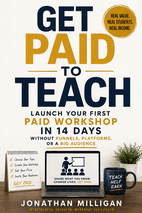
5 Main Takeaways from Get Paid to Teach
Start with a paid proof offer, not a freebie
Your first move should be a paid workshop that validates demand before you build anything. Charging raises the quality of participants and gets you income immediately, so you avoid wasting time on people who won't pay.
Craft one belief that sells the transformation
People buy a new belief about what's possible, not information. Use a single sentence that names the opportunity and the mechanism; that sentence becomes your workshop title and framework, answering every objection in advance.
Use a lazy launch to test and build anticipation
Your first week needs only three moves: float the idea, survey your audience, then announce. Surveys make people feel invested, and casual energy beats forced hype. If no one reaches for their wallet, refine the idea before building.
Speak to all four buyer types in your messaging
Most creators write only for their own buyer type, missing three-quarters of potential customers. Translate your value into different languages of desire to fill the room, using a launch that doesn't water down the offer.
Deliver a tight workshop and invite naturally
Limit your workshop to three to five principles with metaphors and short exercises. End with a calm, clear invitation to the next step; most upgrades happen in the days after. Repeat and improve one workshop instead of chasing big launches.
Executive Analysis
The five takeaways form a coherent loop: validate with a paid proof offer, capture the transformation in one belief, test demand with a lightweight launch, appeal to all buyer types, then deliver a focused workshop that naturally leads to upsells. Milligan's central argument is that building a paid teaching business doesn't require a huge audience, complex funnels, or years of content — it starts with a single, low-risk workshop that proves people will pay. The entire process is designed to minimize effort and maximize learning, moving from cold audience feedback to repeatable income.
This book matters because it offers a pragmatic, anti-hustle alternative to the typical “build an audience first” advice. Milligan strips away the fluff of course creation, landing pages, and email sequences, focusing instead on the minimal viable action: get paid, teach, then improve. It sits at the intersection of online education, lean startup methodology, and direct sales, making it essential for coaches, consultants, and subject-matter experts who want to monetize their knowledge without burnout or overinvestment.
Chapter-by-Chapter Key Takeaways
1. The Thriving Paid Teacher (Chapter 1)
You’re standing in one of four places as a teacher, and the goal is the fourth: the thriving paid teacher with lower effort and higher income.
A paid workshop is a proof offer. It validates demand and gets you paid before you build anything.
Teaching and selling aren’t separate steps. When people pay to learn, you teach in a way that helps them want the next step.
Charging raises the quality of everyone in the room. A small list of buyers beats a big crowd of freebie-seekers.
The fourth quadrant is the destination. The path there starts with one decision, and it’s choosing the topic people will actually pay to solve.
Try this: Test your teaching idea by offering a paid workshop immediately; if no one pays, rethink the topic before building any content.
2. Digging for the Vein (Chapter 2)
Frustrations and wants are two sides of the same coin; name the frustration well, and the want comes for free.
These flipped wants become the direct selling points for your workshop—no extra brainstorming needed.
The aspiration is the opposite of the audience’s fear, and it anchors the whole journey.
Try this: Identify your audience's deepest frustration and flip it into the want they'll pay to solve — that want becomes your selling point.
3. Craft the One Belief (Chapter 3)
People don’t buy information, they buy a new belief about what’s possible for them. One sentence can install that belief.
The formula is fixed: a new opportunity is the key to a desired result, attainable only through a new mechanism.
The same sentence names two things. The front becomes your workshop title, the end becomes your framework name, and both create curiosity.
The ten questions answer every objection in advance, and the foundation doc turns that work into copy you’ll reuse all month.
Try this: Write a one-sentence belief that states the new opportunity and the mechanism to achieve it; use the front half as your workshop title and the back half as your framework name.
4. The Hand-Raiser Post (Chapter 4)
Engagement on a hand-raiser post extends its reach; reply to every comment.
Turn public “interested” comments into private DMs once your offer is ready.
The DM follow-up is a natural next step, not a pushy pitch.
Your email list is a separate, often more committed audience—send them the same opportunity.
Try this: Post a hand-raiser question on social media, reply to every comment, then follow up with a private DM once your paid workshop is ready.
Next chapter: “5. Cold, Warm, or Hot” is locked
Keep learning from Get Paid to Teach — and unlock all 600+ book summaries with audio, mindmaps and AI Q&A.
$0.00 due today · 7 days free, then $89.99/year ($7.49/mo) · Cancel anytime before day 7
plus sales tax where applicable