For Better and Worse Quotes
by Stephanie Coontz
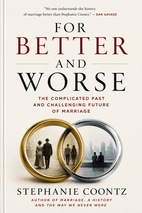
These quotes come from Stephanie Coontz's book "For Better and Worse," which takes a hard look at the history and myths surrounding marriage. You will find lines that challenge everything you thought you knew about romance, tradition, and gender. Some are sharp, some are surprising, and all of them make you stop and think.
What makes this book so quotable is how Coontz packs decades of research into single, punchy observations. She doesn't just describe the past; she connects it to the way we live and love today. Whether she is debunking nostalgia or revealing uncomfortable truths, every line feels like a conversation starter.
Top Quotes from For Better and Worse
“Getting married won’t transform an unhappy person into a happy one or an irresponsible person into a reliable one, at least not for long.”
The author states a central premise about what marriage cannot do.
It debunks the romantic myth that marriage is a cure-all for personal flaws, offering a sobering but realistic view that resonates with many readers.
“There is no such thing as the traditional marriage.”
The author presents a key argument after surveying historical variations.
This succinct declaration challenges nostalgia and opens minds to diverse possibilities by refuting the idea of a single timeless marital norm.
“It would be closer to the truth to say that marriage was invented to turn strangers into relatives.”
The author summarizing anthropological research on the origins of marriage.
This concise statement reframes marriage's purpose from individual reproductive success to social network building, challenging evolutionary psychology myths.
“Other things being equal, a man took precedence over a woman. But other things were seldom equal.”
Describing the intersection of gender and class in premodern Europe and America.
The pithy contrast captures the nuanced reality that social status often overrode gender hierarchy, making it a memorable and thought-provoking statement.
“In other words, going back to that schoolyard taunt, a lot of Americans believe that females are smart enough and competent enough that we could be rich and powerful, but we're way too nice to want to be.”
The author explains the paradox of women being seen as too nice for high-powered positions despite being considered intelligent and competent.
This memorable phrasing captures the double bind women face: being praised for niceness yet penalized for lacking ambition, resonating with many readers' experiences.
“When the word “heterosexuality” first appeared in mainstream dictionaries in the early twentieth century, it was defined as “an abnormal or perverted sexual appetite toward the opposite sex” and a “depraved” or “morbid” passion for the opposite sex.”
The author explains how the term heterosexuality was originally viewed as pathological.
This historical fact shocks modern readers and highlights how rapidly cultural norms about sexuality can shift, making it a powerful reminder that our current definitions are not timeless.
“As one legal scholar explained in 1957: “A man does not commit rape by having sexual intercourse with his lawful wife, even if he does so by force and against her will.””
The author describes the marital rape exemption that existed in U.S. law during the 1950s and 1960s.
This shocking and historically concrete quote forces readers to confront the stark reality of what 'traditional marriage' meant for many women, challenging nostalgic idealizations.
Themes Behind the Quotes
One major theme is that marriage is not a fixed institution but one that has been reinvented over time to serve different purposes, from forming alliances to legitimizing hierarchy. The quotes also reveal how gender roles were deliberately constructed and enforced, often with double standards that persist today.
Another theme is the gap between the ideals we hold about love and commitment and the economic and social realities that shape our choices. Coontz highlights how changes in work, law, and culture have created new pressures and expectations, making modern relationships both more rewarding and more fragile.
Quotes by Chapter
Introduction
“What's going on here is not an outright rejection of marriage so much as a growing worry that achieving or sustaining the kind of marriage most people now want might be especially difficult in today's social and economic climate.”
The author interprets data on declining marriage expectations among young people.
It captures the nuanced ambivalence of a generation that still values marriage but fears the obstacles, making the trend relatable and empathetic.
“Understanding what is beyond people's control as a couple can help them better manage what is within their control.”
The author reflects on how external forces affect relationships.
This offers practical wisdom, reducing self-blame and directing energy toward actionable change, which many couples find empowering.
Chapter 1: The Many and Much Misunderstood “Traditional” Marriages
“Writing for the majority in the 2015 Supreme Court decision legalizing same-sex marriage, Justice Anthony Kennedy described marriage as the “keystone of civilization,” embodying humanity's “highest ideals of love, fidelity, devotion, sacrifice, and family.””
Justice Anthony Kennedy in the 2015 Supreme Court decision legalizing same-sex marriage.
This eloquent summary of marriage's idealized role is frequently cited by proponents of traditional marriage, making it a powerful contrast to historical realities.
“In 2023, a book called Get Married, hailed as “vitally important” in The New York Times, claimed that the only way to “save civilization” in the twenty-first century is to convince more people to marry.”
The book Get Married, hailed as vitally important in The New York Times.
Captures the extreme pro-marriage rhetoric that the chapter critiques as historically naive and oversimplified.
“There is no evidence in either the ethnographic or the archaeological record of band-level societies that they practiced the systematic oppression of women or the punitive attitudes toward children born out of wedlock characteristic of the stratified societies that arose later.”
The author concluding about gender relations in band-level societies.
Directly counters the claim that patriarchy is universal or natural, offering a hopeful perspective on gender equality's deep historical roots.
Chapter 2: The Paradox of Patriarchy and the Dark Side of Democracy
“Far from being a holdover from the days of aristocratic patriarchy, subsuming a wife's name into her husband's was part of a new set of gender arrangements that celebrated the brotherhood of men and the marital status—along with the motherhood—of women.”
From the prologue explaining the historical origins of the 'Mrs. Man' naming convention.
This line reframes a seemingly archaic custom as a modern invention tied to democratic capitalism, challenging common assumptions about the roots of patriarchal practices.
“If all men are born free, how is it that all women are born slaves?”
Mary Astell, a British author, posed this question in 1706, directly challenging the contradiction between the emerging rhetoric of natural rights and women's subordination.
This succinct, ironic question exposes the hypocrisy of Enlightenment ideals, making it a timeless feminist rallying cry that resonates with ongoing struggles for gender equality.
“This was the great paradox of the Enlightenment and the Age of Revolution: They simultaneously popularized the historically exceptional idea that all human beings have universal moral rights and impelled people who denied such rights to others to justify it on grounds that those others were somehow less than fully human.”
The author summarizes the central contradiction of the era, where liberty for some was built on dehumanizing others.
This passage crystallizes the book's core argument, showing how lofty principles were twisted to create racist and sexist justifications—a pattern that still haunts modern debates about rights and inclusion.
Chapter 3: How the Gender Legacy of Democracy Holds Women Back
“The problem with this argument is that the democratizing market societies of the eighteenth and nineteenth centuries didn’t just allow “self-determining” women to follow preexisting “feminine” interests and aptitudes. They helped create those interests and aptitudes, praising and rewarding some activities when done by women and denigrating or penalizing different choices.”
The author rebuts the argument that women's career choices reflect innate preferences by pointing out that democratic societies historically shaped those preferences.
This line powerfully exposes the social construction of gender interests, challenging the notion of 'natural' feminine aptitudes and highlighting the role of historical ideology.
“When we think about what's supposedly “normal” for people of our gender to feel, it can actually change our memory or interpretation of our feelings.”
From a study where volunteers recalled emotions after being prompted about gender, the author summarizes the finding.
It succinctly reveals how gender stereotypes can distort self-perception, making readers question the authenticity of their own emotional memories.
“The expectation that women will take responsibility for the invisible labor of anticipating people’s needs and managing, fine-tuning, or repairing emotions—and that because they are more empathetic and better organized than men, they need to do so—has become a source of particular inequality and tension in contemporary heterosexual marriages.”
In concluding the chapter, the author identifies a major source of marital inequality stemming from gendered expectations.
It names the often-invisible emotional labor expected of women and connects it directly to historical ideology, making a compelling case for structural change.
Chapter 4: Separate Spheres, Soulmate Love & Sexual Tension
“Each [sex] has what the other has not: each completes the other, and is completed by the other: they are in nothing alike, and the happiness and perfection of both depends on each asking and receiving from the other what the other only can give.”
British philosopher John Ruskin in an 1865 essay explaining the basis of love in the male-breadwinner marriage.
This passage succinctly defines the Victorian ideal of complementary opposites, a core concept that shaped courtship and marriage norms in the era.
“Attraction or affinity for...the opposite...constitutes the very embodiment and heart's core of true love.”
Popular lecturer and author Orson Fowler declaring that opposites attract is the essence of true love.
It captures the era's belief that difference, not similarity, fuels romantic love, a notion that still echoes in modern ideas about 'opposites attract'.
“I cannot have a separate existence from you, I breathe by you; I live by you.”
A nineteenth-century suitor writing to his intended, expressing total emotional dependence.
This line reveals the intense emotional disclosure expected of Victorian men, contrasting sharply with modern male emotional reserve and surprising today's readers.
“In exact proportion as the love of any individual tends to sexual gratification as such, it is debasing and brutal: because unguided by intellect, and unsanctified by moral purity.”
Orson Fowler in his tome 'Love and Parentage' condemning sex for pleasure alone.
It encapsulates the Victorian ambivalence toward sexual pleasure, framing even marital sex as morally dangerous unless tied to higher purposes.
Chapter 5: From Spiritual Soulmates to Sexual Playmates
“But I left out the first lines, which reveal that the thrilling pulses, beseeching eyes, throbbing breasts, caressing touches, and soft lips were not those of the soldier's sweetheart or wife but of his mother.”
The author describes a World War I poem that initially seems romantic but is actually about a soldier's longing for his mother.
The twist forces readers to confront how drastically assumptions about sensual language and mother-son relationships have changed, making it a memorable and provocative passage.
“A 1914 Atlantic article titled “The Repeal of Reticence” lamented the new “obsession” that had set people “all a-babbling about matters once excluded from the amenities of conversation.””
The author illustrates the early twentieth-century shift in American sexual frankness.
This vivid phrase captures the shock of the era's sexual revolution and mirrors contemporary debates about openness, making it timeless and quotable.
“In the words of a St. Louis newspaper editor, it was now “Sex O'Clock” in America.”
The author summarizes the dramatic change in public discourse about sex by 1913.
The metaphor is punchy and memorable, perfectly encapsulating the sense of a cultural turning point—and it resonates with modern readers who recognize similar moments in their own time.
Chapter 7: Has Marriage Become a Luxury Good?
“But societal nostalgia has a different dynamic. When people think nostalgically about an entire era or community rather than about particular experiences, they start identifying more intensely with the kind of people they associated with in the past and judging members of other groups more negatively.”
The author contrasts the effects of personal nostalgia with those of societal nostalgia.
It pinpoints the dangerous shift from fond reminiscence to group-based hostility, a pattern that resonates strongly in today's polarized political climate.
“In 1965, the average compensation for a CEO in the largest US companies was 21 times the wage of a typical worker in that company. In 2023, it was 290 times as much.”
The author compares CEO-to-worker pay ratios across decades to illustrate the erosion of postwar economic fairness.
The sheer scale of the increase provides an undeniable, easily grasped statistic that underscores the economic inequality driving much of today's societal nostalgia.
“If the equitable income growth of that period had continued, by 2018 the bottom 90 percent of the population, Black as well as White, would have ended up with incomes 67 percent higher than they actually did.”
The author cites Rand Corporation economists Carter Price and Kathryn Edwards on the lost wage growth since the postwar era.
This striking counterfactual makes the scale of economic loss tangible for ordinary Americans, grounding the chapter's argument that inequality is a driver of marriage's changing status.
Chapter 8: The New “Rules of Engagement”
“A disestablished religion would never again enroll or retain such a high proportion of the population as when it was “the only game in town.””
The author uses the analogy of church disestablishment to explain the deinstitutionalization of marriage.
This memorable metaphor captures the shift from compulsory marriage to a voluntary institution that must now compete for participants. It succinctly explains why marriage rates have declined.
“But after centuries of indoctrination in the sexual double standards of both aristocratic patriarchy and market-based democracy, Americans lack a widely-agreed-upon script for how to have uncommitted sex in a guilt-free, safe, and nonexploitative way.”
The author discusses the challenges of navigating premarital sex in an era of delayed marriage.
This sentence powerfully diagnoses the root of many contemporary sexual problems: outdated norms persisting alongside new freedoms. It resonates because it names a gap in our cultural understanding.