Flow Quotes
by Mihaly Csikszentmihalyi
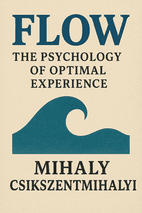
Welcome to a curated set of quotes from Flow by Mihaly Csikszentmihalyi. Here you will find lines that capture the essence of optimal experience, the joy of focused effort, and the power of controlling your own attention. These are not just clever sayings; they are insights backed by decades of research.
What makes this book so quotable is its ability to balance scientific rigor with life changing wisdom. Each quote offers a new way to think about happiness, work, and the moments that make life feel complete. Whether you are new to the concept of flow or a longtime fan, these words will resonate and inspire.
Top Quotes from Flow
“Happiness, in fact, is a condition that must be prepared for, cultivated, and defended privately by each person.”
The author reflects on his discovery that happiness depends on inner interpretation, not external events.
This line reframes happiness as an active, internal discipline rather than a passive outcome, empowering readers to take responsibility for their own well-being.
“The best moments usually occur when a person’s body or mind is stretched to its limits in a voluntary effort to accomplish something difficult and worthwhile.”
The author describes the nature of optimal experience, contrasting it with passive relaxation.
It captures the counterintuitive truth that deep enjoyment comes from challenge and effort, not ease, inspiring readers to seek growth through difficulty.
“Flow—the state in which people are so involved in an activity that nothing else seems to matter; the experience itself is so enjoyable that people will do it even at great cost, for the sheer sake of doing it.”
The author introduces the concept of flow after studying experts and ordinary people across cultures.
This succinct definition of flow has become iconic, perfectly describing the immersive, autotelic experience that is central to the book's thesis.
“The mark of a person who is in control of consciousness is the ability to focus attention at will, to be oblivious to distractions, to concentrate for as long as it takes to achieve a goal, and not longer.”
This is in the section on attention as psychic energy, after describing how attention selects information.
It provides a clear, actionable definition of self-mastery that many strive for, emphasizing the disciplined use of attention as the key to a fulfilling life.
“Enjoyment is characterized by this forward movement: by a sense of novelty, of accomplishment.”
In the section distinguishing pleasure from enjoyment, the author defines the essence of enjoyment.
It captures the active, growth-oriented nature of true satisfaction, inspiring readers to seek challenges that expand their selves.
“In short, it transformed the self by making it more complex. In this growth of the self lies the key to flow activities.”
From the summary of flow activities, describing how optimal experiences lead to personal growth.
This line captures the essence of flow's transformative power, linking enjoyment to the development of a more complex self.
“Enjoyment, as we have seen, does not depend on what you do, but rather on how you do it.”
After discussing leisure activities and material resources.
This succinct principle challenges the focus on external activities and emphasizes the importance of personal engagement and skill.
Themes Behind the Quotes
The quotes from Flow explore the idea that true happiness comes from within, not from external events. They stress that we can shape our own experience by learning to focus our attention and by choosing challenges that match our skills. This inward control is what makes life enjoyable, even in difficult circumstances.
Another key theme is the nature of optimal experience, or flow. It occurs when we are fully absorbed in an activity, whether at work or at play. The quotes show that flow requires effort, novelty, and a balance between challenge and ability. They also discuss the role of the body, the importance of solitude, and how work can be a source of deep satisfaction when done with purpose. Ultimately, the book encourages us to design our lives around activities that bring this kind of engaged fulfillment.
Quotes by Chapter
Chapter 1
“The “liberated” view of human nature, which accepts and endorses every instinct or drive we happen to have simply because it's there, results in consequences that are quite reactionary.”
The author critiques the modern belief that following instinct is inherently liberating.
It provocatively flips conventional wisdom, showing how unrestrained instincts can lead to a passive, fatalistic mindset.
Chapter 2
“A person can make himself happy, or miserable, regardless of what is actually happening “outside,” just by changing the contents of consciousness.”
This appears in a discussion of how consciousness can override genetic and environmental influences.
It captures the empowering idea that our inner state is largely independent of external circumstances, a cornerstone of the flow philosophy. This resonates because it places the locus of control squarely within the individual.
“His ability to persevere despite obstacles and setbacks is the quality people most admire in others, and justly so; it is probably the most important trait not only for succeeding in life, but for enjoying it as well.”
This follows examples of people who transform hopeless situations through force of personality.
It articulates a universal admiration for resilience and connects it directly to both achievement and happiness, making it a deeply relatable and motivating insight.
“The reflection consciousness provides is what we call our life: the sum of all we have heard, seen, felt, hoped, and suffered from birth to death.”
This appears when describing consciousness as the mirror of subjective reality.
It poetically equates life itself with the contents of consciousness, urging readers to cherish and curate what they allow into their awareness.
Chapter 3
“The bottom line is, rather, how we feel about ourselves and about what happens to us.”
After arguing that external symbols like wealth and status are deceptive, the author states this as the true determinant of life quality.
This line cuts through materialist illusions and refocuses attention on subjective experience, a core theme of the book that empowers readers to look inward.
“Optimal experience, and the psychological conditions that make it possible, seem to be the same the world over.”
After describing cross-cultural studies of enjoyment, the author notes the universal pattern of flow.
This statement underscores the shared human potential for deep engagement, making the concept of flow relatable and applicable across all cultures.
“The challenges of competition can be stimulating and enjoyable. But when beating the opponent takes precedence in the mind over performing as well as possible, enjoyment tends to disappear.”
In discussing competition as a source of challenge, the author warns against losing intrinsic motivation.
It offers a timeless insight into the balance between competition and personal growth, reminding readers that true enjoyment comes from mastery, not merely winning.
Chapter 4
“One cannot enjoy doing the same thing at the same level for long.”
From the discussion of the dynamic nature of flow and the need for increasing challenges.
It succinctly expresses the universal truth that stagnation leads to boredom, motivating continuous growth.
“It is not only the “real” challenges presented by the situation that count, but those that the person is aware of.”
From the section emphasizing subjective perception in flow experiences.
It highlights how our awareness and interpretation of challenges shape our experience, empowering individuals to find opportunities.
“It is not skills we actually have that determine how we feel, but the ones we think we have.”
From the same paragraph about perception, focusing on self-assessment of abilities.
This reinforces the idea that our beliefs about our skills are more influential than objective reality, encouraging a growth mindset.
Chapter 5
“When we are unhappy, depressed, or bored we have an easy remedy at hand: to use the body for all it is worth.”
Opening of the chapter, introducing the body as a source of remedy.
It immediately offers a practical and hopeful solution for common negative states, making the reader feel empowered.
“What gives it a preciousness beyond reckoning is the fact that without it there would be no experiences, and therefore no record of life as we know it.”
Discussion on the value of the body beyond chemical or neural assessment.
This profound statement reframes the body as the essential vessel for all experience, giving life its meaning.
“But if one takes control of what the body can do, and learns to impose order on physical sensations, entropy yields to a sense of enjoyable harmony in consciousness.”
Describing the shift from chaos to flow through body control.
It captures the core mechanism of flow—transforming disorder into enjoyable order—and inspires active self-mastery.
Chapter 6
“Life without memory is no life at all... our memory is our coherence, our reason, our feeling, even our action. Without it, we are nothing.”
The author quotes the Spanish filmmaker Buñuel on the importance of memory for human identity.
It poetically captures the fundamental role of memory in giving coherence to our lives and underscores the tragedy of losing it.
“Contrary to what we tend to assume, the normal state of the mind is chaos.”
Csikszentmihalyi describes the natural disorder of consciousness before it is structured by attention.
This challenges the comforting assumption that the mind is naturally orderly, highlighting why we need flow activities to create order.
“To avoid this condition, people are naturally eager to fill their minds with whatever information is readily available, as long as it distracts attention from turning inward and dwelling on negative feelings.”
Explaining why people turn to television and other passive distractions to escape psychic entropy.
It insightfully reveals the psychological drive behind media consumption and the avoidance of introspection, making sense of a common modern habit.
“Great thinkers have always been motivated by the enjoyment of thinking rather than by the material rewards that could be gained by it.”
Arguing against material determinism in the history of philosophy and science.
It affirms intrinsic motivation as the true engine of creativity and discovery, countering the cynical view that external rewards drive intellectual progress.
Chapter 7
“Work gives man nobility, and turns him into an animal.”
An old Italian proverb cited by the author to highlight the paradoxical nature of work.
This ironic saying captures the dual potential of work to ennoble or degrade. It is memorable for its wit and deep insight into how the quality of work shapes the self.
“Blessed is he who has found his work; let him ask no other blessedness.”
Thomas Carlyle's aphorism on the value of finding fulfilling work.
This concise statement encapsulates the importance of meaningful work for human happiness. It resonates because it suggests that work can be a source of blessedness, not just a means to an end.
“It gives me a great satisfaction. To be outdoors, to talk with people, to be with my animals...I talk to everybody—plants, birds, flowers, and animals. Everything in nature keeps you company; you see nature progress every day. You feel clean and happy: too bad that you get tired and have to go home.... even when you have to work a lot it is very beautiful.”
Serafina Vinon, a 76-year-old woman from an Alpine village, describing what she enjoys most in life.
This quote illustrates how work can be intrinsically rewarding and a source of flow, challenging the common assumption that work is a burden. It shows that when tasks are meaningful and connected to one's identity, they become the most enjoyable part of life.
“If I were that toaster and I didn’t work, what would be wrong with me?”
Joe Kramer, a welder with an autotelic personality, explains his method for fixing broken machinery.
This quote captures the essence of an autotelic personality—the ability to find challenges and enjoyment even in mundane tasks. It demonstrates a playful, problem-solving approach that transforms work into a flow activity.
Chapter 8
“Of the things that frighten us, the fear of being left out of the flow of human interaction is certainly one of the worst.”
The author discusses the human dread of social isolation.
This line captures a universal anxiety about being excluded, making it deeply relatable. It underscores how central social connection is to our sense of security.
“The ultimate test for the ability to control the quality of experience is what a person does in solitude, with no external demands to give structure to attention.”
The author reflects on the challenge of managing one's consciousness when alone.
It challenges readers to evaluate their own inner resources, emphasizing that true mastery of experience begins in solitude. The phrasing is clear and memorable.