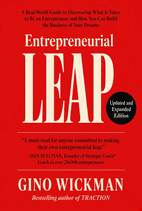
Entrepreneurial Leap, Updated and Expanded Edition Interactive Mindmaps for Entrepreneurial Leap, Updated and Expanded Edition (Free)

Entrepreneurial Leap, Updated and Expanded Edition — Interactive Mindmaps

Entrepreneurial Leap, Updated and Expanded Edition by Gino Wickman Book Cover

by Gino Wickman

Gino Wickman's Entrepreneurial Leap, Updated and Expanded Edition argues entrepreneurship is an identity built on six inborn Essential Traits, offering self-assessments, a 1-2-3 Roadmap, and tools to help aspiring founders, students, and second-generation successors decide whether to leap.

On Insta.page you also get an Apply This Book tool that lets you combine insights from up to 3 books to solve your specific situation.

Chapter mindmaps

Free preview: chapters 1–4 are fully interactive. Click any node to expand or collapse. Subscribe to unlock the rest.

Chapter 1: 1. Know Thyself

Key concepts: 1. Know Thyself

Know Thyself

The Entrepreneurial Profile

  • Entrepreneurs are idea generators, learners, big-picture thinkers, optimists, and risk takers.
  • They are gritty, persuasive, financially motivated, and accountable.
  • Grit is passion and perseverance for long-term goals.
  • Hallowell's formula: pop = grit + imagination + optimism.

The Challenging Side

  • Entrepreneurs can be unfocused, disorganized, controlling, perfectionist, selfish, and narcissistic.
  • They often lack financial savvy.
  • Hypomania is linked to entrepreneurial success (Gartner).
  • Difficult qualities stem from the same source as useful ones.

The 80% Rule

  • If 80% of the qualities fit, you're on your way to becoming an entrepreneur.
  • The next chapter's six essential traits require 100% alignment.
  • Without 80%, don't leap; the venture can wait.
  • Run the self-check honestly against the whole list.

Separate Feelings from Identity

  • Feeling different, scared, or like a misfit is normal.
  • Separate how you feel from who you are.
  • Unease about the path says nothing about your constitution for it.
  • Feeling unlike others doesn't determine your fit.

Build Grit, Imagination, and Optimism

  • Hallowell treats all three as the energy entrepreneurs run on.
  • A missing ingredient is worth naming before you commit.
  • Build grit alongside imagination and optimism.
  • Expect the next stage to be stricter; this profile is a starting gate.

Chapter 2: 2. 6 Essential Traits of an Entrepreneur

Key concepts: 2. 6 Essential Traits of an Entrepreneur

6 Essential Traits of an Entrepreneur

Inborn Traits, Not Learned Skills

  • Entrepreneurial success depends on fixed traits, not training.
  • Traits are in your DNA and cannot be acquired.
  • Six essential traits are absolutely necessary for founders.

Visionary and Passionate

  • Vision: connecting dots, seeing big picture, understanding money.
  • Vision needs vary by industry, growth goals, and market shifts.
  • Passion: strong belief in product, carries through failure.

Problem Solver and Driven

  • Problem solver sees solutions, loves trial and error.
  • Drive is internal fire about winning, separate from passion.
  • Only ~10% are born with the gene behind drive.

Risk Taker and Responsible

  • Risk takers leap knowing they may fail, treat failure as learning.
  • Responsibility is total accountability, blame turned inward.
  • Avoid taking on too much or too little responsibility.

Clearing the Bar and Finding Fit

  • You need all six traits; strength in a few doesn't cover absence.
  • Failed result is information about fit, not a verdict on worth.
  • Expect the bar to exclude most people; know yourself.

Chapter 3: 3. What If You’re Missing an Essential Trait?

Key concepts: 3. What If You’re Missing an Essential Trait?

What If You’re Missing an Essential Trait?

The Entrepreneurial Seizure

  • Most businesses started by technicians, not entrepreneurs
  • Jumping in due to technical skill without checking readiness
  • Every company needs technician, manager, and entrepreneur roles
  • All six Essential Traits required; missing one is like a car missing a vital part

Consequences of Missing Traits

  • No vision: better in sales where someone else sets direction
  • No passion: early setbacks will end the business
  • No problem-solving: buy a proven franchise instead of building
  • No drive: outworked by 'batteries-included' people

Adapting to Trait Gaps

  • No risk-taking: bring in a partner or work inside an existing company
  • No responsibility: go solo to avoid employees to blame
  • If missing a trait, delay or restructure—don't treat as small weakness
  • Fill production, management, and ownership seats with people who fit

Self-Assessment Before Commitment

  • Check yourself against every trait a founder needs
  • Entrepreneurial seizure is not proof you're ready
  • If great at selling but not direction, take sales role
  • If enthusiasm fades or lack drive, bring partner or pick structure that supplies momentum

Choosing the Right Structure

  • Weak systems thinking or accountability: buy into established model
  • Stay solo operator until you can own results without blaming employees
  • Work as entrepreneur inside a company if lacking risk tolerance
  • Pick a structure that supplies missing momentum

Chapter 4: 4. Second-Generation Entrepreneurs

Key concepts: 4. Second-Generation Entrepreneurs

Second-Generation Entrepreneurs

Qualifying the Successor

  • Entrepreneurship cannot be inherited; six traits are essential.
  • Traits: visionary, passionate, problem solver, driven, risk taker, responsible.
  • If any trait is missing, don't hand over an entrepreneur-dependent company.
  • Non-entrepreneurial children can run the business or take fitting roles.

Survival Odds and Earning Respect

  • Only 32% of second-generation businesses survive; 13% in third, 3% beyond.
  • Prove yourself elsewhere first to build credibility.
  • Expect to work harder than anyone else for the same respect.

Handover as a Survival Decision

  • Send next generation to build a career and reputation outside first.
  • Inside the firm, they must earn twice what the founder was granted.
  • Decide if the business needs growth or just steady hands.
  • Treat each handover as determining whether the company outlives you.
You've reached the end of the free mindmaps

Next chapter: “5. The Entrepreneur-in-the-Making Assessment” is locked

See every chapter of Entrepreneurial Leap, Updated and Expanded Edition as an interactive mindmap — and unlock all 500+ book summaries with audio and AI Q&A.

$0.00 due today · 7 days free, then $89.99/year ($7.49/mo) · Cancel anytime before day 7

Continue exploring Entrepreneurial Leap, Updated and Expanded Edition