Empire of AI Quotes
by Karen Hao
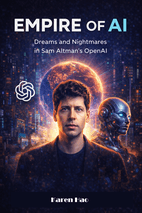
This page gathers the most striking lines from Karen Hao's Empire of AI. You will find sharp observations about power, deception, and the race to control artificial intelligence. Some quotes capture the dark humor inside Silicon Valley. Others reveal the tension between mission statements and real world decisions.
What makes this book so quotable is its raw honesty. The quotes do not shy away from uncomfortable truths about the people building AI and the contradictions they live with. They are memorable because they cut through the hype and show the human stakes behind the technology.
Top Quotes from Empire of AI
“If this action destroys the company, it could in fact be consistent with the mission.”
Board member Helen Toner says this during a tense meeting with OpenAI's leadership after the firing.
It reveals the board's radical ideological purity, prioritizing mission over survival, which shocks employees and readers and highlights the extreme stakes of the governance struggle.
“The drama highlighted one of the most urgent questions of our generation: How do we govern artificial intelligence?”
The author reflects on the meaning of Sam Altman's ouster and reinstatement at OpenAI.
It captures the central dilemma of the book in a single, urgent question, making the stakes clear for every reader.
“Climate change is bad, but it’s not going to kill everyone,” he said. “Al could render humanity extinct.”
Musk responds to researcher Timnit Gebru who questioned his focus on AI over climate change.
It starkly contrasts two existential risks and reveals Musk's absolute conviction that AI poses a unique, total threat to humanity.
“He sometimes lied about details so insignificant that it was hard to say why the dishonesty mattered at all. But over time, those tiny “paper cuts,” as one person called them, led to an atmosphere of pervasive distrust and chaos at the company.”
Describing the accusations against Sam Altman from his time at Loopt regarding his tendency to distort the truth.
This line captures how small, seemingly meaningless lies can accumulate into a toxic culture, offering a powerful caution about the long-term costs of dishonesty in leadership.
“AGI could be more extreme. What if all value gets locked up in one place? That is the trajectory we're on as a society. And we've never seen that extreme of it. I don’t think that's a good world. That's not a world that I want to sign up for. That's not a world that I want to help build.”
OpenAI co-founder Greg Brockman, during an interview, describes the dystopian potential of AGI concentrating wealth.
This passage captures a rare moment of genuine ethical concern from a tech leader, starkly acknowledging the dangerous trajectory of AI development. It resonates because it directly confronts the uncomfortable possibility that AGI could worsen inequality.
“Cade Metz, a longtime chronicler of Al, calls this rebranding the original sin of the field: So much of the hype and peril that now surround the technology flow from McCarthy's fateful decision to hitch it to this alluring yet elusive concept of “intelligence.””
Journalist Cade Metz's characterization of the field's naming.
The "original sin" metaphor vividly captures how the term "intelligence" has fueled both unrealistic hype and existential fear, a central theme of the chapter.
“It was a warning that Big Al was increasingly going the way of Big Tobacco, as two researchers put it, distorting and censoring critical scholarship against the interests of the public to escape scrutiny.”
The author reflects on the broader meaning of Timnit Gebru's firing from Google.
This analogy powerfully ties AI industry behavior to historical corporate malfeasance, making the systemic suppression of critical research starkly relatable.
Themes Behind the Quotes
A central theme is the tension between idealism and pragmatism. The organization was founded on openness and safety, but constant pressure for funding and competition leads to compromises and contradictions. The quotes highlight how lofty goals get twisted by the need to win.
Another theme is the immense personal cost of building AGI. Leaders and employees grapple with sleepless nights, ethical dilemmas, and the fear of what they are creating. There is also a recurring focus on the power of language, how the term artificial intelligence itself is used as a marketing tool to shape narratives and avoid accountability.
Quotes by Chapter
Prologue: A Run for the Throne
“The board no longer has confidence in his ability to continue leading OpenAl.”
From the official public announcement of Sam Altman's firing by OpenAI's board.
This line crystallizes the board's dramatic and devastating verdict, immediately creating the central conflict of the prologue and raising questions about Altman's true character.
“Just imagine all those GPUs working together.”
Chief scientist Ilya Sutskever tries to reassure employees during an all-hands meeting after Altman's firing.
This absurdly tone-deaf advice—urging employees to visualize computer chips instead of addressing their human concerns—perfectly encapsulates the disconnect between the board's techno-optimism and the workforce's anxiety.
Chapter 1: Divine Right
“Sam can tell a tale that you want to be part of, that is compelling, and that seems real, that seems even likely.”
Geoff Ralston, later head of Y Combinator, explains Altman's storytelling skill.
It identifies Altman's core talent—narrative persuasion—as the engine behind his dealmaking and the successful launch of OpenAI.
“If you have a structure of the future where there's a lot of innovation and other people will come up with new things in the thing you're working on,” he concluded, “that's great for society. It's actually not that good for your business.”
Peter Thiel lecturing on monopoly strategy, explaining why sustained innovation can be bad for a single company's profits.
This quote starkly contrasts societal benefit with business self-interest, exposing a core philosophical tension that drives much of the tech industry's approach to competition and progress.
Chapter 2: A Civilizing Mission
“The Open in openAl means that everyone should benefit from the fruits of Al after its [sic] built, but it’s totally OK to not share the science.”
Sutskever's private message to Musk, Altman, and Brockman shortly after OpenAI's launch.
It reveals the deliberate strategy behind the 'open' branding, highlighting the tension between transparency and control that would later define the organization's controversies.
“I really feel like we as Americans have stopped daring to dream.”
Greg Brockman recounting the story of JFK and the NASA janitor while describing his vision for OpenAI's culture.
It encapsulates the aspirational, patriotic vision that Brockman brought to OpenAI, appealing to readers who believe in grand missions and collective purpose.
“Our goal right now...is to do the best thing there is to do,” Brockman replied. “It's a little vague.”
Brockman responds to Amodei's question about OpenAI's goal during a meeting.
This line reveals the early strategic ambiguity at OpenAI, highlighting how the founders struggled to articulate a concrete mission despite grand ambitions.
“My probability assessment of OpenAl being relevant to DeepMind/Google without a dramatic change in execution and resources is 0%. Not 1%. I wish it were otherwise.”
Musk's email to Altman, Brockman, and Sutskever after stepping down as cochair.
A brutally realistic assessment that underscores the immense resource gap OpenAI faced, foreshadowing its eventual pivot to a for-profit structure and Microsoft partnership.
Chapter 3: Nerve Center
“I think that it's fairly likely that it will not take too long of a time for the entire surface of the Earth to become covered with data centers and power stations.”
Sutskever speaking to the New York Times without satire.
A chilling vision of the environmental cost of AGI, revealing a disturbing lack of concern for planetary limits.
“Greg doesn't have a vision. He's not the Sam Altman visionary. He just wants a cool hard problem to solve and to prove out that he's 10x smarter than anyone else.”
A former engineer describing Brockman's motivation.
This candid critique exposes the personal ego and drive behind the mission, adding depth to the portrayal of a key figure.
“There is a misalignment between what the company publicly espouses and how it operates behind closed doors,” I wrote. “Over time, it has allowed a fierce competitiveness and mounting pressure for ever more funding to erode its founding ideals of transparency, openness, and collaboration.”
The author, Karen Hao, states in her 2020 MIT Technology Review article the central contradiction she observed at OpenAI.
This line exposes the core hypocrisy of a mission-driven AI company, revealing how internal pressures undermined its original values. It resonates because it crystallizes a pattern many critics see in the industry: rhetoric versus reality.
Chapter 5: Scale of Ambition
“The name artificial intelligence was thus a marketing tool from the very beginning, the promise of what the technology could bring embedded within it.”
The author explains the origin of the term "artificial intelligence" as a marketing decision by John McCarthy.
This line exposes the foundational branding of AI as a deliberate promise, highlighting how the name itself has shaped expectations and hype.
“The goalposts for Al development are forever shifting and, as the research director at Data & Society Jenna Burrell once described it, an “ever- receding horizon of the future.””
Jenna Burrell's description of AI's ever-changing benchmarks.
The image of an "ever-receding horizon" perfectly encapsulates the elusive, unattainable nature of AI's goals, making the reader question the endless pursuit.
“What's left unsaid is that in a vacuum of agreed-upon meaning, “artificial intelligence” or “artificial general intelligence” can be whatever OpenAl wants.”
The author critiques OpenAI's vague promises about AGI's benefits.
This quote reveals how the lack of a fixed definition allows powerful companies to define AI arbitrarily, underscoring the chapter's critique of elite control.
Chapter 6: Ascension
“To paraphrase that famous Disney quote,” Altman wrote, “we should make more money so that we can do more research, not do more research so that we can make more money.”
From Altman's internal memo outlining OpenAI's shift toward commercialization.
The inversion of a familiar motto reveals how Altman justified profit-seeking as a means to an altruistic end, a core tension in the company's philosophy.
“No one was prepared for this responsibility,” one employee remembers. “It kept people up at night.”
An OpenAI employee describing the anxiety around building AGI.
It humanizes the immense weight of developing transformative AI, showing that even insiders felt overwhelmed by the stakes.
“We must hold ourselves responsible for a good outcome for the world,” he wrote in his vision document. “On the other hand, if an authoritarian government builds AGI before we do and misuses it, we will have also failed at our mission —we almost certainly have to make rapid technical progress in order to succeed at our mission.”
Altman's rationale for accelerating OpenAI's work and tightening secrecy.
This stark either-or framing captures the ethical dilemma that drove OpenAI's relentless pace and the justification for its more aggressive, less transparent approach.
“Low-stakes things should be low-drama, so we can save our high-drama capacity for high-stakes things (of which there will be many).”
Altman's advice in his vision document to unify the company's warring factions.
The memorable aphorism crystallizes the intense focus and prioritization Altman demanded, highlighting the pressure-cooker atmosphere inside OpenAI.
Chapter 7: Science in Captivity
“There's Turing, but he committed suicide. So that's depressing.”
William Agnew continues his reflection on the lack of visible queer figures in AI.
The blunt juxtaposition of a celebrated figure with a tragic end underscores the historical erasure and trauma, resonating with anyone who has felt unseen.
“Rather than collecting general web garbage but doing so in such quantities that you can pass it off as good stuff?”
Emily Bender replied to Gebru, aligning with her critique of large language model datasets.
This metaphor perfectly skewers the sloppy, harmful data practices of big tech, and its vivid imagery makes the ethical problem instantly graspable.
“We cannot agree to #1 and #2 as you are requesting. We respect your decision to leave Google as a result.”
Megan Kacholia's email to Timnit Gebru, rejecting her conditions for staying and turning her resignation ultimatum into a firing.
The cold, bureaucratic language reveals how corporations disguise retaliation as respect, making the quote a chilling example of institutional gaslighting.
Chapter 8: Dawn of Commerce
“To Antonio Regalado, cofounder Robert Mcintyre called his product “100 percent fatal.””
Describing Nectome's cryogenic brain preservation service that requires the customer's death.
The blunt, darkly comic phrase captures the audacious and unsettling nature of Silicon Valley's longevity obsession.
“But without carbon-free alternatives, rising energy consumption would “destroy the planet,” he said.”
Altman on the urgency of clean energy, justifying his investment in Helion.
The stark apocalyptic framing amplifies the high-stakes rhetoric around AI and energy, making Altman's vision feel both noble and alarming.